EdTech Summer – 1010!

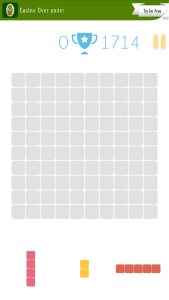
A dear friend of mine and my personal mentor in my new life as a “techbrarian”, Tonya (You should follow her on Twitter: @tonya_nc – she’s pretty amazing!), sent me a message a few days ago telling me about an addictive, simple game app.  It’s called 1010! and has the feel of Tetris.  The premise is simply to stack the blocks of various shapes into horizontal and vertical lines to eliminate them.  Of course I tried it out and BAM! It was 30 minutes later and I realized that I was slightly addicted.  Consider yourself warned.
IMG_2756

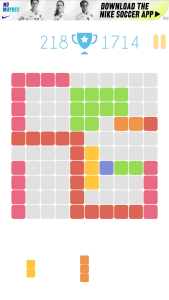
However, after playing a few times I put my educator hat on and saw it as an opportunity for game-based learning in the classroom.  Then I was able to chalk up all the time spent playing this little addictive devil to research… this is research of the best kind.  You see, the playing board is a 10 x 10 square which immediately triggers images of a hundreds board in all grade levels.  I can see allowing students to play for a bit, get the feel of the game, then a teacher can have the student identify the numbers that would be covered by their first three blocks given in the lower grades.  I can see setting up a tens frame and having the students fill up the tens frame within the 10 x 10 square, keeping track of the groups of ten they can create.  The goal of course would be to show that there are 10 ones in a tens frame and 10 tens in a hundreds board.  Maybe have a contest to see which student can clear ten rows, either horizontally or vertically, while counting by tens to 100.  Students can practice making groups of 10 by deciding how many more they need to add in order to clear that row or column, quickly connecting those obscure addition and subtraction fact families to ten. IMG_2757In the upper grades, students can answer questions related to the perimeter and area of the figures they received, as well as the figures they create while playing.  See which student can create the largest area/perimeter and compare the area to the perimeter of each figure given.  The importance of learning that one “block” is one square unit is a vitally important stepping stone to higher level math skills in elementary school with the goal being to move from counting blocks to discover square units to actually calculating the area by multiplying length by width.

IMG_2758

Want a real brainteaser?  Try to figure out how they keep score in this thing!
IMG_2759

What do you think?  Go check it out, and comment below with other ideas for use in the classroom.  As always, using technology for the sake of using technology is useless, but being able to seamlessly integrate technology to garner student engagement and enthusiasm is priceless.
Oregon Trail Revived!

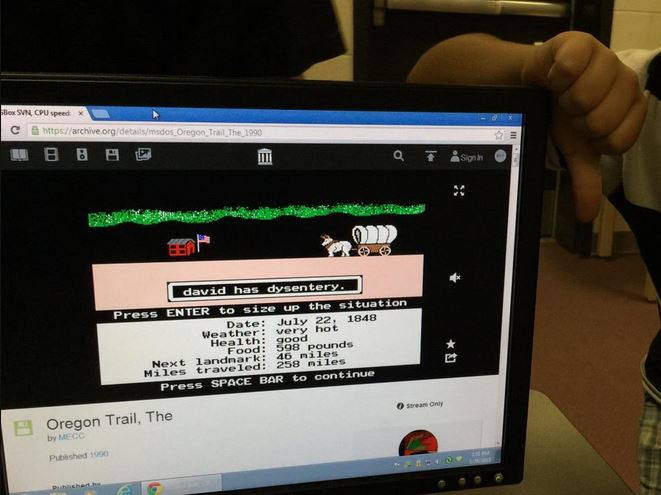
dysentery

I feel as if I have done the world a huge favor today!  The next generation of students that come out of my school will know what The Oregon Trail is all about.  THE question was asked today… “What is dysentery?” I may or may not have given a fist pump in the air followed by the same explanation I received in elementary school. Okay, I did… and apparently dysentery sounds as disgusting now as it did over 20 years ago.

I was worried that the students would feel that the video game was outdated and boring.  I got a few laughs, especially after hearing the music and seeing the fonts.  However, once they started playing, they were hooked.  The room went from complete silence to uproar when someone died or got hurt back to complete silence.  It wasn’t until after the discussions in the room upon completion of the Trail that students realized that the banker, farmer, and carpenter each had different amounts of money given to them.  Typically the bankers made it to Oregon with the greatest success while the farmers didn’t make it at all.  We had just started an awesome discussion on what that meant for today’s economy and making good decisions in planning their future when they had to go back to their regular classes.  Nearly every student asked for the link so they could play at home.  I’m looking forward to hearing more about their adventures; hopefully they won’t include as much dysentery.

Learning on the Oregon Trail

OregonTrail

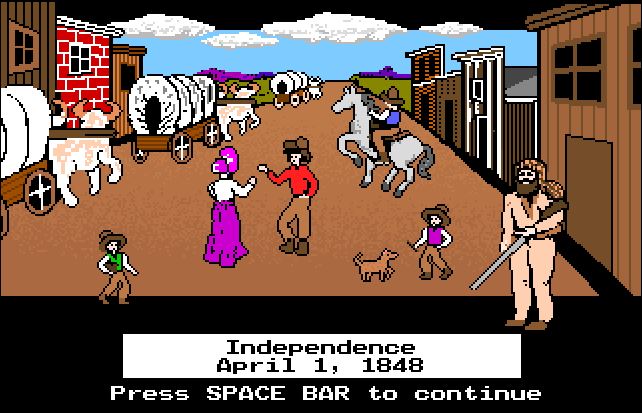
If you went to elementary school between 1990-1996, you probably remember playing computer games to enhance your educational experience.  I did… I remember playing Oregon Trail at least once a week, trying my best not to die of dysentery and wondering if I had purchased enough oxen, wishing I could carry more than 3 spare wagon wheels on my journey across the Wild West.  We also played relics like Treasure Mountain, Where in the World is Carmen Sandiego, and Number Munchers.  Apparently there are a ton of old computer games that have been archived.  Thanks to Internet Archives, the Oregon Trail is accessible to students again!  As I just played the original Oregon Trail from 1990, I was thrust back in time to my elementary AG class (Yes, I was that kid).  Students (or adults at home who are just as excited as I am right now) can now play the original version or the “updated” Deluxe version, along with several other old MS-DOS computer games, Sega Genesis games, and Internet Arcade games.  Many titles/games are not appropriate for students, as you can imagine; I would suggest linking to a specific game and not to the library of games that is available.

So I’m thinking… how can I bring back this old gem to my students today?  Will they be as enamored as I was, or will it look too “old” and pixelated to grab their attention?  Luckily for me, this is my last week with my 3rd-5th grade students and I am certainly going to find out.  You see, at the end of the school year, I like to give each of my classes the freedom to play board games with their friends for an entire media class (50 minutes).  I find playing games builds camaraderie among the students as the year is winding down and the end-of-year-crazy sets in.  I also enjoy popping in on games and playing with the students.  I set the timer for 10-15 minutes per game and let them play.  Most of the games can be completed within 15 minutes.  My younger students practice their math skills in Hungry Hippos, Hi-Ho Cherry-O, and Chutes and Ladders.  They use strategy in Connect Four and spatial reasoning when solving puzzles.  My upper grade students get excited about Apples to Apples, Junior so we usually play that as a class for about 20 minutes before I split them into smaller teams to keep the game going for the remainder of the class.

I think this year will be different; I’m thinking this year, we will explore Oregon Trail once again.  I am going to resurrect it for my 3rd-5th grade students.  Students will be given approximately 30 minutes to “play the game”.  As they complete their journey, they will answer some questions for future collaborative discussions.

Pertinent questions on their journey:

  • What did you choose to be (banker, farmer, or carpenter) and why?
  • Who travels with you?
  • What month did you decide to leave?  Why did you choose that month?
  • How much money did you have to spend?
  • What did you buy at the General Store before you left?
  • Did you change your ration throughout the journey?  If you did, why?
  • Did you ever stop to rest?
  • Did you stop to speak with the locals?  If so, did they help you make decisions?
  • What difficulties do you encounter on your trip?  How did you handle those?
  • Did everyone make it to Oregon safely?
  • How many miles did you travel all together?
  • How long did it take you to reach Oregon from your starting point?

After playing Oregon Trail, we will then sort into groups based on what the traveler chose to be and compare and contrast journeys.  We will put everyone who made it to Oregon with all their party intact together to discuss strategies, as well as taking those who died into a group to discuss preventative measures for the next trip.  Finally, students will write a reflection on their journey with details on their journey and if they would change anything on their journey.  At the very end of class, I will show students on a map where the real Oregon Trail led and we will discuss similarities and differences between what they experienced and what those on the Trail experienced.

I am looking forward to this week in class.  Now if you’ll excuse me, I will be playing games… errrr, researching for class.