You down with GPD? Yeah, You Know Me!

Good luck getting that out of your head!

What is GPD?  Gamified Professional Development.  Microcredentialing, badging, gamification… these seem to be the latest and greatest buzzwords in education.  Normally, I am immediately turned off by buzzwords.  For example: “21st Century Learning”… y’all, it’s 2018 – for the love of everything holy, let’s move on from that one, please!  “Innovation”… putting a worksheet in Google Classroom is NOT innovation, it’s a digital worksheet.  “Project-Based Learning”… doing a class project at the end of a unit does not merit the label of PBL.  I get frustrated because the buzzword becomes a “thing” and everyone rushes to do “the thing” without giving “the thing” any real thought or due diligence.

With that small rant behind me (I’m sure it won’t be the last though), I have to say I’m a huge fan of the move toward gamifying professional development.  For the first 8(ish) years of my career, professional development was the one thing I dreaded more than any other.  Give me all the paperwork, grades, conferences, faculty meetings, or any other <insert educational acronym here>, and I’ll do it with a smile on my face.  Give me some ridiculous professional development where I sit through an hour workshop of something someone with a higher pay grade than me thought I needed to know, and I was immediately rolling my eyes and mentally checked out.  I had numerous CEUs from professional development I’d attended, but hadn’t learned a single thing, other than how to refine my ability to pass notes more stealthily.  Then, Lucas Gillispie was hired by my district in 2014 and his first PD with us was #Education, in which I learned what I was missing in professional development.  I realized that I needed to personalize my professional development.  I immediately started using Twitter professionally and following the folks Lucas recommended following; my Twitter PD exploded from that moment.

I continued to learn from Lucas as a pilot participant in the gamified professional development he created called “EPIC Academy” in 2015.  I was immediately hooked by the aspect of a leaderboard and earning points!  Above all else, the learning that happened here was RELEVANT!  If the quest didn’t pertain to what I needed at the time, I just dropped the quest and chose something else.  I had CHOICE in what I learned.  The quests in EPIC Academy were designed to be bite-sized pieces of information.  Showing mastery of each bite led to another bite, and before you know it, you’ve created a product that shows mastery of something much bigger.

In 2016, Lucas asked me to come onboard as a quest designer for EPIC.  I was terrified as this was “his baby” and I wanted to be sure to maintain the level of awesome he had precedented, while keeping the “buzzword” aspect out of it.  I wanted to give each quest I designed the forethought it deserved, and have participants create a product that was relevant and useful to them and their learners.  I designed the quest chains for Augmented Reality and Digital Formative Assessment that year.  Since then, I have been privileged to design the quest chains for Digital Storytelling, BreakoutEDU, Digital BreakoutEDU, Teacher Productivity Tools, Classcraft, and BreakoutEDU 2.0.

EPIC Academy has taken off exponentially since 2016.  Lucas applied for, and was awarded, a Digital Learning Initiative Showcase Grant from the NC Department of Public Instruction to expand EPIC Academy, to connect and share the content to educators from across the state.  As part of this grant, Lucas designed a model for mentors to assist those in EPIC Academy.  As an EPIC Mentor, we support and encourage educators new to the gamified professional development world.

Screen Shot 2018-04-29 at 7.57.15 PM

I have watched this model flourish under Lucas’s leadership.  There are no educators in EPIC that were required to join; participation is completely optional.  With some of the latest buzzwords being “microcredentialing”, “badging”, “gamification”, I am thankful that EPIC Academy is untarnished by the effects of buzzwords thus far.  Through EPIC alone, I have gained over 8 Digital Learning Competency CEUs, but more importantly, my students and staff have been exposed to the benefits of Google Drive, Coding, Skype, Augmented Reality, Digital Formative Assessment, YouTube, Virtual Field Trips, BreakoutEDU, Flipgrid, Appsmashing, QR Codes, Game Based Learning, and much more.  My teaching has been taken to the next level, and my desire for continuing learning is piqued.  GPD is the way to create life-long learners of educators; the days of one-hour professional development is ancient history for me. So… who’s down with GPD?
The Secret to Coaching

For the past 4 years, I have had the pleasure to be part of an amazing network of educators from across North Carolina – the Digital Leaders Coaching Network.  Started in 2014 by the Friday Institute, this cadre of teacher leaders has been given tools to practice the art of coaching.  Over the past four years, we have engaged in multiple book studies, several personality tests, and more coaching scenarios than imaginable.  We have had guest speakers from across the United States and even internationally.  I have met some of the most incredible educators from across our state, educators that see themselves as leaders, educators that are the exemplar of growth mindset.  I have seen our group grow exponentially, both in attendance and in terms of professional growth of individuals that are taking part.  In 2014, there were a little over 50 educators in attendance, and there is so much interest that now we have two cohorts each year, both rocking a full house of educators!  Last year I served as a mentor in the east cohort (#eastisbeast, #bEastmode) and this year, I serve as a mentor in the west cohort (#westisbest).

There is so little professional development available for instructional coaches.  Without professional development, educators become stuck in a rut, not knowing what best practices are and how to implement change in their school.  This network has given me best practices, protocols, a professional learning network, and has changed the culture of both schools in which I have worked.  It has allowed me to grow from a timid first-year media coordinator to a confident innovation facilitator, leading a pilot that is changing the role of media coordinators in my district to formally include the role of a digital learning coach.  I teach all 400 students in my school in multiple subject areas, co-planning and co-teaching with their content area classroom teachers, as well as design and implement professional development for teachers in my school and media coordinators/innovation facilitators across my district.  I stay current with educational technology trends and bring those trends to my school through grant writing and working with research organizations.  Oh – and I also teach media classes once a month and hold open book circulation times every morning and throughout the day.  I also manage our 1:1 and BYOD initiatives in my school.  Without this network of tremendous educators, and the support of the leaders at the Friday Institute and NCDPI and NCTIES organization, so much of the change that has been implemented in my schools and district may not have happened.  This opportunity was certainly a catalyst for so much growth and forward momentum both within myself and my district.

Over the past four years, I have presented multiple times at our state technology conference (ISTE affiliate) NCTIES as a featured speaker, worked with amazing educators to share information about being a connected educator, coding in the classroom, and MinecraftEDU at NCCAT’s Teaching Generation Z seminars, accepted the challenge of piloting the Innovation Facilitator job description, and was elected to the NCTIES Board of Directors as the North Region Representative.  I was also named as a Future Ready Instructional Coach Thought Leader.  It is not a coincidence that all of this happened during my time with NCDLCN.  I felt more confident being part of this cadre, more prepared to face whatever may come my way, and more connected to those outside my district.

So with all of the time spent in the past four years of NCDLCN, what have I learned to be the number ONE secret to coaching?!  Relationships.  Everything boils down to relationships.  Relationships with your administration, relationships with your teachers, and relationships with the students.

When I first started coaching, I was so excited to change the face of education that I started as a bulldozer.  I went in and started making suggestions before I had even taken a second glance.  Rookie mistake.  I learned the hard way that I needed to work in my space first, changing what was directly pertinent to me, then building relationships and trust with administration and teachers around me.  Once I took a step back, and started informally meeting with teachers, listening to their ideas and encouraging their efforts, praising their strengths, I started to build the trust that is so vital to implement sustainable change.  Once my administration and the teachers I served trusted me, I was able to see change happen quickly.  No longer did I have teachers working with me to plan lessons because they “had” to as a mandate, but because they wanted to; they were excited to use the knowledge I could provide as a curator of resources and strategies.

How does one build relationships?  Slowly.  Spending one lunch period with a teacher, then giving them constructive criticism on a lesson is a recipe for disaster.  Informal time outside of school, emailing, social media, lunches on workdays… those nuggets of time are when the real relationships begin to form.  When you, as a coach, see a teacher excelling in an area, point it out to them!  As teachers, we (I still consider myself to always be a teacher first) are our worst critic.  To hear a fellow educator acknowledge a strength is a great motivator and relationship builder.  In my current position, it has taken me almost two years to feel as though I have a solid relationship in which I can have critical conversations with my staff without a long-lasting negative impact.

Where do your loyalties lie?  This is always a tough question!  Many times as a coach, we can become the go-between; administration needs us to share information with teachers, while teachers want us to share grievances with administration.  Do not, and I repeat, do NOT put yourself in that situation!  Make it very clear to both parties that you are not a liaison.  Your loyalties lie with the students you serve, both directly and indirectly.  One of the fastest ways to destroy a positive coaching relationship is to be seen as a coach that reports back to the administration.  With that said, when a teacher I am working with is doing something amazing, I will notify our administration.  However, if we are working through a hurdle, that stays between me and the teacher in question.  Everything we do as coaches is ultimately for the good of the students.  Placing your loyalties there can only yield positive results.

So there you have it – the secret to coaching, as gathered by multiple sources and personal experience.  Building relationships and trust, and taking preventative measures to keep those relationships intact, will propel you and your school(s) forward allowing you to see measurable and sustainable change.

What do you feel is the secret to coaching?  Comment below!  I’d love to have feedback and chat with other coaches!


How I Got My [Educational] Groove Back

It’s been 8 long months since I’ve been inspired to write a blog post.  I’ve been saying that I’ll get motivated and I’ll write, but it’s just not happened.  So many blocks, so many doubts… until I attended #PiedmontDLC hosted by Gaston County Schools last weekend.

I’ll be honest; I wasn’t looking forward to getting up early to drive down to Gastonia.  The school was a little over 90 minutes from my house.  I was excited to see my edu-friends from across the state.  I was honored to be asked to present at this event and looking forward to learning with others!  I was stoked that Dave Burgess, author of Teach Like A Pirate, would be in attendance giving the opening keynote and invitation only workshop (which I was invited to – woo hoo!), but even all of that wasn’t enough to make me jump out of bed on Saturday morning.  I even joked with an educator friend of mine that he had lost his educational “mojo” and we were going to spend the day at this conference getting it back.  I had no idea that the one who’d lost their “mojo” was me.

Upon arriving, I sought out the room I would be presenting in (I’m a planner like that), and began to prepare myself mentally to share with those who would attend my session.  I double-checked my materials and presentation, then meandered in to the opening session and keynote only a few minutes before it began after visiting with educator friends from across the state.  I had no expectations of the opening keynote, but I knew I had enjoyed the book Teach Like A Pirate when I read it several years ago.

In November 2014, I read the professional development book once on my Kindle upon the recommendation of a dear friend Lisa Milstead, agreed with the content that was written, and then moved on.  Then as a door prize at an edcamp in 2015, I won an autographed copy of the book, and read it again (careful not to mark in it because – hello – it was autographed!).  I was much more intrigued the second time I read it – I bought in to what this Pirate Dave fellow was selling.  I suggested a book study to my administrator who told me to run with it!  After contacting Dave and Shelley, we purchased books for each teacher in our school, including a copy that I marked up with highlighter and notes in the margins.  That year the theme in the media center was “ARGH you reading?” and every reading reward party was pirate themed (Pirate Party, Shipwreck Party, Sunken Treasures Party).  We even used the acronym PIRATE to encourage diversity in reading selection – Pick Interesting Reads And Try Everything.  I was energized!

Then… I fell overboard, so to speak.  I still agreed with the ideals and philosophy, the basic principles within the book, but didn’t practice them regularly.  I couldn’t find my enthusiasm, my passion.  I tried rereading the highlights and notes from the book study, and I tried following along with the #tlap conversation on Twitter.  I read a few of Pirate Dave’s blog posts, but I just couldn’t duplicate the energy I had found during my second reading of the book.

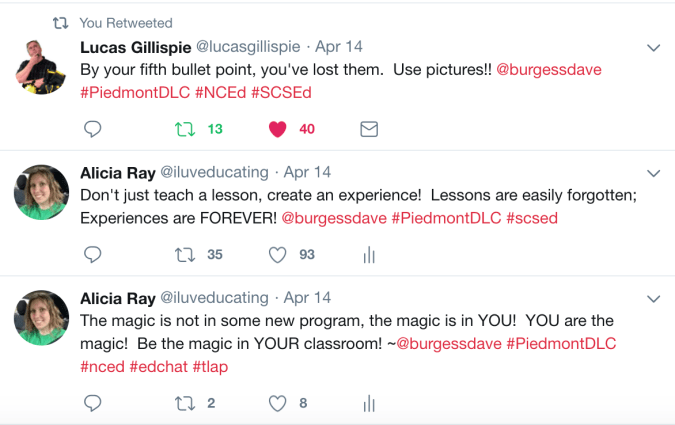
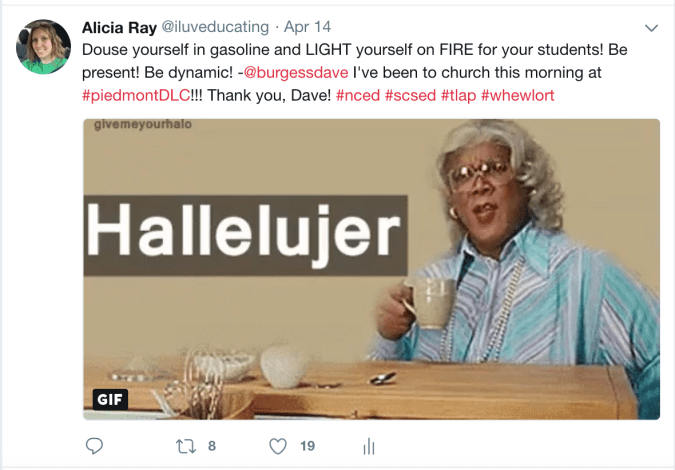
And then… Piedmont DLC happened.  The captain himself, Dave Burgess, shared his story.  I have never heard someone speak so fast in my life, with so much energy and enthusiasm, so much passion and excitement.  I was torn between rolling my eyes (hey, I teach middle school now – I’m a bit more cynical than I used to be) and being on the edge of my seat.  I was captivated by what Dave Burgess had to say.  I remembered reading the words, but this was a whole new experience.  In fact, I tweeted that I felt as though I’d been to church or something.  Here are some Twitter highlights from the keynote:

Screen Shot 2018-04-23 at 7.27.26 PMScreen Shot 2018-04-23 at 7.27.39 PM

After sitting through the keynote, I was so pumped.  I was determined to be the magic in our media center.  The creativity workshop he did with us later in the day was just as fabulous, but the keynote is what got me amped up.  It reminded me of my why – why I got into teaching almost 13 years ago.  It reminded me what is important – and to remain optimistic and passionate about my work.

If you’ve ever seen Dave speak, you know what I’m talking about; you know that church of the south altar call, hallelujah feeling I experienced.  If you’ve not ever seen him speak, get to a Pirate Keynote ASAP!  As for me, I’ve got a renewed sense of passion and enthusiasm for the work I do.  I’m asking more creative questions as I plan for lessons with my students and workshops with my teachers.  I’m working harder to reach every kid, wanting to do everything I can to help them love school & engage in conversation.  I’m reflecting on the experiences from this year, and asking for student evaluations, to make next year better than ever before.  So, Dave Burgess, here’s to you.  Thanks for helping me find the mojo that I didn’t realize I’d lost and for helping me get my [educational] groove back!

Screen Shot 2018-04-23 at 7.28.22 PM