I’ve not finished the book. I had to stop reading. So many ideas were swirling in my head that I couldn’t continue without getting part of these thoughts written down. I promise I’ll finish it. Surely, if you’ve been with me since the beginning of #DBC50Summer, you trust that I will uphold the integrity of #DBC50Summer by reading every word of every book. I will finish book 48. But it won’t be tonight. I can’t.
I have decided that Todd Nesloney is my spirit animal. Seriously – the parallels in our educational walk are insane… right up to where he becomes an administrator. I’m going to let you keep that one for both of us, okay, Todd? In previous blogs, I mentioned my journey in education. I was hired after three interviews with the same administrator (two face-to-face and one over the phone) as a fifth grade math teacher on a three-teacher team. I taught math to three sets of 20-22 fifth grade students. I had one small 20-25 minute block of SSR time (self-selected reading or silent sustained reading – pick an acronym meaning) and rarely conferenced with students. Why? Teaching reading was the job of our ELA teacher. Not. My. Job. (I, too, Todd, was wrong.) I used that time to grade papers, conference about Accelerated Math or Superstars Math, or troubleshoot the problems our Accelerated Reader program was having (ugh). It was the most dreaded part of my day, and I didn’t mind letting students know that I hated it. How arrogant I was! Then I transitioned to become a math and science teacher on two-teacher team. After two years of that, I was self-contained, teaching all subject areas in fifth grade. Only then, did I view myself as a reading teacher. How I wish I could go back and change my mindset then!
When former students hear that I work in a media center, I usually receive one of two reactions. A sideways glance and “oh really?” or a flat out “No WAY! I never imagined you in a library!” That’s how bad my disdain for teaching reading was coming across to students. I realize the impossibility of my next statement, but boy do I wish I had Sparks in the Dark by Travis Crowder and Todd Nesloney (coauthor of Kids Deserve It and author of Stories from Webb) when I was in the classroom!
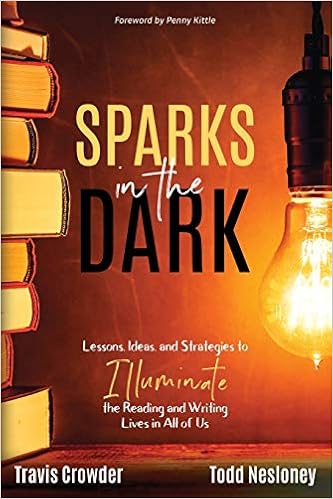
This beautiful book eloquently states all that is right with reading and writing in the classroom! Every classroom, not just ELA, should be reading and writing daily! With intentionality. When I taught math and when I taught math and science, I should have been incorporating reading and writing. In a math methods class in college, I took a course that required writing every step to a problem in a problem set in paragraph form. We were to explain our chosen problem like we were explaining complex math to a kindergarten student. It was our responsibility to read the responses of our teammates, because we then presented their responses to the class. We wrote, read, and talked… in math. Never once did we draw diagrams unless we could specifically describe those diagrams in paragraph form. It was the hardest class I took in my undergrad coursework, but also the most meaningful. (I never used the information while teaching math, but I should have. Looking back, I realize that I did my students a huge disservice.)
I’m only on chapter 8, but I had to stop and share my takeaways thus far.
Takeaway 1: These fellas have passion for reading and writing in the classroom. Travis and Todd share their own failures, not only with us as readers, but with their students through written word. I had never considered writing for my students. I should definitely try that and see what happens! I did share the #DBC50Summer Explained post with them during media as an introduction to goal setting and reading as a choice. After they read the post, I asked them who the author was. Most had no idea. When I pointed out the URL was from aliciaray.com, several requested time to reread the article (or let’s be real, read it for the first time because they were now invested). Several immediately bookmarked my blog which blew my mind that they would be interested in these posts. I even shared that it was all “teacher-y stuff” but they didn’t seem to mind bookmarking anyway. (If any of you are reading this, hi and I love you! Do you have a book near you?)
Takeaway 2: Students deserve and crave choice and voice in their reading and writing. I have had a revelation in the past 5 years in the media center… I despise reading quizzes and book reports. I hate what it does to students’ love of reading. I’ve watched my own child devour a book and after watching her eyes light up as she tells me about it, I ask her if she’s doing to take a test on it the next day. It’s like flipping a switch. The light goes out. She’s no longer excited about the book. When did we get to that point as educators? Can’t they just read to enjoy reading? When did the enjoyment of reading a book become superseded by a need to reward students with arbitrary kids’ meal prizes or reward trips that parents still have to pay for after their child earned it (many times at the last moment due to peer pressure)? Traditional book reports do the same thing. Having authentic conversations about what a child is reading, giving them the opportunity to discuss their books with their peers… that will create a love of reading. Travis and Todd agree!
Takeaway 3: The quotes… oh the quotes from this book. Whether it’s the quotes from the likes of Penny Kittle, T.S. Eliot, John Maxwell, Virginia Woolf, Maya Angelou, etc at the beginning of each chapter, or the quotes interspersed within the chapter, this baby is full of amazing quotes! Here are some of my favorites:
- “My reading scores were improving… [but] none of my students were leaving my classroom with a love of reading and writing. Change was necessary.”
- “Change isn’t meant to be easy. If it were, everyone would love and seek out change.”
- “When students see your genuine passion and interest, it will pique theirs.”
- “Reading is part of a well-rounded life.”
- “I find it exciting to work with children who claim to hate reading because much of the time the problem is they simply haven’t found a book that grips their heart or reaches their soul.”
- “Providing time for children to read in every classroom shows the students just how important reading is and that, yes, your math teacher reads, too.”
- “Our children are seeking to be understood while simultaneously seeking to understand. They have questions about current events and the choices that people make…we need to provide a safe space for them to discuss their fears, their worries, their uncertainties.”
- “Arm us with books. Because the pen is mightier than the sword.”
See… powerful stuff, right? That’s not even close to all I’ve highlighted and written notes beside! What power reading and writing have for our students, and for us! If I’ve learned nothing else from #DBC50Summer, it is that truth. Reading and writing has proven to be an insanely powerful practice, and one that I will continue to pursue now that I’ve found my voice again. I will move from professional development books to middle school books and some young adult and picture books and continue this practice of reading and blogging. I believe it’s important for me to practice what I preach, so I want my students to be able to reference my publishing the blogs to a public audience as a positive example of digital footprint, citizenship, goal-setting, and writing for a purpose.
I have so many ideas of implementation plans swirling that I cannot possibly pick one right now…. and I’ve not even finished the book yet. I just had to stop and reflect! I can, however, share some of the possibilities with you.
- Little Free Library – Our carpentry class made these for each elementary school three or four years ago and we supplied the LFL with discard books and Scholastic dollar books. I’d love to lead the initiative to create one for each of our middle and high schools this year.
- Implementing a time in the media center to reflect on books as they return them. What did they like or not like? Should we keep the book in the media center or not? We are just recreating a reading culture at my school and many of the books (especially fiction) are not checked out very much. I have analyzed our collection over and over again, but this time, I will do it with the most important voices – the students’. They will help me decide which books to discard and which books we need to add to our collection through book suggestions.
- We are doing a book tasting as part of a much larger Project-Based Learning experience next month. Stay tuned for a blog post with epic pictures and step-by-step directions for implementing at your school if you choose to do so.
- For the first time ever, our students are given full freedom in book selection in the media center. In the past (in elementary school), every book was leveled and students could only check out books on their level. When students arrived at middle school, I do not level books, but I did require that students choose one fiction and one nonfiction book for a total of two books checked out at a time. I’m releasing control (whew – scary, but it’s the right thing for students, so I’m doing it) and allowing students to check out any three books they’d like. Of course, I’m encouraging them to read a variety of texts and to step out of their comfort zone in genres to try something new, but the ultimate decision is theirs.
- Students are setting their own reading goals this year. Each quarter they are committing to reading “x” number of books before the end of the quarter. We discussed length of books being a factor, reading speed, genre, etc and that every book counted equally. So whether they read a picture book or Divergent, it counts as one book. Because there is no competition between students, only trying to reach your own goal, students were encouraged to create a realistic goal for themselves and share it with me. They then created a flipgrid video that shared their goal and their plan for reaching the goal using the following sentence frame: My name is __(tell your name)__ and my reading goal is to read ___(tell how many books)___ books by October 31. I will reach my goal by ___(share your plan)___. Finally, we will revisit these goals halfway through the quarter, evaluating our progress and at the end of the quarter will share on flipgrid whether they reached the goal and what their next quarter’s goal will be.
There is no reward for reaching their goal other than the satisfaction of reaching their goal and reading tremendous books. There is no consequence for not reaching their goal; we will just make plans for how to reach the goal next time. Finally, there is no quiz, project, report, etc to prove they have read or not read.
Crazy, right? But we’re trying it. Giving them complete ownership will hopefully create a desire to read like never before. Check back in early November for an update on how it’s going. Students had approximately 6 weeks left in the quarter when they created their goal. I am impressed that only 9% of students committed to only reading one book (zero wasn’t an option – they are expected to read something) in six weeks, while 50% of students created a goal of reading 3-8 books in this same time period. That’s an average of a book per week. If my students reach that goal, I will be super pumped! Reading a book per week is a HUGE upgrade from where we are now!
I’m excited to work alongside my administration and teachers to promote a love of reading, writing, and learning in our school. This book is exactly what we need as we partner with our students to create a literacy plan that empowers students to make their own goals and lead the way with reading and writing. It’s going to be awesome! I look forward to finishing the book tomorrow before starting book 49!
In the meantime, go get a copy of Sparks in the Dark and get inspired to implement great changes in your school in regards to reading and writing with purpose and excitement. Be sure to follow Travis and Todd on Twitter at @teachermantrav and @techninjatodd, respectively. Follow the hashtag #SparksintheDark for awesome conversation and ideas to integrate reading and writing into every content area. Check out Todd’s website here and Travis’s website here for more resources, including blogs! The podcast below from Vicki (@coolcatteacher) Davis is an amazing look into the book and the hearts of these two astounding educators! *I highly recommend 10-Minute Teacher Podcast – always! Great resources, conversation, and doesn’t take up a lot of your time. Win-Win-Win!*
Finally, hop over to the flipgrid and share your own story of a time when you saw sparks in the dark! This may be how you create a lifelong love of reading and writing in your school, classroom, or district. It may be a story about a student who finally “got it” and fell in love with literacy because of “that book”. Share with us! Andrea Paulakovich (creator of this amazing flipgrid space and the idea of global collaboration on all DBC, Inc book on flipgrid) and I would love for you to add your thoughts to the flipgrid!
Speaking of book 49 (which I will begin ONLY after I finish the last few chapters of Sparks in the Dark – remember, we’ve established that trust now, yes?)… Sean – it’s time! It’s FINALLY time! I have the best story about my friend Sean, and how we met and mutually connected to Dave Burgess in 2015! I cannot wait to share that story with you when I finally get to read, connect, reflect, and create an implementation plan for his book that released this summer! I’ve been waiting for this moment all summer, Sean! Book 49 is called The Pepper Effect and is written by my friend (and “neighbor”), Sean Gaillard!






 Educational Hindsight