#DBC50Summer 14/50 – 140 Twitter Tips for Educators

I cannot make this up… I did not do this on purpose.  I promise it just happened this way.

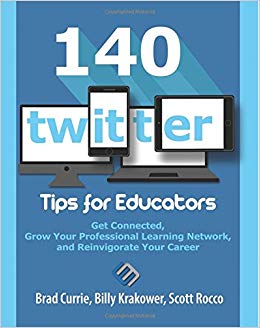
Book 14 is 140 Twitter Tips for Educators by Brad Currie, Billy Krakower, and Scott Rocco.
140edutips


Today is my FIVE YEAR Twitter-versary!!!  I signed up for Twitter five years ago today! And the fact that I am writing a blog about Twitter and how amazing it is on our 5th anniversary is a bit mind-blowing! Isn’t that crazy?! … Okay, back to the book!

This incredible book, which pretty much serves as a user’s manual to create & use your own professional Twitter account, was shared with several hundred North Carolina educators over the past week.  I’m fairly certain the words, “best PD I’ve ever had… ever” came out of my mouth in association with using Twitter as my primary platform for being a connected educator.  Numerous photos were taken of the cover of the book, and a couple even purchased the book while sitting right there in my sessions.

In two weeks, I am so fortunate to work with superstar educator, Emily Brown, to connect dozens of educators (possibly even up to 140, ironically enough) with one another through Twitter.  We are facilitating a session called #Twitter101: Unlock the Power of Being Connected (link to session presentation to be shared after presentations are complete) at the North Carolina Digital Learning Competencies For Educators By Educators “traveling roadshow”.  The North Carolina Department of Public Instruction’s Digital Teaching and Learning Division selected 33 educators through an application process to serve as Ambassadors for Digital Learning Competencies.  Emily & I both felt that Twitter has been a powerful tool and, as she and I are Professional Learning Network (PLN) friends, we decided to work together on the development and implementation of this session!  Ambassadors travel to 4 locations in the western half of the state and 4 locations in the eastern half.  Roughly 500 educators per location are able to attend through registration.  They will receive up to 5 sessions (and lunch) of professional development in digital learning, which is the equivalent of 0.7 Continuing Education Units (CEUs).  A minimum of 2.0 CEU in Digital Learning Competencies are required for teaching licensure renewal in North Carolina.

After encouraging and helping our new friends create a Twitter account, we will show them how to use it to create basic tweets.  Each participant will complete #MyFirstTweet while there.  I am so excited!  I’ve never been in a delivery room to witness the birth of a child, but I would imagine it will feel almost like that to see these educators take their first steps into becoming connected… Okay, maybe that’s a bit exaggerated… maybe. We’ll see.

If the participants choose to stay for the second part of the Twitter session series with me, they will embark on creating a PLN.  It’s so important to find your tribe on Twitter.  We believe in the Chinese proverb, “Give a man a fish and you feed him for a day.  Teach a man to fish and you feed him for a lifetime.”  I will teach these educators how to fish by engaging them in a LIVE #ncdlc chat each day!  It is my goal that teachers will feel confident with the typical guidelines of a Twitter chat and Q1/A1 format by having someone there to walk them through a chat in person, helping with tweet composition, etiquette, etc.  I hope you will join our chat at least once, if not all four days, from Monday, July 23 – Thursday, July 26, 2018.  The tentative time for the chat portion of these sessions will be 11:00-11:30 AM EST.  Please drop in and show these newly connected educators the power of Twitter in education!  I will continue to advertise this information throughout the next two weeks on Twitter.

The final two sessions of the day will be about #BookSnaps, founded by rockstar author Tara Martin, who wrote the 51st DBC book, Be REAL: Educate from the Heart!  Participants will learn how to connect the text and the tech using Snapchat, Google Drawings, Seesaw, Google Slides, etc.  You can find Tara’s How-To videos on her blog here.  Below are examples of #BookSnaps I created and tweeted about 140 Twitter Tips for Educators.

My personal journey on Twitter began in 2013 when I used Twitter for all things Hollywood gossip and Panthers football.  I didn’t tweet, but I followed all the blue checks I could, ha! In 2014, I met Lucas Gillispie who inspired me to try it out as an educator to gain insight, resources, reflect, and share.  Lurking for many months, I finally jumped in to a few chats and would tweet occasionally while attending edcamps.  I’m not sure why I started becoming more invested, but one day in 2015, I received a direct message from a friend telling me about an opportunity to apply for the North Carolina Digital Leaders Coaching Network through the Friday Institute for Educational Innovation.  I applied, was accepted, and just finished my third (and sadly, my final) year as a mentor for that network of professionals. I credit my connectedness on Twitter to many successes I have had in education, and many of the successes of my students.  I also give my PLN credit for picking me up when I felt knocked down.  There were years that I’m not sure I would have returned to education if it weren’t for the amazing educators on Twitter constantly lifting me up.  I feel selfish when I don’t share how incredible my PLN on Twitter is with other educators because it truly is the best professional development I have.  It benefits both me and my students, which is a win-win!  I feel that each and every educator needs to be connected, whether it’s on Twitter, Facebook, Instagram, etc.  Our world is wide open now, and we need to get into it – sharing, collaborating, and reflecting on our practices.  That, in turn, makes our students’ experiences in school better which leads to lifelong learners.

It feels as if it’s a Twitter love story of sorts. HA! Are you rolling your eyes? Stop rolling your eyes, and hear me out!  It’s kind of like Twitter and I met in 2013 through a mutual friend; we’ll call that friend Hollywood.  We went out a few times, but it was never anything serious.  I never completely gave up, but I was quickly losing interest.  Then, a friend came and told me various examples about how wonderful Twitter was, and I decided to it was worth a second chance.  Maybe it had changed… so we started dating here and there again. Then, one day, after about 9-10 months of sporadic dating… it just happened.  Connection.  Love.  Inspiration.  I was hooked.  Twitter and I have been together exclusively for almost 4 years now.  It’s been wonderful.  We have many mutual friends and I want to share Twitter’s awesomeness with everyone around me.  Luckily for them, Twitter has many doppelgängers, looks just like my Twitter, but has a different personality and will meet their own needs.

See… love story… that’s why we’re celebrating our anniversary… (Yes, I did. I went there.)

My implementation of this book, as I celebrate five years of Twitter, is to continue doing what I do on Twitter, but do more of it!  I collaborate, share resources, advocate for students, retweet other educators, and participate in chats with educators who share my vision, as well as educators who challenge me.  I tweet what my students and teachers are doing throughout the school year, as well as during conferences and blog posts.

For me, this book was affirming.  For those who are not yet connected, this book is a must have!

You can follow the conversation on Twitter using the hashtag #140EduTips!  The website for 140 Twitter Tips for Educators is here.  Check out Vicki Davis’s (CoolCatTeacher) blog & podcast with Brad and Billy,   Join the discussion on FlipgridAndrea (the genius behind the idea of using Flipgrid for #DBC50Summer and my #tlapsister) and I would love for you to show some love to those you think everyone should follow on Twitter, and hashtags that you can’t live without!  As always, the password is DBCSummer – and don’t be afraid to step out and be a trendsetter.  This space will become a global book study for all DBC books, so go ahead and take the leap! Again, go grab a copy of this book… Book 14!

Book 15 is a book I wish I had when I taught 5th grade math!  If I had Ditch that Textbook and this book during that time of my life, implementing the ideas and philosophy behind both of them, my students would have been much happier and would have had increased critical thinking skills and would have been better problem solvers, rather than workbook navigators!  I am so looking forward to reading The Classroom Chef by John Stevens and Matt Vaudrey!  Dave Burgess says he gets asked all the time about creating Teach Like A Pirate style lessons for math – this book is it! Soooo cool! Grab your own copy because I’m off to read book 15 for myself!

You down with GPD? Yeah, You Know Me!

Good luck getting that out of your head!

What is GPD?  Gamified Professional Development.  Microcredentialing, badging, gamification… these seem to be the latest and greatest buzzwords in education.  Normally, I am immediately turned off by buzzwords.  For example: “21st Century Learning”… y’all, it’s 2018 – for the love of everything holy, let’s move on from that one, please!  “Innovation”… putting a worksheet in Google Classroom is NOT innovation, it’s a digital worksheet.  “Project-Based Learning”… doing a class project at the end of a unit does not merit the label of PBL.  I get frustrated because the buzzword becomes a “thing” and everyone rushes to do “the thing” without giving “the thing” any real thought or due diligence.

With that small rant behind me (I’m sure it won’t be the last though), I have to say I’m a huge fan of the move toward gamifying professional development.  For the first 8(ish) years of my career, professional development was the one thing I dreaded more than any other.  Give me all the paperwork, grades, conferences, faculty meetings, or any other <insert educational acronym here>, and I’ll do it with a smile on my face.  Give me some ridiculous professional development where I sit through an hour workshop of something someone with a higher pay grade than me thought I needed to know, and I was immediately rolling my eyes and mentally checked out.  I had numerous CEUs from professional development I’d attended, but hadn’t learned a single thing, other than how to refine my ability to pass notes more stealthily.  Then, Lucas Gillispie was hired by my district in 2014 and his first PD with us was #Education, in which I learned what I was missing in professional development.  I realized that I needed to personalize my professional development.  I immediately started using Twitter professionally and following the folks Lucas recommended following; my Twitter PD exploded from that moment.

I continued to learn from Lucas as a pilot participant in the gamified professional development he created called “EPIC Academy” in 2015.  I was immediately hooked by the aspect of a leaderboard and earning points!  Above all else, the learning that happened here was RELEVANT!  If the quest didn’t pertain to what I needed at the time, I just dropped the quest and chose something else.  I had CHOICE in what I learned.  The quests in EPIC Academy were designed to be bite-sized pieces of information.  Showing mastery of each bite led to another bite, and before you know it, you’ve created a product that shows mastery of something much bigger.

In 2016, Lucas asked me to come onboard as a quest designer for EPIC.  I was terrified as this was “his baby” and I wanted to be sure to maintain the level of awesome he had precedented, while keeping the “buzzword” aspect out of it.  I wanted to give each quest I designed the forethought it deserved, and have participants create a product that was relevant and useful to them and their learners.  I designed the quest chains for Augmented Reality and Digital Formative Assessment that year.  Since then, I have been privileged to design the quest chains for Digital Storytelling, BreakoutEDU, Digital BreakoutEDU, Teacher Productivity Tools, Classcraft, and BreakoutEDU 2.0.

EPIC Academy has taken off exponentially since 2016.  Lucas applied for, and was awarded, a Digital Learning Initiative Showcase Grant from the NC Department of Public Instruction to expand EPIC Academy, to connect and share the content to educators from across the state.  As part of this grant, Lucas designed a model for mentors to assist those in EPIC Academy.  As an EPIC Mentor, we support and encourage educators new to the gamified professional development world.

Screen Shot 2018-04-29 at 7.57.15 PM

I have watched this model flourish under Lucas’s leadership.  There are no educators in EPIC that were required to join; participation is completely optional.  With some of the latest buzzwords being “microcredentialing”, “badging”, “gamification”, I am thankful that EPIC Academy is untarnished by the effects of buzzwords thus far.  Through EPIC alone, I have gained over 8 Digital Learning Competency CEUs, but more importantly, my students and staff have been exposed to the benefits of Google Drive, Coding, Skype, Augmented Reality, Digital Formative Assessment, YouTube, Virtual Field Trips, BreakoutEDU, Flipgrid, Appsmashing, QR Codes, Game Based Learning, and much more.  My teaching has been taken to the next level, and my desire for continuing learning is piqued.  GPD is the way to create life-long learners of educators; the days of one-hour professional development is ancient history for me. So… who’s down with GPD?

The Secret to Coaching

For the past 4 years, I have had the pleasure to be part of an amazing network of educators from across North Carolina – the Digital Leaders Coaching Network.  Started in 2014 by the Friday Institute, this cadre of teacher leaders has been given tools to practice the art of coaching.  Over the past four years, we have engaged in multiple book studies, several personality tests, and more coaching scenarios than imaginable.  We have had guest speakers from across the United States and even internationally.  I have met some of the most incredible educators from across our state, educators that see themselves as leaders, educators that are the exemplar of growth mindset.  I have seen our group grow exponentially, both in attendance and in terms of professional growth of individuals that are taking part.  In 2014, there were a little over 50 educators in attendance, and there is so much interest that now we have two cohorts each year, both rocking a full house of educators!  Last year I served as a mentor in the east cohort (#eastisbeast, #bEastmode) and this year, I serve as a mentor in the west cohort (#westisbest).

There is so little professional development available for instructional coaches.  Without professional development, educators become stuck in a rut, not knowing what best practices are and how to implement change in their school.  This network has given me best practices, protocols, a professional learning network, and has changed the culture of both schools in which I have worked.  It has allowed me to grow from a timid first-year media coordinator to a confident innovation facilitator, leading a pilot that is changing the role of media coordinators in my district to formally include the role of a digital learning coach.  I teach all 400 students in my school in multiple subject areas, co-planning and co-teaching with their content area classroom teachers, as well as design and implement professional development for teachers in my school and media coordinators/innovation facilitators across my district.  I stay current with educational technology trends and bring those trends to my school through grant writing and working with research organizations.  Oh – and I also teach media classes once a month and hold open book circulation times every morning and throughout the day.  I also manage our 1:1 and BYOD initiatives in my school.  Without this network of tremendous educators, and the support of the leaders at the Friday Institute and NCDPI and NCTIES organization, so much of the change that has been implemented in my schools and district may not have happened.  This opportunity was certainly a catalyst for so much growth and forward momentum both within myself and my district.

Over the past four years, I have presented multiple times at our state technology conference (ISTE affiliate) NCTIES as a featured speaker, worked with amazing educators to share information about being a connected educator, coding in the classroom, and MinecraftEDU at NCCAT’s Teaching Generation Z seminars, accepted the challenge of piloting the Innovation Facilitator job description, and was elected to the NCTIES Board of Directors as the North Region Representative.  I was also named as a Future Ready Instructional Coach Thought Leader.  It is not a coincidence that all of this happened during my time with NCDLCN.  I felt more confident being part of this cadre, more prepared to face whatever may come my way, and more connected to those outside my district.

So with all of the time spent in the past four years of NCDLCN, what have I learned to be the number ONE secret to coaching?!  Relationships.  Everything boils down to relationships.  Relationships with your administration, relationships with your teachers, and relationships with the students.

When I first started coaching, I was so excited to change the face of education that I started as a bulldozer.  I went in and started making suggestions before I had even taken a second glance.  Rookie mistake.  I learned the hard way that I needed to work in my space first, changing what was directly pertinent to me, then building relationships and trust with administration and teachers around me.  Once I took a step back, and started informally meeting with teachers, listening to their ideas and encouraging their efforts, praising their strengths, I started to build the trust that is so vital to implement sustainable change.  Once my administration and the teachers I served trusted me, I was able to see change happen quickly.  No longer did I have teachers working with me to plan lessons because they “had” to as a mandate, but because they wanted to; they were excited to use the knowledge I could provide as a curator of resources and strategies.

How does one build relationships?  Slowly.  Spending one lunch period with a teacher, then giving them constructive criticism on a lesson is a recipe for disaster.  Informal time outside of school, emailing, social media, lunches on workdays… those nuggets of time are when the real relationships begin to form.  When you, as a coach, see a teacher excelling in an area, point it out to them!  As teachers, we (I still consider myself to always be a teacher first) are our worst critic.  To hear a fellow educator acknowledge a strength is a great motivator and relationship builder.  In my current position, it has taken me almost two years to feel as though I have a solid relationship in which I can have critical conversations with my staff without a long-lasting negative impact.

Where do your loyalties lie?  This is always a tough question!  Many times as a coach, we can become the go-between; administration needs us to share information with teachers, while teachers want us to share grievances with administration.  Do not, and I repeat, do NOT put yourself in that situation!  Make it very clear to both parties that you are not a liaison.  Your loyalties lie with the students you serve, both directly and indirectly.  One of the fastest ways to destroy a positive coaching relationship is to be seen as a coach that reports back to the administration.  With that said, when a teacher I am working with is doing something amazing, I will notify our administration.  However, if we are working through a hurdle, that stays between me and the teacher in question.  Everything we do as coaches is ultimately for the good of the students.  Placing your loyalties there can only yield positive results.

So there you have it – the secret to coaching, as gathered by multiple sources and personal experience.  Building relationships and trust, and taking preventative measures to keep those relationships intact, will propel you and your school(s) forward allowing you to see measurable and sustainable change.

What do you feel is the secret to coaching?  Comment below!  I’d love to have feedback and chat with other coaches!