#DBC50Summer 28/50: Shattering the Perfect Teacher Myth

Typically when I prepare for any session I present, I create a Google Form that allows me to get to know the participants in a quick snapshot so I can best cater the session to meet their needs. One of the questions I always ask is, “How many years have you been an educator?” with the options as ranges in years of experience. These ranges were not created by accident; they represent my shifts in mindset throughout my career. These are not indicative of every educator’s mindset, but from the reactions I’ve received while presenting, I feel like I’m not exactly alone in these shifts. See what you think!

From 0-3 years, I thought I knew everything about how to teach. I was arrogant. I had just finished my college degree in three years and was one of the youngest people ever hired as a classroom teacher in my district (I was only 20 years old). I thought I didn’t need to sit through any more professional development; I was developed enough, thank you very much.

From 4-7 years, I realized just how little I actually knew about educating. The training wheels were off, so to speak. I had a great professional learning community, but wasn’t using them for support. I struggled through these years and matured more than any other stretch of my career. I attribute massively epic fails to this growth!

From 8-10 years, I experienced what I refer to as the “honeymoon” period. I finally felt confident in my ability to teach. However, it seemed like no one realized that I might know what was I doing, so I was left alone. No observations from other teachers, little to no requests to present content to my colleagues. It was great. I just did what I knew to do and impacted students with little additional responsibility.

Then, somewhere around year 10, administration and those with a higher pay grade than me figured out that my story might benefit other educators. So I started presenting and having people come observe. By no means do I believe that I’m an expert; in fact, it’s quite the opposite. I know enough about lots of things to be dangerous. However, I’m comfortable saying that I don’t know when I don’t know and am always looking to grow and learn. (I’ve just started my 13th year – Lucky 13!)

Then I suspect, around year 16-20, I will wonder if this is what I want to do for the rest of my career. I’m invested enough to be fearful of losing retirement benefits, but am I really sure I can continue this pace for another 10-14 years. Finally, year 20 and beyond, I believe I will be calculating my time left to teach and feel that it will be bittersweet. While I love educating (thus my twitter handle @iluveducating), knowing that I will only be 50 years old when I reach retirement, I can begin traveling and hopefully continue to impact education through other avenues. Or I may not leave at all. If given the choice right this minute, I’d still get up and go every morning! I enjoy it that much!

Book 28 released by Dave Burgess Consulting, Inc is all about that perfect teacher. You know the one… comes in every day, perfect teaching outfit, beautiful classroom with perfectly laminated posters covering the wall (How do they manage to laminate so perfectly? I always have an edge that is peeling!), students are amazingly well-behaved, scores are phenomenal, all the parents love them and administration thinks they walk on water. They have no idea what Pinterest-Fail even means because everything they touch educationally turns to gold. Okay, so I may be exaggerating, but you get the point. It was the teacher I was trying to be my first three years of teaching. The veteran teachers made it look so simple. They were the epitome of a perfect teacher! The thing is… these perfect teachers… they’re unicorns, leprechauns, centaurs… they don’t exist. And book 28’s author Aaron Hogan is out to prove it in Shattering the Perfect Teacher Myth!
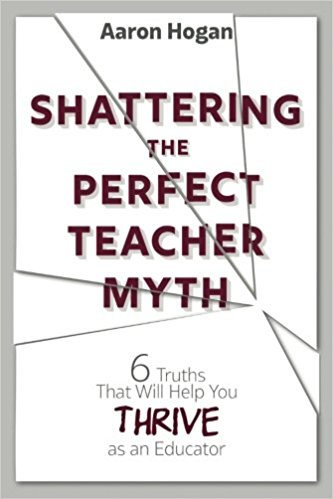
teachermyth

This book was a quick read if you just read it at the surface level. I was able to finish it in about 2 hours, but I don’t recommend that you approach the book in this manner. In fact, neither does Aaron. This is a book that you will want to read a chapter, put it down, reflect, write, sleep, then come back to it a few days later. It’s powerful and honestly, pretty heavy at some points. It’s important to note that “heavy” is not a bad thing! Aaron is pushing us to not just survive in the teaching world, but to THRIVE as an educator! In order to THRIVE, he suggests:

T – Teaching Expectations

H – Hook Your Students

R – Reject Isolation

I – Imagine It Better

V – Value Vulnerability

E – Everyday Every Day

Aaron is very clear and quick to say that these suggestions are not a “fix-it” to every problem we will face. It will not prevent failure and it will not be effortless. Because of the depth of each of these suggestions, it is really in the best interest of the reader to take bite-sized chunks of this book. (This is clearly a “do as I say, not as I do” statement right now. Just trust me. I’ll take bite-sized chunks in the future because it was fantastic and I want to really spend time on a deep dive of this one.)

In Teaching Expectations, Aaron says that we need to model, teach, reteach, review, model – all those things we’d do for content pedagogy, that we consider to just be “good teaching” – we need to be doing those things for teaching behaviors as well! I love when he flips the script and asks if we’d send a student out of the classroom for not mastering the content. Instead, we’d find ways to reteach. It’s not three strikes and you’re out for mastering content, so why do we use philosophies like that for behavior? We can’t assume students know how to behave. We must teach them and set high expectations.

Hook Your Students was awesome because it took me back to Teach Like A Pirate by Dave Burgess. We need the constant reminder to do all we can do grab our students’ attention before we even begin to deliver the content.

Reject Isolation speaks to being a connected educator. Read about Aaron’s journey on social media and how it’s impacted him as an educator. We do not have to be in a silo anymore. Social media gives us a way out; it allows us to find “our people”. I can’t imagine my life (both professionally and personally) without the amazing PLN of which I get to be a part. I love you all!

Imagine It Better was a real gut-check. Spend some time here. What can you imagine doing better? What sacred cows can be slain? When you’re trying to be innovative, everything is back on the table. I’m really looking forward to revisiting this section!

Value Vulnerability speaks for itself. I love how Aaron spins this to be not only our own vulnerability but the vulnerability of others as well. He discusses being honest in your uncertainty and quieting the whispers that happen between adults in our schools.

Finally, the part that resonated with me and has inspired my implementation plan is Everyday Every Day. This section is about building authentic relationships with students and teachers. Aaron talks about positioning yourself to get to know your students and staff. He repurposed his time in the hallways to “make it about more than just enforcing expectations”. His Selfie of the Day idea was phenomenal! I love the connections he was able to make with students and the impact it had on his school! I do very well connecting with my students. If I’m being honest, building rapport with students is one of my strengths as an educator. However, I’ve noticed that the past two years have been a struggle for me to get to know my 6th grade students. Sure I know the surface level information, but I feel guilty when they see me really connect with my 8th graders (because I’ve had them for a couple of years). While I don’t want to force the connection and I know real relationships take time, I want to build a stronger foundation with my 6th grade students. So that is my implementation for this year. I’m honestly not sure how to go about making this happen quite yet. I need to think through it a bit more. On #HiveSummit Matt Miller (author of Ditch That Textbook and another DBC book that you’ll hear about later in #DBC50Summer) suggests using Google Slides as a getting to know you activity (also read about this idea & suggested as implementation plan in Teaching Math with Google Apps by Alice Keeler and the late Diana Herrington). Michael Matera (creator of #HiveSummit – see website here – and author of Explore Like A Pirate) says he’d like to try this, and I think I might like that as well. There are 150 6th grade students coming in this year, so I need this implementation to be realistic while still making an impact. The Google Slides might just be the way to meet both criteria, but I’m going to continue investigating options of how to intentionally build a strong foundation with my 6th grade students, as well as new students who come in throughout the year.

Shattering the Perfect Teacher Myth is a yet another wonderful addition to the DBC, Inc line up. I appreciate Aaron’s willingness to share some of his epic fails and believe this book was really written for anyone and everyone in education. There were some places where I was nodding my head, while I was scratching my head in others. I’m excited to dive into this deeper in the future because I have no doubts that I will be pushed out of my comfort zone and constantly reminded that I should be intentional about the decisions I make in education.

You can follow along with the conversation on Twitter using the hashtag #TeacherMyth and I encourage you to join the chat on Tuesday nights from 9:30 – 10:00 pm EST using the same hashtag! This is a wonderful community of encouraging educators! Another terrific resource is Aaron’s blog! He also shares questions and resources from the book here. Vicki Davis hosted Aaron on the 10-Minute Teacher Podcast and you can listen here. You can also subscribe to Aaron’s YouTube channel to see some of the videos he mentions in the book. As always, the flipgrid (idea from the phenomenal Andrea Paulakovich) is available for you to share your thoughts and reflections. If prompted for a password, use DBCSummer. This space is designed to be a global collaboration and reflection space on all DBC books, so please don’t feel limited by the question, just share your thoughts! The question is only there if you need it to start conversation.

Check out my twitter reflections from my reading of Shattering the Perfect Teacher Myth.

I am so excited to finally be able to read Social Leadia by Jennifer Casa-Todd! I won this book in a #DBCChallenge and am so excited to dig into it! I had wanted it for a long time before winning it! Dave and DBC, Inc even sent me an autographed copy of the book, so that makes it even cooler! So glad Tara Martin made the Captain pose for a quick picture with my book before it was sent my way! That was a huge surprise!

Let’s go with Book 29! Blog will be up in a few days.

#DBC50Summer 26/50: Shift This

You know the saying “It’s all downhill from here”? I just spent the last little bit in an internet time warp looking up what that meant. It’s one of those rabbit holes. There is discussion online (apparently, a LOT of discussion online) about whether this is said in positive or negative connotation. I’ll spare you the details, but I choose to see it as a cyclist who has made it over the highest hill in a race, meaning things will get easier from here on. That’s what I thought would happen when I reached halfway in #DBC50Summer. I’d reached the top of the #DBC50Summer hill and could see the “end” (waaaaayy off in the distance). It’ll be easier now that I’m halfway, right?

Things. Are. Definitely. Not. Easier.

I am continuing to be stretched and challenged as an educator to truly know my educational beliefs as I read these books published by Dave & Shelley Burgess! I’m having to be more thoughtful about creating an implementation plan for these books that is realistic and attainable, while still making big waves. (Because, you know, Pirate ships do that – Pirate Pun, check!)

Book 26 was an empowering book! I’m currently ready to run through the halls yelling to the top of my lungs that I’m making changes and I want everyone on board. I’m ready to use my word from Lead Like A Pirate and be relentless in not accepting the status quo from teachers or students that I have the pleasure of serving. Shift This by Joy Kirr was so incredible that I have actually read it TWICE since last night. With that said, just go ahead and get your copy now! Seriously, it’s that good.

shiftthis

Here’s a little tidbit about me. I don’t like confrontation, in any form. I very much dislike arguments. I am a people pleaser (Yes, me too, Joy!) If someone confronts me face-to-face, I typically just bow out of the conversation with the quickest escape route I can find. If I do manage to find the guts to stand my ground, it usually ends with me stumbling over my words and tears. Mine. It’s embarrassing to be honest. If the confrontation is digital, I avoid that person like the plague until it blows over (or an appropriate amount of time has passed).

This book equips me with so many options for coaching teachers, and dealing with the dismissal and pushback that will likely happen (which in my eyes feels like confrontation – remember I take everything personally even though I shouldn’t). Finding a teacher’s comfort level in making changes in their classroom is so important. Allowing teachers to be in charge of their own changes makes change seem less intimidating. That leads to a higher success rate through sustaining said change. Thanks to Joy, I now have 4 scaffolded levels of change for topics that are very near and dear to my heart. These topics include:

  • Classroom Environment
  • Classwork
  • Homework
  • Grading
  • Social Media
  • Student-Directed Learning

Each of these includes small changes that feel “safe” while making a ginormous (yes, I’m choosing to use that word) impact on student empowerment and lifelong learning. I could easily see where I was in regards to the sliding scale of shifts on each topic and could find a shift I can make in the new year to make an even greater impact. I love that Joy repeatedly states that this was not an overnight large-scale change! She mentions frequently that the changes she has implemented in her classroom are from YEARS of small changes. I also respect that Joy speaks about the next step she is going to make as well! It shows that she’s not done growing and changing, and I appreciate that so much!

This book is like taking a snapshot into Joy’s classroom, seeing it from Point E to Point L, with the understanding that the story was already in play (Point A to Point D) and it continues to evolve now (Point M to Point “Retirement”). I’m sure even at this point, Joy is making small shifts for the her school year and that’s incredibly powerful to me!

I have got to meet this lady. We share so many educational philosophies and through my first reading of the book, I spent the majority of the time standing on her soap box with her, agreeing with every passionate sentence she wrote (sometimes even agreeing out loud). I would love to sit and discuss these beliefs about student empowerment, grading, homework, etc with Joy! There would be a lot of nodding. That’s for sure!

The second time I read the book, I read it through the eyes of an instructional coach. I could literally place every teacher I work with on the sliding scales included with each topic and can see what small change could be made in the coming school year. I want the teachers to be comfortable with the changes because, as Joy says, “Whatever you do has to work for you. If you are not comfortable with something, the students won’t get out of it what you hope for them.” Through discussion and reflection (both with students and within themselves), these changes can be tweaked to meet the needs of their classrooms.

Here are some quotes that I absolutely loved from the book!


One of the things I love most about the DBC, Inc books is that the resources shared within the book, and readily available after reading the book, are abundant. Joy’s book is no different. She includes links to all kinds of goodness via tinyurl.com in her book! I’m looking forward to diving into these links even more, as I know they will provide “a-ha” moments beyond what I read (which is already impressive).

As I mentioned, I can seriously make an implementation goal for every single section within the book. For example, in regards to grading… I have the luxury of not assigning grades to students as I am the media coordinator but I do provide feedback. Joy makes me want to shift this to have students select the work they’d like to turn in for feedback. That small shift gives students choice and allows me to see their best work. I appreciate that!

The implementation goal I choose to complete is related to social media. As I read the section of the book about social media shifts: lurking, then sharing I couldn’t help but laugh out loud. Joy and I have very similar stories about our first experiences on social media. (I, too, came home from a conference and spent hours checking out the hashtag when I got home, Joy!) I have reached a point in social media where I’ve been thinking what’s next? as I already share my own content and blog and get new resources and have an amazingly supportive Professional Learning Network (PLN). Joy gives me the next step though, and it is so obvious for it to be the next step (couldn’t see the forest for the trees kind of obvious)… hand it over to the students. Give them the opportunity to blog and tweet out their own content! The best part about this… my principal and I just had a similar discussion this week in which we’ve decided to generate a social media team of students who will get the ball rolling with student-led blogging and social media. We’ll get to see the school from the eyes of our students, and we’re both so excited about what this will look like at the end of the year! The initial social media team will work out the kinks, set the parameters (with some guidance from the principal and I on policy and student safety) and teach other students how to write a blog and share on social media. This group of students will also fulfill one of the implementations from Your School Rocks, which was to create a school hashtag (we had one, but I didn’t put two and two together, so I’m sure the students hadn’t either… now the new one will be clearly stated and shared). We are allowing the students to use their voice by sharing their hashtag ideas for our school, then vote on their favorite to select one! It’s going to be awesome!

I am excited with and empowered by this book! You should visit Joy’s website which has incredible information, including the resources for the book, blogs about shift stories where teachers have shared their stories about their own small shifts leading to big changes, and podcasts with Joy including The Wired Educator. The community on Twitter uses the hashtag #ShiftThis (Be careful with that one, ha! Joy has a funny story about that!) and the chat will resume on August 21, 2018 at 8:00 pm EST! We will meet (almost) every Tuesday night after that. I have the privilege of moderating the chat on December 4, 2018 about Shifting Mindsets! True to Joy Kirr fashion, she is shifting how she moderates Twitter chats, so click here for more information about that small shift! I’m expecting it to lead to massive impacts!

As always, the flipgrid is wide open for global collaboration! Share a story about a small shift you’ve made and how it impacted your classroom. If you should need a password, use DBCSummer to access the grid. A massive thank you to Andrea Paulakovich, a superstar educator from Kansas, for sharing the genius idea to open a global collaboration space for every DBC book!

Book 27 is Unmapped Potential by Julie Hasson and Missy Lennard, the Purposeful Principals! I just purchased this book at the beginning of July, so I’m thrilled to read it for the first time! Look for the blog soon!


#DBC50Summer 25/50: Teaching Math with Google Apps

I love the fact that book 24 and book 25 in the Dave Burgess Consulting, Inc line up came out back-to-back! These two books flow well together as they both discuss that the most important thing in math isn’t the answer itself, but is found in the process of finding the answer. When students ask, “when am I ever going to use this” the answer is now clear, no matter what concept being covered…the critical thinking skills developed in math will be used every. single. day.

Book 25 is the third book published by DBC for Alice Keeler. (The first two released were 50 Things and 50 Things Further, both co-authored with Dr. Libbi Miller.) Alice co-authored book 25 with the late Diana Herrington. Sadly, Diana passed away unexpectedly on May 17, 2017, just a few weeks after the release of their book. Diana’s love of teaching math and her passion for making math fun for students lives on in her words in the book. Teaching Math with Google Apps is book 25, and marks the halfway point in #DBC50Summer!

googlemath

Choosing from any of the Alice Keeler Google Apps books will result in a beautiful read. These pages are printed completely in color and organized in such a way that the content is easy to navigate and understand. Teaching Math with Google Apps can be used as a cover to cover professional development read, or as a quick reference guide (I’ll be using it as both)! In this book in particular, the sections of reading are color-coded in the top corners. I personally enjoy a good color-coding system, so this immediately spoke to my heart. I also love that Alice & Diana brought in some familiar faces to contribute! We get to hear from Shelley Burgess (co-author of P is for Pirate and co-author of Lead Like A Pirate), John Stevens (Table Talk Math and co-author of The Classroom Chef), and Denis Sheeran (Instant Relevance).

There are so many amazing tips, tools, activities, examples, and templates included in this book! The complete list of links is available when you purchase the book. That list of links alone is worth every penny! There are examples and templates for elementary through high school math classes, so there’s something for everyone here!

Some of my favorite activities within the book are Pixel Art using Google Sheets (I know, right? Genius stuff! It’s like a digital color by number), utilizing all that Google Forms has to offer through the implementation of self-graded quizzes that offer students immediate feedback, and using the Explore feature in Google Apps to make math relevant to students through maps, shopping, and can even be used to complete a scavenger hunt to find math “in the wild”.

Alice and Diana suggest using Discovery activities to learn collaboratively. Another idea they have is to put the beginning of the lesson in the middle. So think about this… typically students come into math class (or any class) and we quickly review (those who got it yesterday are now tuned out while those who didn’t get it yesterday are already frustrated), probably go over homework (waste of time – both the giving it and the going over it), and then start your lesson for the day 10-15 minutes later having wasted valuable class time. Diana challenges us to switch that up? What if we put our beginning in the middle? What if we didn’t go over homework (or give it for that matter) and we start with an extension from the day before? And… wait for it… they do this collaboratively so those that excelled yesterday have the opportunity to refine their knowledge by peer tutoring those who struggled yesterday. Their peers, those that struggled, get to hear the information from a different perspective and will likely have more understanding. Meanwhile, the teacher is monitoring and asking questions. After completing the extension activity and discussing it as a class, you transition into the day’s mini-lesson and allow students to discover the math using activities in Google Apps rather than telling them (Alice & Diana give the example that we typically TELL students the Pythagorean Theorem… why not ask the students what it is? They have Google! Google will tell them!) This shift in teaching and learning even sounds as though it would flow better. Makes much more sense to me anyhow. Great thinking, Diana!

Some of my favorite quotes from this one are listed below. (Y’all, Alice Keeler has a way with quotes, by the way. After meeting her in June, I can hear her saying some of these in my head now. I can hear the conviction behind some of these quotes and even if you aren’t really sure if you agree, you’ll find yourself nodding along, because the passion in her voice makes it so that it’s the gospel truth.)

“No matter the medium, design for student engagement.”

“Teach like YouTube and Google exist.” (one of my favorite favorites) Going hand-in-hand with that one, Alice says, “I have a rule: Do not tell students things they can look up.” [see Pythagorean Theorem statement above]

“Glitter, scissors, and glue should not be abandoned. Sometimes technology is not the best tool. While work can be created on paper…the work can still be submitted digitally…insert an image”

“The conversation becomes a risk-free learning zone – and that’s where the magic happens!”

“It is important for students to approach a problem with strategies rather than procedural steps. Strategies help them make connections when confronted with new situations.”

My implementation for this book is two-fold.  There is an activity (and template, woo hoo, get the book and you have access to the template, too) in the book where students take a selfie and upload into a collaborative Google Slides presentation and share a couple of things about themselves. I want to do this during my first media class with my 6th grade students. It introduces students to Google Classroom, Google Slides, and allows me to get to know the students’ names and faces as well. Secondly, at some point in time this year (and knowing how much Alice loves her spreadsheets, she would recommend sooner rather than later), I want to complete the Google Sheets activity included in the book where students will discover how to input data and manipulate Google Sheets. Using Google Sheets more will only help my students in the long run, so giving them a strong foundation with this template on the basics is a great place to start. I’m excited to see where this takes my students, and the staff! This book is specifically geared toward math teachers, but there’s so many activities here that can be adapted across the curriculum that I would truly recommend this book to anyone! The back of the book even has some Google tutorials for those moments when you’re reading and think, I have no idea what they mean by revision history. Detailed information with a beautiful screenshot is included here as well!

As usual with books co-authored by Alice Keeler, there is a vast world of information on her website. Go to alicekeeler.com and knock yourself out! Check out the hashtag #GoogleMath on Twitter for more. You can also subscribe to the Google Math Newsletter here! Don’t forget that if you want that link with ALL the resources, templates, examples, and other amazingness included in the book, you need to purchase a copy for yourself! You can do that here! Finally, you can always contribute to the flipgrid using the password DBCSummer (if it asks for one). Andrea Paulakovich had the brilliant idea to create a space for global collaboration around each DBC book, and I love it! Please share your thoughts there! We always include a prompt, but that prompt isn’t required. If you have something better in mind, share that! We just want to learn together in that digital space!

***One of Diana’s visions was to create a scholarship fund to encourage students to go into STEM fields. There is a gofundme page here or you can donate directly Fresno State in memory of Diana Herrington. These donations go toward an endowment at California State University Fresno for students who want to teach math! Diana’s passion for math lives on! Any donation is appreciated!***

Well, we’ve reached the halfway point! Next up is a book by one of the sweetest ladies I’ve ever “met” (well, met virtually…on Twitter, but I will meet her face-to-face one day, I hope)! If you want to know how to make small changes for a HUGE impact, check out book 26 in #DBC50Summer: Shift This by Joy Kirr!