#DBCBookBlogs: Stop. Right. Now.

It’s been a minute and I have missed writing #DBCBookBlogs posts! I am so thankful that book 59 was released last week and mine came in quicker than I expected. As soon as I received my Amazon notification that it was delivered, I knew what I’d be doing tonight! Dave Burgess, President of Dave Burgess Consulting, Inc, best-selling author of Teach Like A Pirate, and co-author (with his wife and fellow educator, Shelley) of P is for Pirate, tweeted earlier today:

Boy, was he right!!! My toes were stepped on, I questioned some of the things the authors suggest to stop, and I whole-heartedly agreed with others! My feathers got ruffled a few times. I’ll be the first to say that I don’t agree with every word in this book; however, I put my big girl undies on and enjoyed reading the educational conversation about each point. With that being said, you don’t have to agree with everything they share to find something that you have within your power to Stop. Right. Now. Jump in with Jimmy Casas and Jeff Zoul (co-authors of Start. Right. Now. with Todd Whitaker) to discover the 39 things they believe we should stop in order to make schools better.

stoprightnow

Here’s my completely raw, wide-open, honest, I-just-finished-this-book reflection. I had several moments where my toes were stepped on and I was convicted because I knew I did those things. I also had several moments where I literally said out loud, “Do whaaat? Oh, no, they didn’t!” There were moments that I would love to watch people with WAY more educational experience and research-based statistics go head to head arguing about the merit of that particular stop… all while I pull up a big bowl of kettle corn (way better than popcorn anyday) and a Big Gulp of Sprite! It would be the ultimate version of Celebrity Death Match minus the whole death part (yeah, I used to watch that on MTV – embarrassing).

With all of that bias and judgment in mind, this book was another incredible addition to the Dave Burgess Consulting, Inc line. Even the stops I didn’t agree with were met with valuable explanations of their opinions. I could follow their line of thought. There were some that I eventually joined their line of thought even though I was vehemently against it when I read the title of that chapter. There were FAR more stops that I agree with than those I didn’t agree with, and making those stops (ahem, right now, ahem) will certainly change education for the better!

The book is organized by stops written as chapters. I loved that each chapter was written in the same format. I knew what to expect. They started with what “it” was that we needed to stop, why we need to stop doing it, and how we can do better as educators. Each of the stops can be put into one (or more) of five areas. Each area begins with a P – Practices, Programs, Processes, Philosophies, and People. These stops are not organized in any order throughout the book, but I’m an organizer (it’s a blessing and a curse), so I created a quick graphic with the stops under the most prominent category (understanding that some stops easily lend themselves to more than one area).
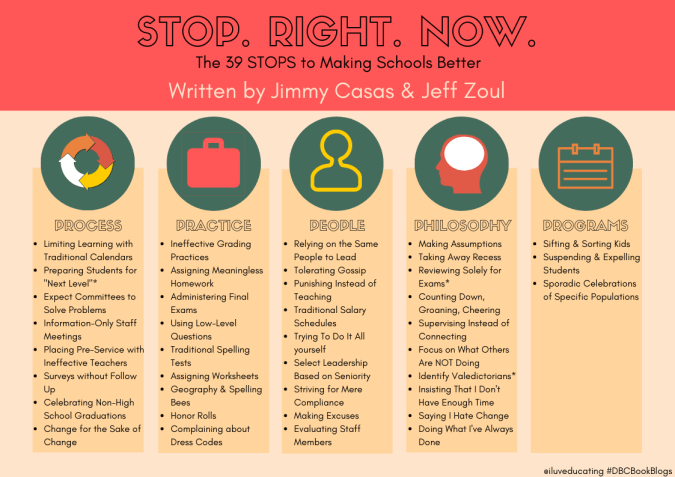
StopRightNow (1)

Click here for StopRightNow PDF.

A few that stood out to me were Saying I Hate Change, Preparing Students for the Next Level, and Relying on the Same People to Lead.

I am 110% guilty of saying that I hate change. The reality is that I don’t really hate change, but I hate feeling out of control. If I am in control of whatever the change is, I wonder what the problem is of those who aren’t getting on board. Ironic, right? I should know exactly what their problem is, because it’s my problem every time I’m in their shoes. I tend to get a bit bent out of shape when I don’t know what’s coming. Many times, change goes hand-in-hand with the unknown. So rather than saying I hate change, I should be confronting what’s really bothering me… a lack of control and the unknown.

I taught fifth grade for over seven years before beginning my role as a media coordinator. Every year around Christmas, I would stop checking planners for students. I expected the students to bring me notes from home if they had one. What was my defense every time a parent complained that their child didn’t have their homework written down or that I didn’t receive their note? I’m getting them ready for middle school. Looking back, what a ridiculous thought that was. They weren’t ready for me to release that responsibility to them all at once. I needed to focus on preparing them for right then.

I was reading a blog post from Dave Burgess earlier today very similar to this very thing!  In it, he says he “gets a bit confrontational when asked, ‘Don’t you worry about the fact that you are making school so engaging and fun that when they get to their college classes or to a real job they won’t be prepared?’

His response:

“So what people are saying when they ask this is basically, ‘Okay…since life is going to suck for these kids later, shouldn’t we make it suck now, too, so they’ll be ready for it?’ I don’t buy it, at all.”

My middle schoolers are middle schoolers. Just because my eighth graders will be freshmen next year doesn’t mean that I should treat them like freshmen now. They are still eighth graders! What’s ironic about this whole thing is that when our sixth graders come to us in the fall, we commonly say, “Well, they’re really still just like fifth graders”… the irony is that those fifth grade teachers have been trying to get them ready to be sixth graders (I know, because I was one of those teachers). I love Jeff & Jimmy’s thoughts on this so much that I created a graphic for it and tweeted it this evening. “Prepare them thoroughly at their current level,” they say.

There is so much truth to that! If we prepare them for RIGHT NOW, they will be prepared for the next level coming at them by default.

Finally, selecting the same people to lead stood out to me. It did so because I’ve been on both sides of this argument. I was the one who desperately wanted to go to our state technology conference. The only way we were able to attend was to be chosen by our district OR to submit a proposal and be accepted to present. Well, I wasn’t about to submit a proposal – I wanted to learn, not teach! I didn’t feel “ready” to present at a state conference when I had never even presented within my own school or district! I was never chosen by my district as it was the same people always asked to attend and I was so frustrated by that! The professional jealousy was real, y’all. Now, I’m completely on the other side; I’m asked to do so much that I’m stretched too thin as times. Thankfully my director has been preaching this exact same thing for years, so he really makes it a point to purposefully select others to step up and he builds leadership capacity in them. This has allowed me to step back into my role at my school, as well as have time to do things like #DBC50Summer and create my own professional growth opportunities. I’ve gotten over the insecurities that went with not being chosen for this conference or that event or this committee. It’s awfully nice to have that weight lifted; I’ve got to be perfectly honest about that.

My implementation? I’m going to focus on the Gots rather than the Nots! What are people doing rather than what they are not doing! It’s so easy to get pulled into the frustration and negativity when I’m busting my tail to be the very best educator I can be and do all I can do for my students and teachers while seeing others run in the school at the last minute and dash out the door the second they can leave. Instead of being aggravated, I choose to focus on the positive. I will assume the best of others and focus on what the strengths of others are, rather than breathing life into the things that drive me crazy.

There is so much to love about Stop. Right. Now! As I type, it’s the number 1 new release in Experimental Education Methods on Amazon and for good reason. Even the parts I didn’t agree with, I enjoyed reading and I love that it challenged my thinking as I read. Now I’m reconsidering some of my own philosophies, which can only strengthen my educational practices! I love books and conversations that make me do that! This was one of those books that made me wonder how I even felt about a topic so I could form an opinion before continuing the chapter. I had no idea how I felt about professional dress code; I’d never even stopped to consider it. Now, I have a philosophy on dress code (and no worries, Jeff and Jimmy – I won’t be complaining about it).

Definitely take the time to grab a copy of the latest addition to the DBC collection! Book 59 won’t disappoint! It’s a pretty quick read and is full of thought-provoking conversation starters! Be sure to hop on over the Flipgrid (it’s still available) to share your thoughts! The question relates to school calendar, but feel free to share any reflections you have on the book! Check out the amazing website for DBC to find information about each of the Pirate Authors and how to connect with them on social media. The book says to use #StopRightNow to discuss ideas from the book, but I’ve also seen (and used) #StopRightNow39 as a way to differentiate between the book and the popular phrase.

I’m so excited to see which books ends up being Book 60. Several folks are posting on social media about upcoming books with DBC including Dan Tricarico‘s Sanctuaries, Tamara Letter‘s A Passion for Kindness, and Lisa Johnson‘s book Creatively Productive. It looks like 2019 is going to be another amazing year for DBC, which means tons of #DBCBookBlogs posts! I can’t wait to see what the new year has in store for us!

Rumor has it… Teach Like A Pirate will be out on audiobook soon!!! And BONUS: it’s read by the Captain himself! <squeeee> How do I know that? Easy! I’m signed up for the DBC eNewsletter! With that I get the #SundaySeven with tidbits from DBC and their authors and a monthly newsletter that lets the DBC readers know what’s coming up soon! If you aren’t signed up, click the link here and sign up where it says Subscribe to the DBCI eNews on the side!
#DBCBookBlogs: The Princes of Serendip

Do you remember your first car? I remember mine, clearly.

Two-toned – dark blue and gray. 1990. Lexus ES250. Power windows. Sunroof. Decent sound system. While this may sound like luxury to some, looking back I can assure you it was not. I went to school with kids from very wealthy families. There were brand new sports cars, new Jeeps, BMWs, Explorers, etc. in our the spaces of our senior parking lot. My car could be heard from miles away, and the rust was showing and paint was chipping off. The fabric of the interior was hanging from the roof of the car. But to this 16 year old, the windows, sunroof, and sound system worked and it had the “L” on the front grill, so it was better than walking.

Why do I start this blog talking about my first car? Because my mom bought the car for me to drive and made me pay every cent of the car back to her. I remember being so angry. She made me pay for the car and pay for the gas to drive it. (She did pay the insurance.) Very few of my friends were made to pay for their car; their parents paid for it and gifted it to them. Not me. Nope. I got a job at a clothing chain and worked to pay for the car and my gas. Mom always told me that I would appreciate the car more if I worked to pay for it.

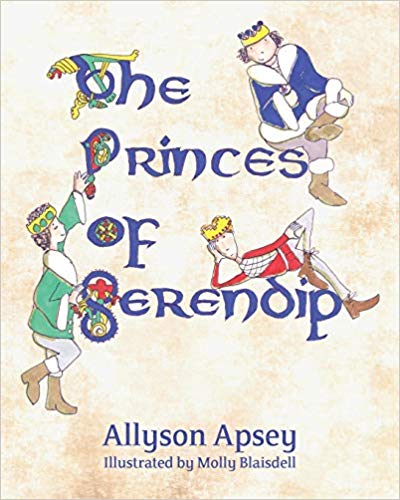
Allyson Apsey brings us the 58th book in the Dave Burgess Consulting, Inc line of awesome. (At this point, can we really call it anything other than that? I mean, really?) If you’ll remember correctly, Allyson also brought us book 46 as well, The Path to Serendipity. Her newest book, just released a couple of days ago, shares a powerful message in picture book format. Yep – DBC now has TWO children’s books! The Princes of Serendip joins the family and shows us the importance of pride, kindness, and gratitude. The illustrations are absolutely stunning! The illustrator for this book is Molly Blaisdell, and she did a terrific job with the artistry of the princes and their lessons learned.

princesofserendip

Allyson newest book is her own version of the 16th century Persian tale The Three Princes of Serendip. In the original tale (as much as my limited research could bring up), the King questions his three sons about their readiness to take over the role of king and is proud of their answers. He decides they have completed their formal education and sends them out into the village to discover what life is like there to polish their education through real world experiences. The three princes decide to tell the emperor that they saw a camel on the road based on clues from their trip along the road, even though they did not. They are accused to stealing the camel and are sent to jail. Someone finds the camel, and they are released. When questioned about how they knew about the camel so well without ever seeing it, they share their keen observation skills and the emperor is so impressed that he asks them to stay at his guests.

There are several variations of the story as it has been passed down through generations. Find more information here and here. These could easily be adapted to be more appropriate for younger students, if desired.

Allyson’s tale is about the princes discovery of pride, kindness, and gratitude. It is heartwarming and the perfect social-emotional learning book for any home, classroom, or school! Much like with Dolphins in Trees by Aaron Polansky, I immediately started thinking of ways to use this book in a classroom setting. It opens up so many conversation possibilities as a read aloud option!

  • Why do you believe the King was disgusted with his sons?
  • How would you feel as the King?
  • Why do you believe the author chose those three virtues for the princes to discover?
  • Which of these virtues do you believe is the most important?
  • What other virtue would you have them discover?
  • Create a parable (short story) that teaches the princes about the virtue you chose.
  • How would this story be different if it was set in today’s time?

Some terrific opportunities present themselves to create authentic learning and self-reflection from this children’s book as well.

  • Think of someone (or a people, charity, etc) less fortunate than you. Research the day-to-day problems they must overcome, and create a way to help solve their problems.
  • What unfamiliar words do you see? How can we use the context around them to infer their meaning?
  • Serendipity is defined in this book – why do you believe the author shares the origin of the word?
  • What did formal education look like for princes and/or princesses of the medieval times? Compare this to the story.
  • Compare the original tale (or a modified version of the original for younger students, if desired) to Allyson’s story.
  • How do the pictures enhance the story?
  • Illustrate your version of a modern-day Princes of Serendip.
  • Writing prompt: Do you believe Americans are spoiled? (Reference the USA Today article on the Ryder Cup in Paris, Oct 2, 2018)
  • Do you believe you are like the princes? Why or why not?
  • How do the princes change from the beginning of the story to the end of the story?

These are just a few ideas off the top of my head. I am certain you have many amazing ideas for incorporating this story into your classroom, home, or school! Please share those awesome ideas on the flipgrid that Andrea Paulakovich and I co-pilot.

Follow along on Twitter using the hashtag #PrincesOfSerendip. The most precious video can be found on Facebook and YouTube of Allyson opening the Amazon package of her book for the first time. It is moving to see an author touch a book they have worked so hard to create, and see and hear the pride as they hold the finished product in their hands. Check out the video below (or click here if you have problems viewing)!

This is the perfect book to purchase your child’s teacher and/or librarian in this holiday season! Here is the Amazon link to purchase The Princes of Serendip.

My girls’ reactions after asking me to read it for a second time, scooting closer and closer as I read each page:

My 5 year old: “My favorite part of the book was when the kids worked hard to cheer up their dad when he was sad. Kindness is my favorite and it means to be really nice to another human. It was really sad that the girl got burned. I don’t like fire.”

My 9 year old: “My favorite part of the book was the whole entire thing. I loved it. Kindness is my favorite because there is kindness inside of us and we can be kind to others. I like that they stop ordering their servants around at the end. I love the illustrations.”

So how will I implement this book? The problem of the Princes of Serendip is that everything was handed to them. They were spoiled. I will allow my students to fail and experience defeat. I will encourage them to get back up and try again every single time. It is only through reflecting on our failures that we learn life lessons. When the students I serve are working through a tough BreakoutEDU game, I watch the frustration on their faces. I see them get agitated as they work through the problems; I see them put down a clue, and eventually pick it back up again. I smile at them as they whine and complain that it’s too hard. Then, we celebrate together as they unlock the locks one by one. The pride in themselves is so evident as I hear squealing and laughter throughout the media center. This is part of my why. Allowing students to fail in a controlled, safe environment and encouraging them to persevere and get back up again, determined to succeed, gives them the resilience to get back up again when the stakes are higher.

I’m so excited to see where the DBC, Inc line goes next! Definitely go to the Dave Burgess Consulting, Inc website and sign up for their newsletter, if you’ve not already! From the November eNewsletter, it appears that 2/3 of the Start. Right. Now. crew is coming out with a second book titled Stop. Right. Now. I’m intrigued by what Jimmy Casas and Jeff Zoul have in story for us and can’t wait for it to come out! Several books are being transformed into audiobooks in the near future, so watch for those! If you’ve subscribed to their newsletter, you will also receive #SundaySeven which is super cool!

Finally, my mom was right. I do appreciate things more if I work hard for them. (Don’t tell her I said that though.)

#DBCBookBlogs: Make Learning Magical

Several years ago, there was a night of games at a conference. This was the first time I ever spoke to Tisha Richmond. Fast forward to last April and I knew I’d met a new best friend.

She was playing Code Names with her class! That is one of my (and my students’) favorite games to play!

I had no idea who this Tisha Richmond lady was, but I already adored her. Who can resist another tabletop gamer AND her Twitter handle sounded way cool – @tishrich.

So when I found out she was releasing a book with THE Dave Burgess Consulting, Inc I was so excited (as evidenced by the sheer number of exclamation points in the above tweet, ha)!

The day it was available on Amazon, it was purchased, and on Sept 18, it arrived!

Finally – I get to share my thoughts about Make Learning Magical by Tisha Richmond, book 57 (and the most recent release) in the amazing line of Dave Burgess Consulting, Inc books.

MLMagical

Stop right now and go get your copy. Seriously. This was one of those books that I didn’t want to put down. It is a book from which I had SO much I wanted to do that I had to wait and get my sleep on before I could make a decision about my implementation plan (Spoiler alert: I still couldn’t make a decision).

There are so many practical ideas within Tisha’s book and every single one seems feasible in any classroom. Tisha was a culinary arts teacher who has now transitioned to a new role as her district’s tech integration specialist. She shares how she gamified her classroom and how she gave her students an authentic audience. In her class it wasn’t just about spending time in the kitchen, it was also about spending time with one another and students putting their own spin on culinary creations.

Her acronym (because, hello… it is a DBC book after all… we know how much we love those acronyms) It’s magical… no, really… it’s MAGICAL.

  • Memorable Beginnings

  • Authenticity and Agency

  • Gamified Experiences

  • Innovation

  • Creativity, Collaboration, and Curiosity

  • Authentic Audience

  • Legacy

See… MAGICAL.

Memorable Beginnings

Tisha advocates for leaving the syllabus, handbook, rules and procedures until AFTER getting to know our students. I love this! After all, I teach kids. I need to know those kids and they need to know me before any true learning connections can happen. Learning certainly isn’t magical if students don’t feel comfortable in their own environment.

From this section, I choose to implement the decor. She speaks to using all senses to engage students. These include using music to engage the ears, aromas to engage the nose, visually pleasing colors with the psychology of colors to engage the eyes. As I seek to be more magical in my lessons, I will consider what students are seeing, smelling, and hearing.

Authenticity and Agency

This entire section – the whole thing – spoke to me at the core. Having an attitude of gratitude, giving students voice, and sharing our failures are keys to a magical environment. I am implementing the #GratitudeSnaps co-created by Tisha and Tara Martin (author of Be REAL) and sharing one thing I am thankful for each day for the next three weeks.

Gamified Experiences

If you loved Michael Matera‘s eXPlore Like a Pirate, you will certainly love this part of the book! In fact, Michael wrote the foreword for Make Learning Magical! I personally love the mini-games that Tisha shares.

Last spring I was awarded a local mini-grant to purchase tabletop games for use in the classroom. I am so pumped to be using these games in connection to curriculum across grade levels. The game club that I have the pleasure of facilitating is every Friday afternoon and we are enjoying spending time together. I will be implementing these games into classrooms and blogging about them as the implementation for this section (and the main implementation of this book).

*Think of the other implementations as “side quests“.

Innovation

Tisha reminds us of George Couros‘s The Innovator’s Mindset in which George explores the idea of innovating inside our boxes. This means to use what we have and innovate with that.

It is in this section that Tisha shares her biggest mic drop moment (in my opinion). This is where I feel like she’s come off of the book’s pages and is talking to me face-to-face in my living room, and I bet you’ll feel the same way!

“I’ve had moments of irrational fear and doubt when I’ve strongly considered going back to comfortable and easy; however, the fire inside me is too strong. I know that I can never go back to comfortable and easy, because in the discomfort and challenge is where I’ve experienced such growth. In the fear, I’ve discovered things about myself I hadn’t realized and become even more certain of what I believe and hold dear to my heart.”

~Tisha Richmond, Make Learning Magical

Here I am getting goosebumps again just reading that part of Tisha’s heart in word form. This reminds me so much of Shawn Mendes’s song “It Isn’t In My Blood.” We hear this  phrase repeated time and time again – it’s like an anthem.

Sometimes I feel like giving up
But I just can’t
It isn’t in my blood

Creativity, Collaboration, and Curiosity

So much is covered in this section that is pure gold! From considering the introvert to giving more opportunities for making in the classroom, from creating buzz for lessons (think Teach Like A Pirate hooks) to sketchnoting and being a connected educator, there is so much in this one short section. Tisha is really bringing the heat, so to speak.

My implementation (which scares the socks off of me) is to be more intentional in sketchnoting. Being a connected educator has given me opportunities to learn from Carrie Baughcum, Sylvia Duckworth, Julie Woodard, Monica Spillman, and more. If you’re not following these rockstars, I’d suggest taking a moment to rectify the situation before moving forward.

Authentic Audience

Giving students an authentic audience is so important. It is well known that students will do bare minimum in most cases when their teachers are the sole audience. They will put in a little more work when their peers become part of the audience. But when we allow students to publish their work to the world, it gets real… really real.

My implementation is to pull in more audiences for the students and teachers I serve.

Legacy

When is the last time you ran into one of your own former teachers? As an educator, did you take the time to speak with your former teacher and share their impact? I hope so. I was in JROTC throughout my entire high school career. For a reason I will never understand, my Sergeant saw leadership potential in me and within just days promoted me to Colorguard Commander. At the first home football game of my freshman year, I carried the American Flag onto the field flanked by two riflemen and the state colors. I was shaking like a leaf, but I did my job. We marched on the field, we presented the colors, we ordered the colors, and we marched back off in perfect unison. Until that moment, I’d never experienced leadership to that degree. He deeply impacted me through that quick decision to give me a promotion and declare that I would command cadets that were much more experienced than I was.

Be sure to thank your former teachers, if at all possible, who impacted you in a positive way. My first year students are now in their early to mid twenties. I am blessed to watch them get married, start families, and begin their careers through social media. The thought of leaving my own legacy in children is both terrifying and empowering. We should never take it lightly.

Tisha’s book is further proof that the DBC, Inc line of educational books is only getting stronger and stronger. Who would have ever thought that 6 years ago at the release of Teach Like A Pirate, some edgy book with a pirate map on the cover self-published from a kitchen table, would have the legacy that it is leaving on education around the globe. It’s powerful, and truly – it’s mind-blowing.

To follow along with Make Learning Magical conversations, follow Tisha Richmond and add the hashtag #MLMagical to your tweetdeck columns. Go spend some time on Tisha’s website and blog found here. You will also see a section for recipes along the top (or click here). <Tisha, I need lessons, ma’am! Just saying… I struggle with boiling water, no lie.> Tisha has also done podcasts and videos! Check out this one with Jeff Utecht of Shifting Our Schools, this one with StoriesInEdu, or this Recap of #MasteryChat! As if all of that isn’t enough, Make Learning Magical comes with its own slice of magic… Ann Brucker of BreakoutEDU created an epic #BreakoutEDU game to partner with the book! Whaaat? I know, right?! So awesome! I want to do a book study, just so I can set the game up for others to play! This is an incredible partnership and I really hope to see more of this in the future!

The flipgrid is available for you to reflect, share your own thoughts and implementations from Make Learning Magical! A special thank you to Andrea Paulakovich for allowing me to co-pilot this incredible global collaboration spaces for all of the DBC books!

The next book to be released is yet to be seen publicly…. ooooh, wait a minute… just double-checked Twitter to see this post…

Allyson Apsey (author of The Path to Serendipity has released the Amazon link to her first picture book (and the second children’s book in the DBC, Inc line) titled The Princes of Serendip! This book will begin shipping soon! Go grab a copy of Make Learning Magical AND The Princes of Serendip now! Book 58 is coming soon!