#DBC50Summer 5/50: Ditch That Textbook

Okay, friends. (Is it okay that I call you friends?  If you’ve stuck with me for 5 posts, I feel like we’re close enough to be friends.) I hope you’re a friend because I’m getting ready to tell you something quite embarrassing about myself… oooh goodness.

When I was hired two months after graduating from Appalachian State University with a degree in elementary education, I knew everything there was to know about teaching.  I’d had the classes, right?  I just knew I was going to be a creative teacher – you know, with projects and all.  I couldn’t wait to teach math, as that was my concentration area. I was hired to teach fifth grade students and somehow lucked up to be specialized in math!  I taught three math classes a day for 65 minutes each.  I also did read aloud with my homeroom, self-selected reading, and a teensy bit of writing (okay, let’s be honest – we did it once a quarter so they’d have a writing grade)

So there I was… a math teacher.  Twenty years old (Goodness, what a baby I was!) and getting to influence ten-, eleven-, and twelve-year old girls and boys hoping they would love math as much as I did.  What’s not to love?!  It’s logical, there is always a correct answer, and you complete the same steps over and over again.  I found out quick, fast, and in a hurry that everyone doesn’t love math! Many don’t even like it! (I know – I was shocked, too!!!) However, I was a TERRIFIC math teacher.  Do you know how I know that?  Great test scores. Every year. In fact, my very first year of teaching I had 100% of students pass the standardized math test in my state. That naturally made me an amazing teacher, right?  How did I do it??

I sat on a wooden stool at my overhead cart (yeah, true story) and using purple, hot pink, and teal blue Vis-A-Vis wet erase markers, I worked every. single. problem. in. the. math. textbook. while my students copied it in their math notebook.  We would do the odd problems together and the even problems independently.  Students sat in desks that created a 5 x 4 array (just a fancy way of saying rows and columns).  I sat at the “front” of the room.  Pencils were sharpened, notebooks were used, math procedures were learned… I was an amazing math teacher.

I am so embarrassed by that story.  Unfortunately, it’s all true. I was that teacher. Now mind you, I remember every single student I had; we built great relationships!  I went to watch them play ball games and got to know their families.  I even gave my youngest daughter the middle name of one of my students from my first year. The vast majority of that group have graduated from college and are doing their best to “adult” today.  I think back and remember them with a smile.

And I bet they hated my class!  I don’t blame them.  I did them a GREAT disservice. I was that teacher. I needed book 5 of the #DBC50 twelve years ago.  I should have made it a point to Ditch That Textbook!

DitchBook

Now I’ll be the first to admit when I saw this book, I thought I knew exactly what it would say.  I need to make sure I’m using resources other than the textbook. WRONG!  Matt Miller (blog and Twitter) gives us so much more than just other resources.  Now with both Teach Like A Pirate and Learn Like A Pirate, I refused to give the meaning of the acronyms away.  I believe you need to know what DITCH stands for in order to get you in the right frame of mind.

  • D – Different

  • I – Innovative

  • T – Tech-Laden

  • C – Creative

  • H – Hands-On

Contrary to belief, Matt Miller isn’t writing about throwing textbooks away.  He wants us to be more… well… pirate-y with our lessons.  He wants us to give students a chance to think critically, solve problems, communicate with others, create something!  I completely agree, even as the math teacher who gave problem after problem from the textbook. (I’m going to go ahead and complete my confession by fully disclosing that I also gave entire pages of workbook problems to complete at home each night. Y’all – I was horrible.) I didn’t intend to be “that” teacher – I had planned on doing projects and collaborating and creating data sets from experiments… then the pressure and time crunch of teaching started. I flaked. I completely abandoned those thoughts and went back to what I knew.

Matt Miller makes it crystal clear that we are providing students with a great disservice if we prepare them for our own future rather than theirs.

That is exactly what I was doing.  In fact, I was even worse than that – I was preparing them for my past!  After twelve years, I am a completely different teacher. Thankfully someone like Matt pushed me out of my comfort zone.  Someone told me that I needed to make the learning relevant to my students.  Someone forced me to incorporate technology into my lesson (If you know me and my professional passions now, that might have just made you laugh out loud… but sadly, it’s true – I had to be FORCED).  Someone finally told me to DITCH that Textbook!  The biggest question in my mind… how much damage had I done before I finally revolutionized my classroom?  For how many students did I contribute to the hatred of math?

If you are me from twelve years ago, you need to read Chapter 24 of this book.  It has over twenty-five ideas to help you think outside the textbook.  I desperately want a colored poster of these ideas (Stick figures are just fine by me, Matt!). I’m slightly ashamed to say that it took me an inordinate amount of time to realize it was an alphabetized list. It’s full of good stuff though so I’d check it out! Many of the ideas I have actually incorporated into my lessons since that horrific first year of teaching. I also loved the chapter about student blogging! In fact, all of the activity ideas that Matt shares for ways to make your classroom different, innovative, tech-laden, creative, and hands-on are spectacular! Working in a middle school, the majority of my students know how to do these activities with little to no instruction from me!  How cool is that?!

Two things really stood out to me from #DitchBook (search using the hashtag on Twitter for more inspiration and resources).

  1. Create a mission statement and/or choose a word to describe your classroom for next year.  This is similar to the activity that we did in P is for Pirate, where we chose five words to describe the learning experience. It’s powerful to choose just one word though! I have a mission statement for the media center and it has set the culture of the space since writing it.  It can be found on the back of a brochure given to parents/students and teachers at the beginning of the year. I used canva.com to create the brochure. Click here to see a PDF version.
  2. In Matt’s conclusion, he passionately urges us to put thought into action. He suggests starting with a conversation, either with him, or whomever is your Yoda (okay, so maybe he doesn’t say it like that…), then start planning!  Once you have your plan, punch fear in the face (he really does say it like that, though); don’t let fear hold you back from following through with your plan.  He got me pumped up by saying these few sentences about WHY we should follow the plans with action.

They’re the future.  Your students are worth it.  You are worth it.  Do it anyway.  Embrace the messy and the complicated.  Go out on a limb because that’s where the fruit is. Go ahead.  You know you want to.  Ditch that textbook! ~@jmattmiller

You know what I’m going to say next… go buy this book.  I highly recommend this book to middle and high school teachers.  Chances are that your textbooks are insanely outdated anyway, so go ahead – Ditch That Textbook!

Matt Miller’s Website/Blog is phenomenal!  It’s full of excellent tips, ideas, and templates to help you go paperless and infuse technology and creativity into your classroom!  Click here to check it out!  As always, here is the Flipgrid (idea from the fabulous Andrea Paulakovich) – passcode is DBCSummer!

**You know those annoying infomercials that pull you in and just when you think they’ve given you everything, they say, “But WAIT, there’s more!”  Consider me an infomercial, I’m cool with that.  You will be too when you see the “more”!

Wow – five of the #DBC50 are complete!  This has been so much fun!  I’m using Matt Miller’s philosophy and not trying to implement ALL of the ideas from ALL of the books – that isn’t possible!  I’m just trying to pick one or two things after reading each book that is actionable in 2018-2019!  A little insight into my personality (as if you didn’t have enough already – HA!)… I am a spreadsheet/table kind of girl. So as I read & blog, I’m creating a spreadsheet as I go through #DBC50summer to hold myself accountable for reading the book, reflecting and blogging about the book, and then the most important space is the action for the school year related to that book!  Do you know who else loves a good spreadsheet on Google Sheets?  The author of BOOK SIX – Alice Keeler!  I am thrilled to write about 50 Things You Can Do With Google Classroom, co-authored by Alice Keeler and Libbi Miller!  I use this book as a resource on the regular, so the blog for this little gem will be coming VERY soon!

 

#DBC50Summer 4/50: Learn Like A Pirate

Not a week goes by that I am not asked this one question.  It may come from a former student, parents of former students, another teacher, instructional coaches at other workshops, the custodial staff at my school, etc who asks “the question” that everyone who has left the classroom is asked (or a very similar version of “the question”).

A few weeks ago, I was tying up loose ends in the media center before students went home for the summer.  As is the usual during a class change, students stopped by to say hello or exchange hugs on their way to the next class, asked a million questions, switched out library books, or knocked on the windows to the media center (I work in an honest-to-God fishbowl) then waved.  It’s my favorite five times of the day because I love hearing their energy as they switch classes, calling out to one another, sharing funny stories, singing, etc. Our school custodians were helping me break down cardboard in the makerspace and one of them mentioned that he could tell that I love my job by the way I interact with the students and that I’m always smiling (it’s true – and can be a bit annoying for some; I swear I do have a neutral face, and even a scowl occasionally, ha!). I thanked him for noticing and agreed that yes I do love my job very much.  He immediately went on to ask “the question”… “Do you ever miss teaching in the classroom? Would you want to go back and have your own class again?”

Now, hold that thought… I’ll come back to this.

learnlap

This weekend I am blessed to attend #BadgeSummit in Chicago, IL where ISTE2018 is hosted!  This one-day event pulls together the greatest minds of Digital Badging in the world to share, discuss, and learn from one another.  (Spoiler – One of the Pirate crew will be presenting! Must find him tomorrow!) Because of his amazing work in this arena, my director Lucas Gillispie was invited to present, and brought along three of his EPIC Academy mentors. After a cancelled direct flight to Chicago O’Hare, a rescheduled connecting flight in DC, a successful four-person stand-by for a different direct flight (you know that’s a big deal) where we all scored window seats, we finally boarded a plane 2 hours later.  My seat mate was AH-MAZING (aka, she didn’t speak at all while I tried to read) so I was able to take in nearly all of the 4th book in the DBC line up, Learn Like A Pirate by Paul Solarz (web, twitter). I finished it up in the hotel and had to reflect!

Side Note: They put a country girl in the city and keep saying it will be a fun adventure…  If you happen to see me around Chicago, expect to see a “deer in the headlights” look. I may not be able to hold a coherent conversation due to the insane amount of city life I’m trying to overcome.  Don’t judge.

Now… back to “the question”… I miss the connection with the students after working with them and building relationships for 180 days. There is a bond between my students and me where they become “my kids”.  As Paul mentions in Learn Like A Pirate, this relationship started before they ever entered my classroom.  A quick high-five or a good morning was all it took to begin building the relationship in the years leading up to being in my class.  That relationship would blossom during our 180 days, and without fail, I would ugly-cry on the last day of school every year.  I still do… again, don’t judge.

Before reading #LearnLAP, that would have been my answer – it’s the same answer almost any educator will give you that has left the classroom to move into another role like administration, counseling, specialist/support staff, etc. After spending time with Paul (totally on a first-name basis because, I swear, we had a heart-to-heart conversation while I read this book; he just doesn’t know about it) my answer has changed.  YES – I MISS BEING IN THE CLASSROOM!  I want to scream it from my 14th floor window right now.  He got me so excited about his student-led classroom and his passion for empowering students by allowing them to have all of the control (or perceive to have all of the control because ‘the teacher’s decisions are final’, per Paul).  I want to jump back into a classroom next year so I can implement all of these amazing ideas!

He wrote this book in a way that his student-led classroom is easily replicable!  He breaks down the PIRATE acronym meant for teachers, created by Dave Burgess in Teach Like A Pirate (the mother’ship’, if you will – Pirate Pun for the win) and rebuilds it for students.  He focuses each letter on a necessary component of the student-led classroom.  Each letter makes his student-led classroom successful.  This book is all about empowering students to take charge of their learning and accept full responsibility for what they learn, or don’t learn. Paul even has them watch the clock to let their peers know when it’s time to transition to the next part of the day through a five-minute warning and then a stop time. As in the #TLAP post, I will not share his acronym with you here; you’ve got to get the book for all that juicy goodness!  He discusses the important of collaboration, feedback, making improvements, having students up and moving, using the 21st century skills, and genius hour/Passion projects. There information on makerspace, Mystery Skype, Quality Boosters, rigor (that’s a soapbox for me all by itself, like “innovation” is for Don and Paul did an amazing job keeping me off of it).  It’s a whole lot of awesome wrapped up in only 250 pages.  Those pages FLY by when you’re reading!  Throughout the 250 pages, Paul gives you resources and lessons that he’s used in the form of QR codes (or links for digital versions of the book)!  Rather than tell you what he does, he SHOWS it to you!  This was a great addition to the book!  I’m not sure whose idea that was, but kudos to you!  I couldn’t check out the links until I got to the hotel, and when I got here, I couldn’t stop looking at them!  I was overwhelmed at the vast amount of resources available at your fingertips to empower students within this book!

I have to tell you that my biggest takeaway from this book wasn’t the empowerment of students though. Now, please, settle down. (Whew! I hope Paul, Dave, and Shelley aren’t having a small heart attack right now if they’re reading this – keep going; trust me. It’ll be okay.)  I realize that the book centers on the idea of student-led classrooms and empowerment and collaboration and student success being more than a grade, etc… I get it.  And I wholeheartedly agree with every single one of those principles!  However… my biggest takeaway from this book is even larger than those massive philosophies of education.  Ready?  It’s a big one…

MODEL YOUR EXPECTATIONS!

Boom – dropped it. Am I right, though, or am I right?  What really stood out to me through this entire manifesto of Paul Solarz (which fit perfectly as the 4th DBC book as it really pulled together the pirate teacher’s role, genius hour, being bold and relentless in reaching students, etc) is that Paul doesn’t expect any of these things to “just happen”.  He repeatedly says that it is the teacher who must MODEL the collaboration for students.  The teacher must MODEL appropriate use of “Give Me Five.”  The teacher continually MODELS expectations in peer feedback.  The teacher MODELS posing the questions that produce better answers, so that students will begin asking these questions of one another.  Paul never says, “on the first day of school, students get thrown into this whole idea of leading the classroom, doing whatever they want, and I let them figure it out Hunger Games style when an issue arises”… nope. He starts the year by modeling his expectations and continues to revisit the model that he expects students to follow throughout the year with immediate feedback when the model he’s established isn’t met.  Therefore, my big takeaway isn’t the obvious empowerment, collaboration, newly & brilliantly formed PIRATE acronym… instead, it’s this reminder that if I want students to perform a task a certain way, act a certain way, react a certain way… I need to be their model.

If I want students to know how to check out a book in the media center, I need to model that. If I want students showing kindness to other students, I need to model that.  All teachers need to model that.  If I want students to engage in a love of learning, I need to model a love of learning by showing that I never stop trying to better myself. All teachers should exhibit a life-long love of learning.  If I want my students to be risk-takers and not fear the epic fails that will inevitably come with those risks, I must model that for them.  I cannot be afraid to fail either.  Teachers must learn from failure and remember that eyes are watching our reactions to our own failures!  For example, we can’t throw the technology out tomorrow just because it didn’t work today; we problem-solve and try again.

It doesn’t matter if your students are in PreK or if they are in college, they are watching.  Eyes are on you, as the educators, at all levels, all the time – you do not get time “off the clock”.  They’re watching you at school, on social media, when they run into you at the store (Wait, you don’t live at your school either? Weird!), when they overhear you venting to another teacher about “that kid” on your nerves that day, when they feel the stress of standardized testing radiating off of us, when they see the eye roll toward a teacher that you don’t see eye-to-eye with… they are watching.  You don’t get time off.  We should be modeling these habits that will help them be successful, not just in the next grade level as Paul says, but help them be successful at life.  If you are a classroom teacher, or if you are like me, and have left the classroom (while some days desperately missing the relationships that can only be built over 180 days of love, laughter, and learning), we must all remember that we are modeling behaviors for students.

Are you modeling positive, successful behaviors?  Are you sure?  All the time?

I had to do some soul searching myself… I don’t model those appropriate behaviors ALL the time. I admit it. I get aggravated.  Sometimes, I give up when something frustrates me. I am insanely scared of failure. I worry that others may see me as weak, or delight in my shortcomings, if they see me fail, so sometimes I put up a wall and refuse to fail by not even trying to begin with. I’ve got to do better, even though I don’t have my own classroom of students anymore. All of us can do better, if we’re honest with ourselves, regardless of our educational job title. If we want to empower our students to collaborate, lead, and succeed, we must first model collaboration, leadership that creates other leaders, and success through failures. Paul taught me that, maybe inadvertently, through his amazing addition to the DBC line up, Learn Like A Pirate.

With that in mind, I recommend that you click this little hyperlink right here… BUY THIS BOOK.  While you’re at it… go ahead and pick up Book 5/50, too! Do you know what the fifth book was?  I’m so excited to write about Ditch That Textbook by Matt Miller next!  You’re also going to learn something pretty shameful about me from my early years in education… see you soon!

In the meantime, check out these additional Learn Like A Pirate treasures!  In true PIRATE fashion, you can check out the community on Twitter by searching for #LearnLAP!  You can also add your thoughts on the Flipgrid that Andrea Paulakovich and I co-pilot (Amazing idea, Andrea)!  The passcode is DBCSummer!

Dave’s blog announcing release of #LearnLAP!

Subscribe to Paul Solarz on YouTube!

The Principal Center Podcast: Learn Like A Pirate.

Vicki Davis: Episode 73 of the 10-Minute Teacher Podcast

KidsCode: An Interview with Paul Solarz


#DBC50Summer 3/50: P is for Pirate

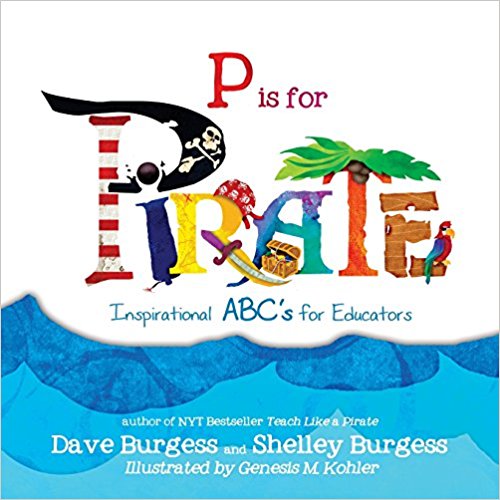
The third book in the Dave Burgess Consulting, Inc line up was written by the Pirate Captain AND his wife, Shelley!  This picture book may look like it is meant for children, but it’s not.  This inspirational alphabet book is written by the Captain and his First Mate for educators! Follow along with each letter of the alphabet as Dave and Shelley Burgess encourage educators to embrace the calling that is teaching in P is for Pirate.

pisforpirate

One of the treats within the pages of this short book is the Hidden Treasure!  Sure, the treasures lie within the words themselves – the inspiration the reader pulls from the text – but y’all, there is also real pirate treasure hidden in each page!  I love the idea of a treasure hunt in a pirate book!  How cool!

There are several names within the book that are recognizable to anyone who has followed the DBC line up!  It’s little things like that – seeing how far back the connections really go – that get me excited about reading these books in the order they were released.  How cool to see names pop up that are now soundly anchored to DBC! See what I did there?!  Anchor?! *Also, a little squeeee moment for me was seeing my friend Lisa Milstead‘s contribution in the second part of the book!  Within the second part of the book is also contributions from the Pirate Kids – Ashlyn and Hayden when they were 11 and 13, respectively.  Pretty awesome to see a family of Pirates come together in one book!

Even though this is the shortest book currently published by DBC, this book is FULL of quotes that should be put on posters and placed around every single workroom and teacher’s lounge!  Lucky for you… Shelley Burgess worked tirelessly to make this happen for us!  If you sign up for Dave’s email newsletter at the top of his webpage, you will receive these posters in a Google Drive folder!  Notable quotes from P is for Pirate and Teach Like A Pirate are connected to beautiful imagery to create printable posters!  Simply print the ones you want to a color printer and place inspiration everywhere you go!  Voila! a little Pirate makeover for your school!  Thanks, Shelley!

My biggest takeaway from this book originates in the letter “G”!  This is your GPS – “to get where you want to go, you need a precise destination,” says Shelley and Dave.  The challenge issued on this page made me stop in my tracks and carefully consider my answer.  It is written in Teach Like A Pirate, but really resonated with me from this third book.  Are you ready for the challenge?

If your students had to describe their experience in your class using only five words, what would you want those words to be?

Whew… that’s some heavy stuff for a picture book, right?! What words would you WANT students to use?  In reflecting on the space in which I’m the primary adult (I hesitate to call this my space because it really belongs to my students), I want the media center to embody these five words.  These five words are my GPS for the culture that has been created in that space, the experiences my students have every time they step into the doors whether it’s for media class or for a co-learning experience or for independent or small group work, and even the moments they step in just to say hello between classes (and sometimes during classes when they have confiscated the bathroom pass as an opportunity to pop in for a quick visit).  I hope my students would choose these five words, or something synonymous.  In fact… this would be a great reflection activity for my 7th and 8th graders at the beginning of the year, and my 6th graders at the end of the year (as they are learning the ropes, so to speak).  Hmmm… I’m looking forward to their answers in the Fall.  Perhaps I will remember to blog about them.

Anyhow, my five words are as follows (and in no particular order)…

  • welcoming
  • safe
  • exciting
  • memorable
  • uncommon

I want my students to always feel welcome in the media center.  It is their space.  I want them to own it and feel that they are always invited and welcomed with open arms, whether they come once a year, or once a day.

In the same vein, I want them to feel as though they are safe and accepted there.  I want them to feel physically safe, but also emotionally safe.  I want my students to feel as though they can share their soul without fear of judgment when they step into their media center.  If they have no where else to turn, I want them to know they can always come to me.  They never have to fight their middle school battles alone.  These battles are sometimes bigger than you or I could ever imagine and would break our hearts.

It is my desire that they feel their media center is exciting!  I want them to be pumped up when they see the note on their classroom door saying to report to the media center!  I want students running into the media center rather than running out.  I love when they come in asking with enthusiasm what we’ll be doing that day!

When students reflect on their middle school years, I want them to remember the experiences they had while in the media center.  I want them to have positive memories of literacy, technology, and the thought-provoking activities we did throughout the year.  I want the space and their experiences to be memorable!

Finally, my goal is to be uncommon!  I want students, teacher, parents, administration, and community members to know that something about this media center, these experiences, and this teacher is different from the ordinary.  I want them to wonder why I’m so enthusiastic about teaching students!  I want them to be curious about where I get ideas for experiences for my students.  I want them to see that I am willing to go the extra mile to make learning fun again.  I want to be uncommon!

What are your five words?  How do you want the experiences, the culture, the vibe you create to be described?  How do YOU want to be described?  If you aren’t living up to those five words every. single. day… you should be reflecting and revising.  Share your five words and any other reflections you may have from P is for Pirate using the Flipgrid co-piloted by Andrea Paulakovich (blog and Twitter) and myself (Great idea, Andrea! We are #BetterTogether!). You can access the Flipgrid here and use the passcode DBCSummer to share your five words for the GPS challenge!

Check out the video below from Dave where he issues the GPS challenge to you himself!  You may also use this link!

Book 4 is coming up next!  Prepare to read the first addition to the “___LAP” series!  While Dave taught us to Teach Like A Pirate, Paul Solarz brings us a different perspective in Learn Like A Pirate!  He changes up the acronym to meet the needs of the student, and I’m so excited to share this book with you as I finish up rereading book 4/50! The blog is coming to you very soon!

As an aside… DBC keeps releasing books as #DBC50Summer continues!  The 51st and 52nd book were released this week on Amazon!  I will continue to refer to this insane adventure as #DBC50Summer, even though Tara Martin (the creator of #BookSnaps) has released her book Be Real (#REALedu) and Mandy Ellis‘s book (the second of the LeadLAP guide books) Lead with Literacy has also been released! Wow, two books in ONE week; I’m going to need DBC to slow down just a tad so I can get caught up….. or not!  I can’t wait to read, reflect, implement, and blog about these two additions to the DBC line up!  I plan to continue these blogs no matter what the DBC number and regardless of the season!  I’m so excited that others have joined in the fun and are pushing themselves, committing to reading each of the DBC books and reflecting on them.  I certainly never expected anyone to really read these blogs, much less join in, and it’s so amazing to see others come on board! (Yep – Pirate Pun – boom!) Welcome, new friends!