#DBC50Summer 8/50: The Zen Teacher

So here’s the thing… I bought this book a couple weeks ago when I realized that #DBC50Summer was really going to be a “thing”.  I’m just going to say it. I’m going to get it out in the open. I was not excited. Period. I tried to be… really, I tried so hard!  I gave myself a big pep talk before I even opened it. I knew it was a DBC, Inc book, which meant it was going to have something in it for me… I knew that from reading Pure Genius and Learn Like A Pirate, which were other books that I didn’t think related to my current role in education but gave me so much inspiration. But y’all… I’m just not into this whole idea of chi, zen, yin and yang, feng shui, etc. I’ve got an insanely busy life and I don’t have time for “tranquility” – in fact, I kept thinking that the classroom is the last place I want tranquility – I want organized chaos in my room!  I thrive on that buzz of energy and if it’s not there, then I may as well not be there either.  I was likely the BIGGEST of the naysayers when it came to book eight; pretty sure I’ve rolled my eyes a time or two when asked about it.  All I could picture was super quiet students in rows asking questions of their guru, or what have you, in their mild mannered voices.

I didn’t even make it through the introduction without my highlighter making its presence known.  When Dan Tricarico says in the introduction, “As teachers, we are given an amazing opportunity to influence young people and profoundly affect how they see the world,” I was highlighting.  He continues on to say, “there is, perhaps, no career as fulfilling to the soul as education.” He goes on to discuss in the first chapter this idea of Zen. Taking his words and making them my own, to me Zen is that state where time feels as though it stands still and passes without our knowing at the same time.  I have felt that several times in my life!  When I’m captivated at a conference, when I’m emotionally moved by something I’m witnessing, or when I’m involved in an activity with others where I am so incredibly immersed that I can’t believe the time has passed so quickly. After getting through the introduction and the first chapter, I hung my head in shame at my closed-mindedness about this book.  You should to if you feel like The Zen Teacher, book eight in the DBC, Inc line up, is not for you.  Because it is.  It’s for ALL of us!

thezenteacher

Here’s the thing, my friends.  This book is about taking care of yourself.  Dave Burgess talks about the danger of never being “done” in his blog – the announcement of the release of this very book.  Because of this constant state of “what’s next,” we run the risk of burn out early in our careers.  Dan helps us combat this through taking the time to live in the present.  He helped me feel a sense of relaxation when he said that “we are not the Gatekeepers of Knowledge.”  I literally went into the margin of the book and wrote “I AM NOT THE GATEKEEPER OF KNOWLEDGE.”  It struck a chord with me when I read it.

I started this book late Thursday evening. Until this point, each of the DBC books have taken me a day or so to read, then another few hours to blog.  This one taking nearly 72 hours to read is not an indication of how boring it was… rather it shows how much it made me stop and THINK!  I did the Zen Assignments at the end of [most of] the chapters.  I can’t even begin to tell you how much more relaxed, focused, and thankful I feel after doing these basic activities.  Dan wants us to take care of ourselves first because until we have taken care of ourselves, we cannot do our jobs, our calling, to the best of our ability.  So I took his advice.  I slowed down.

Those who are closest to me know that I have been up after midnight writing most of the blog posts.  It is a JOY to write them!  I am awake until 2:30-3:00 either because I’m completing the readings and blogs or because I am too excited to sleep after completing them earlier in the night. I have been waking up at 6:30 to get ready for work as I’m an 11-month employee and work August 1 until June 30.  It is not something I’m complaining about, so please don’t consider that to be the case.  It is *SO* much fun to read these books and write my reflections and intentions immediately after finishing the book.  I have learned more about myself, how to be a better educator, and grown my PLN exponentially since I created this personal challenge of #DBC50Summer.  I have met incredible people through this adventure, and I do not intend to stop.  The Zen Teacher just slowed me down enough to think, wait a minute – you need to take care of yourself or you’ll never make it to number 48, 49, 50.  So I did.  I took the time to REALLY take in what Dan had to offer in his book.  We, as educators, must do a better job of this.  We must slow down, we must live in the present, we must find opportunities to show lovingkindness, gratitude, grace, and compassion, not only to our students and our coworkers, but also to ourselves.  If we don’t, we turn into that grumpy educator that everyone is waiting anxiously to hear of a retirement announcement.  I don’t want that to be me.  I never want anyone to say of me, “it’s time she finds something else,” or “we’ll just wait it out, she can’t possibly have that much longer.” (You’re nodding because you have heard it, or said it, about someone else… go ahead, admit it. It’s okay – it’s a safe space.)

I cannot possibly list all of the takeaways I had from this book.  There was something in every single section of every chapter that I highlighted. I immediately recommended this book to my mentor as it sounds like things he would tell me. I feel like Dan looked deep into my soul and said, “child… slow down and look around you.”  I have always been driven and determined.  When someone tells me I ‘can’t do something,’ it just pushes me harder to prove them wrong.  It’s one of my best AND worst attributes.  I was told that I wouldn’t graduate from high school by someone close to me because I was too boy-crazy (hello teenage hormones)… I not only graduated, but graduated 7th in my class.  I was told by university admissions that there was no way I could finish my bachelors degree in 3 years… I said in true southern form, “hey y’all, watch this” – started in August 2003 and walked across the stage at 20 years old in May 2006.  I was told I’d never be able to have children because of a deficiency in my blood which causes blood clots (discovered when I was 20 years old)… Bailey and Sophie (ages 9 and 5, respectively) have three angels watching over them, but I was able to carry 2 of my 5 children and successfully lived through two c-sections.  I was told I’d never be able to finish my masters degree in instructional technology with a toddler at home… I started in January 2011 and graduated with highest honors in May 2012. Glutten for punishment, I went back to receive a master of library science degree, getting my acceptance letter 3 days after I discovered we were expecting Sophie, our youngest. Not willing to turn it down, I finished my MLS in two years, graduating with highest honors in May 2014.  Doing what others say is impossible is kind of my thing, I guess.  It’s never easy, but I refuse to allow them to be “right”.

So… my biggest takeaways:

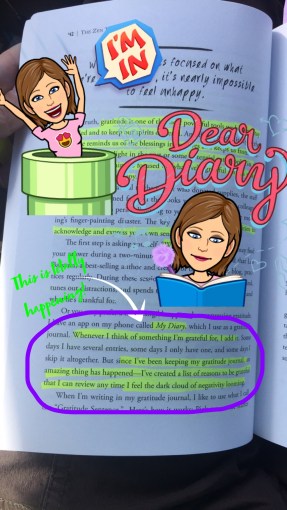
Gratitude Diary on my iPhone – I downloaded it immediately after reading about it and started writing what I was grateful for that very minute. IMG_8987Taking time to find what I enjoy… outside of work.  Most of my “zen” comes from reading professional development books, like the DBC, Inc books – or finding amazing resources for my teachers.  I love spending time on Twitter to connect with my PLN.  I realized that all the things I really enjoyed were still focused on my work life.  So I dug deep… and I came up with push-mowing my yard.  Yep… that’s my enjoyment, my “zen”.  There’s nothing as mindless and thoughtful all at the same time as mowing nearly 2 acres of land with a self-propelled push mower. I put Pentatonix Pandora radio on (which has obviously been set to my specifications), earbuds go in, grab the mower and go. Yesterday I took the day off from reading so I could catch up on sleep and then mowed the yard.
Finally, in 2018-2019, I will be saying “no”… a lot. I immediately backed out of two book studies that I was part of (ironic, right?!) after reading about self-care.  Last year, my calendar was full.  And I mean, FULL.  I had students in the media center every morning, then classes and/or meetings all day, and clubs/meetings every afternoon.  I realized that I have to schedule a planning period for myself.  I feel horrible telling teachers no, but I absolutely must have that time.  The media center became a mess, I was unorganized, and I was staying at work until 5:30-6:00 pm to get caught up on emails and preparing for the next day.  I cannot maintain that level of crazy next year, so I am going to schedule a planning period for myself every single day (with some flexibility for emergencies).  Even if it’s only 30 minutes, it has to happen next year.  For that to happen, I am going to have to say “no” to teachers and students.  Not because I don’t want to work with them, but because I owe it to them to give 100%, and I cannot do that if I’m not prepping for their lesson until the night before it’s delivered.

So… I have learned my lesson, DBC, Inc.  No more doubting…

This book opened my eyes, punched me in the gut, then hugged me and held me close.

Dan Tricarico is certainly a mentor I’d want to have on my side.  This book was written for everyone – every single educator out there… from first year teachers to 35th year, you will get something tremendous if you’ll take the time to be openminded and open this book.  I was hooked from the introduction.  For more information on The Zen Teacher, you can follow Dan at @thezenteacher or the hashtag (I love that the DBC, Inc books are so community-oriented) #ZenTeacher.  I suggest checking out Dan’s website as well!  Share your thoughts on the Flipgrid (Andrea really rocked this whole Flipgrid idea!) using the passcode DBCSummer!  We’d love your thoughts, and to have this as a safe space for teachers throughout the world to share their greatest take-aways, quotes, and inspiration from each DBC, Inc book throughout the summer!

Book nine is coming next!  I know several have been waiting for this one!  Luckily, I got to read it a couple years ago as a book study in the North Carolina Digital Leaders Coaching Network and I am so excited to reread it for #DBC50Summer.  We’re almost one-fifth of the way through the first 50 DBC, Inc books! Many have said there’s no way I can possibly read all of these, blog, and implement the ideas from every single book next year…. did you read what I said earlier?  Watch me. I can do this. For me, for my students, and for my teachers and admin.  Check back soon for Book 9 of 50 – Innovator’s Mindset by George Couros!

#DBC50Summer 7/50: Master the Media

I went into this book through the lens of a teacher, and came out on the other end thinking like a parent.  There are many ways that book seven is different from any other Dave Burgess Consulting, Inc book I’ve ever read.  Master the Media by Julie Smith is a powerful message to teachers and parents alike that our children are inundated with various media and they don’t know what to do with it.  Until we show them how to handle the masses of media thrown their way, they will accept it all as truth.

masterthemedia

This is not your typical educational book.  In truth, it’s even atypical in the line of DBC books.  Other books I have read have the purpose of inspiring, empowering, or even giving lesson ideas.  This book does those things as well to varying degrees, but two things really stood out to me that make Master the Media stand out.

  1. This is informative!!!  There are so many facts and figures within this book!  The statistics will change as time moves on, but in true DBC forethought, the QR codes are dynamic and can be changed for updated links.  I would love to create one large infographic with the content from this book!  Julie did an amazing job collecting the statistics and compiling them in an easy to understand manner.  One thing I LOVE about this book is that it’s informative without reading like a textbook!  Julie puts her own voice, her own personality (which I adore), in the story; that makes the story come alive and not feel bland and impersonal like a textbook.  Her wit is fabulous; I can imagine that in real life, she is quick to throw out clever puns and dry humor.  She and I would quickly become best friends!
  2. The book creates an authentic call for action and a sense of urgency.  Julie speaks to the fact that we must educate our children about media literacy, both at home and at school, throughout the book.  She shares many examples of ways that media exists to deliver buyers to advertisers.  The media are not the enemy and are not to be feared, but we MUST be aware and critical of everything we see around us all the time.  Otherwise, we will be led as sheep.  Julie encourages critical thinking and making informed decisions, not taking the devices away.  Which leads me to a good old fashioned soap box…

I’m learning that I am a minimalist.  If we don’t need it, get rid of it. (My husband and daughters joke that if something goes missing in the house it’s because Mommy threw it away… what’s funny is that they are usually right!)  I mentioned in an earlier blog that I am a completionist (which means I must have all the things in a set).  This must not be confused with a hoarder.  A hoarder I am not, let me just tell you.  If it doesn’t serve a purpose, it usually finds its way to the Goodwill or the trash.  This transfers to the classroom, too.  Upon starting the pilot position of Lead Digital Learning & Media Innovation Facilitator at my school, I found several older Flip cameras, digital cameras, and camcorders while cleaning out.  I held on to a few to appease the masses, but the majority of them went to the technology warehouse in our district last year.  This year, I happily finished the purge of these digital items.  I was questioned, “Why would you want to get rid of this stuff?  I can take it to my classroom if you don’t want it.”  Oooooh, no you don’t!  Welcome to the year 2018… do you see that device you are carrying in your back pocket?  It does more than these three overpriced pieces of technology combined.  These tools are now obsolete because the smart phone has replaced them

Do NOT take the device away at school!  I get so aggravated when I see calculator caddies with cell phones in them during class time.  Or a Rubbermaid tub on the front desk collecting cell phones as students walk in.  I want to scream, “Are you serious right now?”  How about at the next faculty meeting, we collect your phone as you walk in the door?  No?!  So why do we take it away from students?

Technology isn’t going away.  The media aren’t going away.  If anything, it’s growing exponentially and our dependence on digital tools continues to skyrocket.  How about we teach students how to use it responsibly in a controlled environment rather than removing it from their hands?

How about we show them how technology can propel their learning forward, and how it can save them so much time, simplifying their lives by making it more efficient?  Let’s show them that a phone can be MORE THAN social media and texting, MORE THAN entertainment.  Let’s show them how to create something meaningful and share it with the world!  Let’s show them how to take pictures of important information (even create #BookSnaps) rather than spending 15 minutes writing it in notebooks; this allows you get to the good stuff already, which is what the kids want!  Trust me, they are not engaged in learning while writing your notes… they are compliant, and some of them aren’t even that.  Can you imagine throwing the science notes on the board saying, “Hey kids – take a quick picture and email to someone who didn’t bring their phone today… Okay, done?  Great – let’s get to our experiment!”  Boom! You just saved yourself time and kept your kids from being bored and disengaged from the very beginning.

…Annnnnd stepping down from soap box (hopefully to applause and cheers)!

The middle school where I work is 1:1 with Chromebooks, as well as Bring Your Own Device (BYOD).  Almost every student in the school elects to borrow a Chromebook for the year from the district paying a small usage fee.  A handful of students choose to bring their own Chromebook to school.  A vast majority of our 7th and 8th grade students have a cell phone at school, and about 2/5 to 1/2 of our 6th grade students carry a cell phone.  There are times in class when a cell phone is more appropriate to use than a Chromebook.  Students can take pictures, video, and scan QR codes or augmented reality much faster and enjoy better quality with a cell phone than with their Chromebook.  It is my job, and the job of any other person in the building that is breathing, to encourage students to engage in media literacy. I spent a media class last year teaching students how to use their cell phone for “instructional use”.  We spent another media class last year discussing digital footprint and every time we use Minecraft to complete a standard in a subject area, we discuss digital citizenship in that space.  Students are shocked when they come to their monthly media class and the TV says to have their library books, Chromebook, cell phone, and a pencil with them.  Without fail a student in every class asks, “Wait!  Are you serious?  We need our cell phone?”

I agree with Julie that we must discuss all forms of media, which includes print resources such as magazines and books.  We must model to students being critical of everything they see, from advertisements to television to music and film to the news.  In her book, Julie references many questions to ask of our children.  What I love the most is that she has questions to ask at home and questions to ask at school!  So whether you are a parent or an educator, this book will help you take the first steps to understanding and promoting media literacy with your children.  I referenced at the beginning of the blog post that I started reading this book through the lens of a teacher.  I was thinking critically of the lessons I have taught, and the lessons that my students asked for on a survey at the end of the year about what they want to learn.  By the end of the book, I was thinking more like the mother of two girls, ages nine and five.  I was thinking that if we don’t team up with Julie and encourage our children to question what is being thrust at them within media, we are ultimately doing them a disservice.

So how will I implement something from this book?  Well, I’m going to be honest – I’m cheating a bit here.  I plan to have that infographic I mentioned before created, but it will be the students creating it, not me.  I can devote 10 minutes of each media class to facilitating a student discussion about each chapter (Television, Music/Radio, Film, News, Books/Magazines, Advertisements, Internet, Political Media).   Students can create a section of an ongoing infographic with facts from the book each month, reviewing what has already been done.  Then for the remainder of that month, they will be tasked with paying closer attention to the medium of the month and sharing on Flipgrid (an asynchronous video recording website) something they observed within that space during the month.

Julie wrote this book based on her classes where she instructs college students.  Her book is intended for both parents and educators specifically, but I believe that as living, breathing, interacting-with-society humans we should be reading Julie Smith’s Master the Media & begin to be critical of media around us.  Pick up your copy here.  Post your reflections, thoughts, resources, etc. here at our Flipgrid!  (Passcode is DBCSummer) Thank you Andrea Paulakovich for introducing the idea of using Flipgrid to create one world-wide book study!

Podcast: The Principal Center with Julie Smith

What Does Dave Burgess Have To Say?

Julie Smith website

National Association for Media Literacy Education Twitter


Are you ready for book eight?  I can’t believe we’re already on number eight and we just kicked this #DBC50Summer thing off a couple weeks ago!  Book eight focuses on YOU!  Are you taking care of yourself?  Are you working too hard?  We can’t be on our A-Game for our students unless we engage in self-care!  Dan Tricarico shows us how to create focus, simplicity, and tranquility in the classroom in The Zen Teacher!  Grab your copy and prepare to get your Zen on!  So excited to read & blog about book eight!

#DBC50Summer 6/50: 50 Things You Can Do With Google Classroom

This. Book. Is. Gorgeous.  There… I said it.  It’s the first thing I thought when I picked it up!  The weight has been lifted from my shoulders.  This sixth book in the Dave Burgess Consulting, Inc line up is very different than the first five. It’s different in that it is basically a “how-to” book, a resource book for Google Classroom.  The book was just updated a third time in April 2018 (with 10 bonus tips – woo hoo!), and is currently #6 in Computers & Technology on Amazon.  You don’t get that kind of longevity from a book because it’s “gorgeous”.  The full-color pages do make for eye-catching graphics (truly, it is a beautiful book), but it’s the content that keeps readers coming back over and over again!  Alice Keeler and Libbi Miller, Ed.D. walk us through setting up Google Classroom and give practical advice and tips for using Google Classroom in their book 50 Things You Can Do with Google Classroom!

50Things

Google Classroom was launched in 2014 after months of beta testing in classrooms.  If you currently use Google Classroom, it’s likely obvious to you that they have teamed up with educators in the field and respond to feedback related to their product.  They continue to improve the functionality of Google Classroom, updating and tweaking their already impressive online platform. Alice & Libbi used Google Classroom and Google Apps for Education (GAfE) with students and adult learners at the university level.

If you are familiar with the GAfE platform, you can skip right to the good stuff!  If not, no worries! Alice & Libbi have you taken care of with a quick overview of Drive as well as a Getting Started section complete with a quick tour in teacher view and in student view!  Yep – they thought of everything!  Here are a few examples of things you can do with Google Classroom, as indicated by the authors!

  1. Make Class Announcements – Transform one-way communication into two-way communication!
  2. Go Paperless – Use the awesome ideas in DITCH That Textbook paired with Google Classroom to assign and collect classwork from students across all of GAfE (Slides, Sheets, Docs, Drawings, etc)
  3. Organize Assignments with Due Dates – You have the power to indicate a due date for each assignment. These assignments will clearly display the due date within the stream of the student’s view, as well as the tile of the class in the Home page! *This also integrates with Google Calendar if you have it set up!*
  4. Email Students – With a click of a button, you can email all students in your class, or only a few select students.  Perhaps you have a group that hasn’t completed an assignment.  Simply click the assignment, the checkbox beside their name, and choose to email those who aren’t finished all at once with a friendly reminder!
  5. Student Projects – When students turn in work, they can submit multiple artifacts at once.  This makes the feedback process much easier for the teacher as it keeps it together in one place!

There are so many more tips within the book, so you’ll want to grab your own copy!  In my opinion, the single greatest thing about Google Classroom is the ability to create an assignment that automatically generates a copy for every student in your class!  BONUS: It even puts their name in the title for you! (No more trying to figure out which handwriting belongs to which student! No more bulletin board for “NO NAME’s” work! No more waiting to grade the one without a name until the end so you can use process of elimination to determine which student forgot their name!)

This incredibly practical book, complete with screenshots and step-by-step directions, is a must have if you are using Google Classroom!  If you aren’t using Google Classroom yet, you will definitely want to click to BUY IT NOW!  You’re going to want to remember the name of the authors!  Alice Keeler shows up several times in the DBC, Inc line-up and everything she writes is practical and made of solid gold for teachers!  I was fortunate enough to meet her before #iste18 for breakfast and I immediately understood why she appears as a DBC author multiple times!  She is a pirate educator through and through!  She has a passion for the profession of educators.  Within just a few minutes, I was drawn in to everything she had to say.  She had me hooked (It’s been a minute since I used a Pirate Pun… couldn’t pass that one up!) and wanting to jump onboard with her; I had no idea where we were going, but I wanted in!  Her enthusiasm is contagious.

IMG_8808

Amazing Educators – @lucasgillispie, @peggysheehy, @iluveducating, @mpilakow, @bronst, Amy Baskin, @alicekeeler, @tilleymartin, @mr_isaacs

In this post, she announced that this book was available and gives an outline of the 50 Things! You can follow along with the hashtag on Twitter for more #googleclassroom.

SPOILER ALERT: My big takeaway from this book is the integration of GAfE and Google Classroom.  Many in my school are already using Google Classroom and love it! I plan to focus on making teachers’ jobs more efficient by sharing select tips from this book (and, ah-hem, future Google books by Alice Keeler for DBC, Inc) at faculty meetings or via a weekly screencast. It’s time to update the spreadsheet.

The next resource I will give you will change your life.  Honestly.  You will either 1) love me forever, or 2) dream up CSI-esque scenarios where I disappear.  (Please let it be #1, please let it be #1!) This resource is not to be taken lightly.  Do not open the link until you have a couple of hours to spare because it is seriously a rabbit hole of awesome-sauce that you will venture down.  Trust me. I’ve spent hours in this space, clicking links and trying things out… and I made the mistake of returning to it tonight.  I should have published this post about 2 hours ago. Instead, I’ve been playing in Alice’s world of Teacher Tech. I just came up for air and refuse to go back tonight. If you think I’m exaggerating, try clicking the links below at your own risk.

But before you go (because you won’t be back, let’s be real right now), here is the link to the Flipgrid if you’d like to share your own reflections of 50 Things You Can Do with Google Classroom.  Passcode is DBCSummer – be sure to follow our friend Andrea Paulakovich’s journey as well.  The addition of flipgrid was her amazing idea! Finally, Book 7 is one that I’ve been so super pumped about reading and reflecting on for #DBC50Summer! As a media coordinator, I believe teaching Media Literacy is of utmost importance for our students’ future! Author Julie Smith is the Media Literacy guru and she proves it in her book Master the Media! Blog post will be coming in the next couple of days. I expect the soap box will be brought out and stood on… just sayin’!***

Now… you may continue.  May the Force be with you… May the odds be ever in your favor… Let someone know where you are before you click anything below this paragraph. Seriously… they need to make sure you come up for air! It’s incredible!

The website for the book can be found here.  You will find all the awesome of Teacher Tech with Alice Keeler here.  To view Alice’s Add-Ons & Scripts, click here.  Alice’s templates are here.  Finally (but I’d bet you don’t even make it this far because you’ve already taken the red pill from the Matrix and stayed in Wonderland) ed-tech tools… LOTS of ed-tech tools are here.

.

.

.

.

.

.

.

.

***Are you okay? Did you make it out? Isn’t it wonderful? See you next time!***