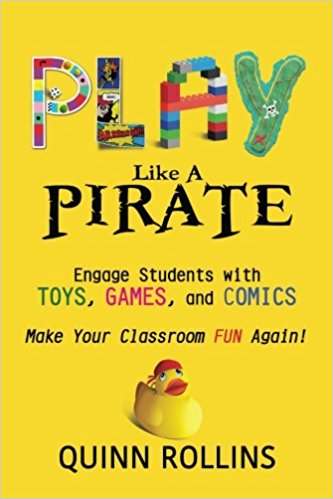
#DBC50Summer 13/50: Play Like A Pirate

Book 13… lucky #13!  The school year in which I implement all of the ideas from the #DBC50Summer is coming up fast.  It is my 13th year in education… lucky #13. This is going to be a fantastic year; I can feel it.  Big things are going to happen, and I’m so excited to experience it!  Last night, as I finished up the blog on Book 12, How Much Water Do We Have, I noted that I was thrilled to be moving into the next book.

However, nothing could have prepared me for opening that book up again!  Typically my DBC books have been purchased from Amazon and I can tell when I bought the book by the purchase date at the top of each book’s page.  I realized that there was no purchase date for our 13th book, Play Like A Pirate by Quinn Rollins.  I knew I had the book; I remembered reading it very clearly because I was never into GI Joe, Transformers, but I do (errrr… did) enjoy playing with Barbies and Lego!  I immediately went to my DBC shelf (yes, that’s a thing at my house).  It’s behind glass in the TV console, not even kidding.  I was thinking that I’m going to have to pay extra to have it shipped in one day rather than 2-Day Prime because I am not letting anything slow me down on #DBC50Summer right now.  Sure enough, there it was – bright yellow and beautiful!  I couldn’t remember if I had highlighted in it, and upon opening it, realized I had not.  I also noticed that the spine of the book looked like it was coming apart.  Moving the first page to lay it down and see if I could repair it (I am a librarian and have book tape for DAYS), I found Pirate Treasure!  Inside the front cover of the book… Written in black ink was the words, “Enjoy #PlayLAP, Dave Burgess”!  It REALLY is Lucky #13!  I couldn’t believe it.  I must have won that book at an edcamp a few years ago!!! That would explain why I had no Amazon purchase date, AND why Dave would have even written in the book.  That was an amazing, LUCKY little discovery last night!
playlap

Within this book, Quinn talks about his own passions of toys, games, and comics.  He discusses ways that educators can use them in the classroom to make learning fun again.  I, too, enjoy toys, games, and comics, so I was enthralled by every word (I used a yellow highlighter for this book, in case anyone is wondering; it felt appropriate).  Here’s the thing though… I could go into some specific examples and link to templates that Quinn references in this book.  I could talk about what I have used in the past to make learning fun for my students.  However, Quinn reminds us that it’s not about incorporating THESE exact ideas into our classroom; it’s about incorporating MY (and YOUR) passions in the classroom.  As I noted in The Zen Teacher blog, I am consumed by work.  It doesn’t feel like work to me, and I enjoy learning new things and creating new lesson ideas.  I also enjoy inspirational quotes (usually related to education, perseverance, etc).

But passions outside of education??? Do I have any of those? Heck, do I even have ONE of those?  In The Zen Teacher blog, my way of “relaxing” was push-mowing the yard… really?  Who does that?

So while there are a bazillion ideas that I can take away from Play Like A Pirate, written in black and white on Quinn’s pages, that’s not what I am moving into the 2018-2019 school year implementing.  Every single idea in the book is something I can see myself doing, and something my students would love, and I will definitely share them with teachers in my school and beyond.  I especially love the trading cards activities and creating Barbies for different eras in history with their Barbie set!  I enjoy a good Lego lesson like the best of ’em!

Before I tell you what my idea for implementing will be, let me share a short story with you.  Like Quinn says on one of the last pages, storytelling is something that educators should be masters at doing.  I am CONSTANTLY teaching through story.  So let me tell you one real fast.  And it’s a true story (which you know are always more interesting, right?)…

As a young girl, I remember Grandma (that was my mom’s mom – she passed away in March 2017) collecting porcelain dolls.  I remember them always being behind glass display cases tucked in corners around the house, except for a few she had displayed on shelves in her room.  When I say shelves, I mean, the individual shelves attached to the wall… and there were a TON of them!  I remember a room that was closed off to me as a kid that held many, many, many more porcelain dolls, still cozy in their original boxes.  Near the dolls in the living room and Grandma’s bedroom, there were pictures mounted in frames with pictures attached at each corner on nearly every square foot of every wall in the house.  See Grandpa and Grandma had 11 children… eleven (some from a previous marriage).  Grandma wanted to be sure that every one of her children and their families were represented.  The tree gets enormous super fast!  It was a true farming family of the south… at the time of her death at age 87, Grandma has 31 grandchildren (I am one of the oldest of the youngest; Mom is number 10 of 11, and Grandma’s youngest daughter – there are generations of us that don’t know one another because the family is so varied in age).  Grandma had 35 great-grandchildren and SIX great-great-grandchildren.  This is important to the story, because of all of those members of the family, before Grandma passed, she wanted me to have one of her porcelain dolls, and it was my choice which one I received.  It was the kindest gesture Grandma could have made and it should have made my eyes well up with tears.  I should have beamed with pride that I was getting one of her precious dolls.  However… I was never allowed to play with those dolls. They were always “off-limits,” so selecting a doll somehow felt… wrong. I eventually chose a doll because it meant so much to Grandma, and was told to choose one for each of my daughters.  I did.  It made Grandma so happy to see her dolls go home with me.  She just knew the dolls, her passions, would continue on, as a way to remember her.  The sad reality is, they are put up in our storage building at the back of our land wrapped up in newspaper and probably won’t be taken out again until my daughters are sorting through my things after I have passed (hopefully many MANY moons from now, ha).

Moral of the story: without being able to play with ‘the thing’, without being able to get our hands on whatever ‘the thing’ is, ‘the thing’ has no real meaning.  Don’t you think it’s the same way for our students?  Quinn creating these hands-on opportunities, which you’ll notice most of which are analog, allows students to get their HANDS ON the thing you’re trying to teach.  Without that experience, your content has no real meaning.  It’s just another ‘thing’ filed away with other useless stuff that you keep collecting and can’t seem to get rid of.

I tell that story because I want to know what my passions are.  Grandma knew her passions.  She may have kept them locked away and out of reach, but at least she had a passion.  I could look around and see it, but I wasn’t allowed to touch it.  My goal in 2018-2019 is to really discover what it is that I’m passionate about.  I was talking to a DBC author friend through DM the other night and I had a realization that I get excited about MANY things in education.  I can talk to educators knowledgeably about nearly ANY educational topic.  I am a educational Jack (ummm, Jill?) of All Trades…but what am I PASSIONATE about?

I like working with other teachers to create lessons in Minecraft… but I don’t know that I’m PASSIONATE about it!  I enjoy leading students through virtual reality experiences, but after nearly two years of high-end virtual reality, I can’t say that it’s a PASSION of mine.  I used to really get into coding and how to implement it in the classroom, but now that has fallen by the wayside. It’s cool & definitely a literacy our students need to know! Don’t get me wrong about that.  But I’m just not passionate about it!  I get incredibly “excited” about new trends in education, a new tech tool, a creative way to use an old tool, helping teachers integrate the tool for the first time (teachers also have the same lightbulb moments that our students do – as I coach I get to see that… the A-HA moment; it’s pretty cool), but after a few months, I’m ready for the “next big thing” and I want to move on.  I could almost say that lifelong learning, continual improvement, and growth mindset are passions, but they are becoming buzzwords – which kills any passion I have about them.

So… what is my passion?  What will sustain me for the next 17 years of education?  Next year will be tremendous.  Next year, I have my “next big thing” – it’s implementing #DBC50Summer… but what will be my passion in Year 14 and beyond?  I joke about how “when I grow up, I want to (insert person to be like or insert job to have)”.  I am coming close to the halfway point of my educational career. What will sustain my enthusiasm?  What passions will drive my instruction?  Going back to Grandma…

What passion will I be able to share with my students that will be meaningful to them because I’ve shared it with them?

That is my implementation for Play Like A Pirate. Quinn shares three passions on the cover of his book (toys, games, and comics).  Surely I can figure out three passions that I have? When I have them figured out – I will let you know! Stay Tuned for that information.  In the meantime, what are your passions?  What is it that you want to, or have implemented, in your classroom or school that brings learning to life and makes it fun for your learners?  Share with Andrea Paulakovich and I on our Flipgrid.  The purpose of the Flipgrid is to create a space for a global book study of each of the Dave Burgess Consulting, Inc books – both the 50 that were out when #DBC50Summer began in June, and all of the subsequent ones!  DBC isn’t stopping, so neither are we! (Shoutout to Andrea for the incredible Flipgrid idea – follow her journey through #DBC50Summer here!) . As always, the Flipgrid password is DBCSummer.

Play Like A Pirate, as most DBC books do, has a following on Twitter – use the hashtag #PlayLAP to unlock the resources within that community.  You may also find Quinn’s website and blog posts here. You will notice along the side of the page, the templates that Quinn references throughout this book.  If you’re interested in where Rubber Duckie is traveling, check out his facebook page here!  Join The Principal Center podcast as they discuss #PlayLAP with Quinn!

Book 14 is one of my favorites, which I’ve got to tell you, is kind of odd.  I don’t typically pick favorites from within the DBC collection (unless it’s #TLAP because hello, it was first; Dave Burgess stepped out on a REALLY shaky limb to get that one to us, and thankfully the limb didn’t break – instead it bore fruit… wow, it’s getting deep in here, and insanely late for me).  However, 140 Twitter Tips for Educators by Brad Currie, Billy Krakower, and Scott Rocco is one of my favorites!  Come back for #DBC50Summer 14/50 to find out why!
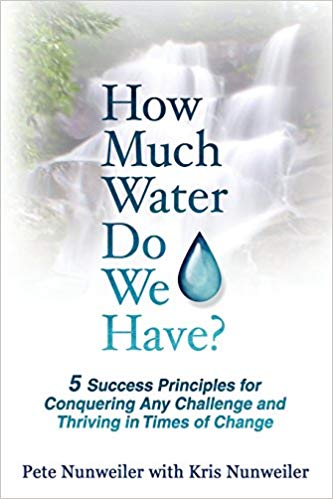
#DBC50Summer 12/50: How Much Water Do We Have?

Up to this point, all 11 books I have read as part of #DBC50Summer have been based on educational theory, practices, and/or pedagogy.  All of them have inspired/motivated me in some way, taught me something new, and/or repurposed something I already did.

Book 12 is very different from the traditional Dave Burgess Consulting, Inc book.  The book is still very conversational, and I still received a great deal of information while reading.  This book is not an “educational” book in the sense of professional development.  In my opinion, How Much Water Do We Have? by Pete Nunweiler with contributions from his wife, Kris Nunweiler is a personal development book with themes that apply in every facet of life, including education.

howmuchwater

Throughout this very short book (only 85 pages), Pete shares 5 principles that will help us figure out the answer to success.  The first 1/3 of the book is a narration of a spontaneous trip to Ramsay Cascade that Pete and his wife, Kris, took together while on an anniversary trip.  Then, Pete shares his 5 principles of creating success (one principle per chapter) and relates it back to the story of the 8 mile roundtrip hike to the waterfall, as well as in the real world.

Even though this book is not your “typical” DBC book, it is still full of great information and is very well-written.  The title of the book was so confusing to me, but once I read the first bit of the introduction, I could see the metaphor that Pete was trying to accomplish.  He explicitly states the metaphor later in the book, as written below.

“Water is a metaphor for all the things that an individual or an organization needs when faced with some type of change or new initiative…Just like water is essential for your physical wellness, information, planning, motivation, support, and leadership are required to ensure that any initiative is successful.” ~Pete Nunweiler

The 5 Waters, as Pete describes them, are

  • Information – Ask the right questions. Get accurate answers from the best sources.  Share that information with the right people at the right time. (Who, What, Where, When, and Why – Ask WHY repeatedly! Know your why!)
  • Planning –  If you fail to plan, plan to fail. (Who, What, Where, When, and Why to create the plan, and HOW to formulate the plan)
  • Motivation – We all do things for our own reasons.  Find out the right reasons for those you lead.  There are no “bad reasons”, but there are “wrong reasons”.  Motivation drives our actions.
  • Support – Encourage others and develop an understanding of how others feel.  Everyone is responsible for recognizing and offering support!
  • Leadership – Are you a manager or a leader?

There were multiple tweet-able quotes within these pages, and after reading each one, I would prepare to tweet it, then stop every time!  Why?  No one would have understood it without the metaphor and the nearly 30 page story of the trip to the waterfall.  So while several quotes were impactful to me, such as “bring a pair of dry socks”, it may not mean anything to the Twitter-verse without reading this book.

The biggest takeaway I got from this book comes from the Leadership section.  Within this chapter, Pete talks about the difference between being a manager and being a leader.  He discusses that “leaders don’t always hold titles and those with titles aren’t always leaders.”  That’s a “preach it” moment if I’ve ever heard one.  Even though the book isn’t “educational,” this idea applies to all avenues of life.  I have worked FOR principals and I have worked WITH principals.  It is a substantial difference in culture with just the change of one word.  Pete gives us two questions to consider… “Who do you receive direction from?” and “Who makes you truly want to come to work every day?”  The answer to the first typically has a title, but the answer for the second is the real leader.  For me… the real leaders are my students.  Let that sink in for a minute. That’s some deep stuff to get from a “non-educational” book, right?

Pete says the following things about leaders and leadership.  Pete’s words are perfect as is, so no paraphrasing here. Not Today! (You just said that in Michelle Dobyne’s voice, didn’t you? HAHA)

“Having a title is not leadership.  Managing or supervising are not the same as leaders, not does providing direction equate to leadership.”

“Leadership is a character trait, which is why the greatest strategy an organization can implement is to promote proven leaders into titled positions…When people with positive leadership characteristics are given positional roles, they can accomplish great things.”

“Businesses are managed; people are led.”

Finally, when I wear the hat of instructional coach, I frequently hear teachers say, “But I’m just a teacher. I’m not a leader; I’m not the principal. I can’t <insert thing here>.” This comes up when we discuss shifting the school culture, mentoring other teachers, sharing at staff meetings or district level workshops, etc.  Do you really want to know who your leaders are?  If you’re actually a leader?  Pete gives us four questions to identify who the leaders are in an organization.

Who do others go to… for information? To hear a plan? For a voice of reason to help them through the day? When they need support?

Identify who these people are in your school.  Those. Are. Your. Leaders.  Is it you?  It very likely is!  You are a teacher leader.  You’re not “just” a teacher! Give yourself credit for being the leader that you are!

So my intentional action from the 12th book…figure out how much water we have. When a new initiative is coming, it has a higher likelihood of success if the entire staff has these five basic principles covered.  Without even one of these 5 Waters, the initiative could quickly fail.  Make sure everyone has enough water!

As this isn’t really an “educational” book, there isn’t quite the Twitter community surrounding this book.  You can find older tweets through the hashtag #5Waters.  Pete has published two other books, and you can find his website here.  His photography is stunning and can be seen here.  As always, the Flipgrid is open for responses with password DBCSummer.  Because the book is a bit different, the prompt is a bit different.  Check it out and respond!  I think you’ll find it helpful! (Thank you, Andrea, for the incredible idea of a global book study and the think tank that utilizing Flipgrid provides us! Go follow her #DBC50Summer journey, too!)

This short read was exactly what I needed at this point in #DBC50Summer.  It’s funny because as you read, Pete asks you to identify a current challenge you are working through, that you want to be successful in implementing.  The entire time I read, my challenge was completing this challenge.  So now, I’m ready to push forward and hop into Lucky #13!!!!  Are you ready to Play Like A Pirate?!  I read this book a couple years ago, and cannot wait to reread it and share with you! GI Joe, Barbie, Trading Cards, and Lego bricks are coming your way very soon!


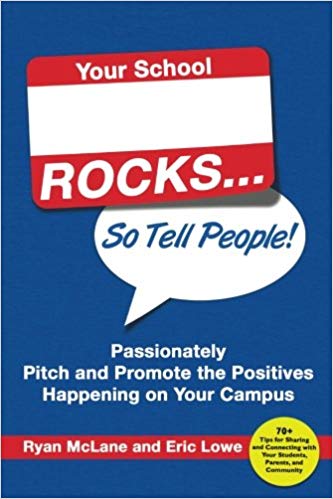
#DBC50Summer 11/50: Your School Rocks

I was told several years ago, “If you don’t tell your story, someone else will.”  This has resonated with me since then.  If there is nothing else you get from this post, remember that one thing.  It is so important for us to tell the real story about what’s going on in education, specifically public education.  In North Carolina (and around the country), public education is under attack, and it is our job to fight back with positive stories about all of the awesome that happens in our buildings every single day.

Book 11 in the Dave Burgess Consulting, Inc line up tells you exactly how to go about telling that story!  Your School Rocks by Ryan McLane and Eric Lowe shares stories of two principals in Ohio and how they use social media to tell their school story, thus building culture within the building and rapport with the community.

yourschoolrocks

This book was released at a time when schools were just beginning to tap into the power of social media.  My district office had just required Facebook pages of each school in our system about 6 months before this book was published.  I remember going to my principal when I started my first position in a media center and begging to start a Facebook page for our school.  At the time, there was so much red tape around it that we ultimately decided to wait.  By the time summer rolled around (about 6 months after I began that position), it was deemed a requirement.  And kudos to our central office, Superintendent, and Board of Education for seeing that this would positively impact our school system.  When school started back, I became the Facebook & Twitter administrator for our school, as well as the Public Information Officer (PIO) in which I wrote articles for our local newspaper and invited the press to big events in our school.

Here’s a few somethings I found out while doing those three roles:

  1. I needed to relax. I was so worried that a negative post would come up and I wouldn’t be able to respond before the firestorm happened that I checked our Facebook and Twitter pages every 30 minutes or so.  It was the last thing I checked before bed and the first thing I checked in the morning.  However, no negative posts ever came. Ever.  As Ryan & Eric say, “Since we kept our posts positive, parents tend to be positive as well.”  This was 100% truth in my experience.
  2. Know your DNR students.  As you know, a DNR typically refers to “Do Not Resuscitate” which gets people’s attention really fast!  However, for us, it meant “Do Not Release”.  Like Ryan and Eric, we respected the wishes of any parent/guardian who did not want their child’s photo or name released on social media.  It was incredibly important that the child’s teacher, special area teachers, principal, assistant principal, and myself knew to keep that student out of the frame when taking pictures!  So, our version of a DNR got our attention really quickly, too! If you are the one posting photos to the school’s social media accounts, you must be DILIGENT about checking, double checking, and triple checking that these students are not posted.  We only had 6 when I was at that school, so it was easy to remember their faces and names.
  3. Parents REALLY respond to social media.  I was constantly blown away by the responses we would get on social media and how immediate those responses would be!  For example, I would record short videos of students practicing for their Parent-Teacher Association (PTA) performance and parents would oooh and aaah over the videos, liking, sharing, and commenting within minutes of the post being published!  More families typically attended those PTA performances where I would post those short videos of them practicing because they could see the hard work their child put in to perfecting the songs. Parents would ask questions about schedule changes and awards information on Facebook as well, and we would post a weekly update in a visual format every Sunday with key information for the week.
  4. Notice that I refer to Facebook and not Twitter.  Our parents were not really on Twitter at the time.  The space they frequented was Facebook, so that’s where I spent the majority of my time sharing school information.  To make sure that our Twitter was not inactive, I linked the Twitter account to the Facebook account.  Every time I would post on Facebook, Twitter would automatically generate a post for me and update on Twitter with a link to the Facebook post.  It wasn’t perfect, but it worked and saved me a ton of time!  I would suggest linking accounts when possible.  Instagram has taken off in popularity so much that, like Ryan and Eric mention, I would ask students where they (and their parents) hang out on social media.  I would imagine more students are on Instagram now than Facebook, to be honest; parents are likely still using Facebook!
  5. Once I started using the school’s social media outlets, there was no longer a need to write newspaper articles or beg the press to come to an event.  Parents would get more information from social media than they would have from the newspaper anyway.  If I was sharing information about an exciting event coming up, the press would contact us, and be more likely to show up on their own and write the article themselves (win-win).

In my current position, I am not in charge of our school’s social media, but I still post pictures on my personal Twitter account frequently!  I make sure to take into consideration students that cannot be photographed and respect the wishes of that family.  I tag our school’s Twitter account and use the district hashtag to promote the images beyond our school.  It also makes the Twitter administrator’s job a bit easier because they only have to retweet from the school’s official Twitter account!

Ryan and Eric reference several times using social media on an eighth grade Washington, DC trip and how a hashtag allowed parents to follow along with their children while they were on the trip.  I used my personal account, and encouraged the other chaperones to use theirs, to tweet pictures about our eighth grade trip to Williamsburg, VA.  Students jumped on board and we had the BEST time tweeting!  I had students let their parents know to follow the hashtag and it really eased many of the parental concerns about sending their child off for their first overnight school trip.  You can still see the posts by searching for #mmms8thgradetrip on Twitter.  I love the idea of pulling together all of the images for a Flipboard or another aggregation tool as suggested in the book!

Currently in my district, we are not allowed to “friend” or “follow” students on social media.  This can make using a hashtag a “gray” area, as this puts interactions in a public forum outside of school and searchable by anyone, but is not sanctioned by the school.  (Note: I have seen many elementary schools create Twitter walls in their classroom where students can write on a sentence strip what they would tweet on social media.  I thought that was a clever way to still encourage connection and collaboration, as well as cyber safety and digital footprint, while still maintaining social media rules for students under the age of 13.)  I need to further investigate the policies for my district in relation to hashtags and interactions outside of friend/follow requests.  In fact, our policy likely needs to be updated to be more clear about social media as the prominence and proliferation of social media has become more and more evident.  My favorite quote from the book stems from this idea, and I am sharing with our new Director of Communications in the coming weeks.

Many educators…are hesitant abut implementing the use of social media because of the potentially negative “what ifs?”  Again, we encourage you also to consider all of the potentially positive “what ifs?” ~Ryan McLane and Eric Lowe

I am taking away multiple ideas from this book, like creating a video newsletter for the media center, encouraging positive character through the use of a daily quote, and having students and other educators write blog posts!

However, I think the one big idea I want to prioritize implementing this school year is working with my administrators to create a hashtag for our school that markets our mission and vision for all of our stakeholders.  This way students can share their thoughts on any platform using the hashtag and they can own the positive promotion of our school.  We are the Mustangs and we are a STEM magnet middle school, so if you can help us think of a creative, short hashtag, please share with me in the comments or on Twitter!

I really enjoyed reading Your School Rocks, and highly suggest purchasing the book, especially if you are not already employing the benefits of using social media and videos in your school or classroom.  I want to stress again, check your district policy!!!  Use the book to reference as you fight the battle, if need be.  However, this is NOT one of those things I would suggest asking for forgiveness later.  In this case, it’s best to ask permission, even if you’re just “test driving” social media tools!

Andrea Paulakovich (who I must give all credit for this incredibly genius idea) and I would love for you to share your thoughts of Your School Rocks on our Flipgrid!  It is our goal that this space will become a global book study of ALL Dave Burgess Consulting books!  So feel free to add your voice.  If no one has posted yet, be a trendsetter!  You may use the prompts for ideas if you’d like, but don’t feel obligated!  Just share your thoughts!  The password is always DBCSummer!

For more information, check out the website at YourSchoolRocks.com – several of the videos referenced in the book are housed there, as well as links to Ryan and Eric’s Google+ streams.  You may also follow along with the community on Twitter using the hashtag #YourSchoolRocks!

Lastly, another exciting takeaway I had while reading was Teach Like A Pirate Day!  Read more about this in the book, but just imagine this for a minute… kids come to school, report to their homeroom for attendance, and then get to CHOOSE which classes they attend for the entire day!  Their choices are outlined in course description guide the day before – would students come to your class?  As a teacher, I would LOVE this day because I would get to teach that lesson I’ve always wanted to teach but felt like I couldn’t because it may not be “on the test” and I know students are excited to come to my class because they CHOSE to be there.  I immediately tweeted a #BookSnap and asked my principal if we could work this out as an enrichment day (days that are already built into our schedule).

The 12th book is another shorter book, with only 85 pages! How Much Water Do We Have? appears to be unlike any other DBC book.  Maybe it’s a risk that DBC took?  I’m not sure!  I’m very much looking forward to “diving in” (see what I did there; it’s been a while since I got to do a SWIDT moment).  I was completely unaware of this book, so it should be exciting to see what happens in book 12!  Stay Tuned!