#DBC50Summer 34/50: Code Breaker

My first experience with coding? High school. Computer Applications 3. We were told to open Notepad on our Dell Optiplex GX110s (yep – big, white computers complete with driver for a 3.5″ diskette). After we were given a sheet with various html codes using angle brackets, we set to creating our own websites. As a junior in high school, I was able to create my first website using code like <h1> and </h1>. My favorite part? I distinctly remember when Mrs. Burgess (Yes, that is really her name! No, the irony of that is not lost on me!) gave us the “cheat codes” to different colored backgrounds and colored text. As soon as I could make my page hot pink and purple, I had succeeded. (Y’all, it was a horrific design. HA!)

Book 34 is a super short, super fast read full of ways to get started with coding in your own classroom/school! Brian Aspinall brings us Code Breaker as book 34 in the Dave Burgess Consulting, Inc line up.
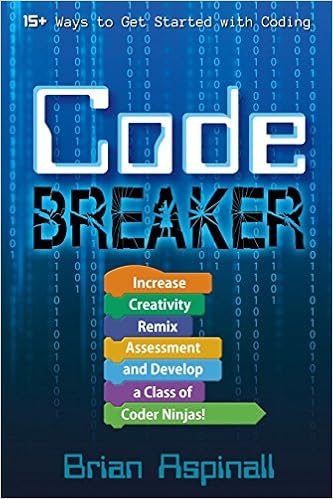
Brian is quick to explain that computer science is not only coding. It’s a way of thinking. He speaks to learning about coding as a language that our students should know, even if they are not planning to become professional programmers. Thinking through the process of writing code is about more than just creating a website or app. It’s about the critical thinking and problem-solving that is put into practice while writing the code. It’s about perseverance and finding those tiny mistakes that can negate an entire block of code. I love his analogy of coding being a part of computer science as biology is a part of natural sciences. That’s when the distinction really clicked for me in a way that I could share with others.

Even if I weren’t already an advocate for teaching students how to code, I would be after reading Code Breaker!

When I became a media coordinator at an elementary school in 2014, I heard about this idea of “Hour of Code” that was taking off in schools across the world. I knew my students needed in on this, so I partnered with our computer teacher and we created a schedule in which every student in our school (yes, even the pre-kindergarten students) would engage in coding within one day. It was fast and furious and so much fun! Our pre-k and kindergarten students enjoyed playing a game of Simon Says and following the tiles along the hallways of our school. They were learning the fundamentals of coding through playing a game they were already familiar with. They learned how the computer only does what the human tells it to do just as they only do what Simon says to do in the game. We then moved from analog coding (unplugged activities) to using code.org for our emerging readers. This is a great place to go for coding instruction, allowing learners (even you!) to move through a curriculum designed for any age group. Even though I’ve moved to a middle school, the Hour of Code has not only continued in that elementary school, but has spread throughout my district.

If you’ve participated in the Hour of Code and are ready to move to the next thing in coding, check out Brian’s book! He gives many ways to integrate coding into multiple subject areas at a variety of ages. There are QR codes linked throughout the book to blog posts to further your learning, as well as examples and resources. At the end of the book there are several more resources, and educators to follow are listed throughout the pages of Code Breaker.

I have some of my favorite resources to share with you as well.

There are several unplugged games to get you started, too!

Earlier this year, I facilitated a session on Coding Camps and shared our activities in a five day summer camp. That slide deck can be accessed here.

With the strides we’ve already made to include coding across our district, I was a bit apprehensive about how I could implement Code Breaker in the new school year. Luckily Brian provides to many new ideas that finding something to implement was incredibly easy! For this book, I will be working with my math team to use MinecraftEDU to show patterns in both constant rate of change and growing patterns as he describes in chapter 4! This experience fits perfectly in our curriculum and we already use Minecraft to do multiple lessons, so students will be excited to see it implemented in patterns as well!

Brian provides excellent resources on his website. Brian has three TEDx Talks! Click for access to Hacking the Classroom, Education Reform, and Beyond Rote Learning. Don Wettrick (remember Pure Genius – such a good book!) interviewed Brian in his StartEdUp podcast. MindShare Learning did a video podcast with Brian, and The Ed Podcast just released a podcast with Brian earlier this summer about coding and why it isn’t necessarily the most important thing being learned (LOVE THIS!). As always, Andrea Paulakovich and I are copiloting a flipgrid which allows for collaboration on a global scale reflecting on each DBC, Inc book. Andrea had this incredible idea of using flipgrid at the beginning of the summer, and I was fortunate enough to get to be part of it! Feel free to share your thoughts with the community here; if no one has posted, be bold and start the conversation! The Twitter community uses the hashtag #CodeBreaker to discuss the ideas in this book. Speaking of Twitter, here are a couple of my reflective tweets while reading the book. Brian speaks so much truth in so few pages! Be sure to grab your copy now!


I was excited to finally be able to read book 34 and am equally pumped to get to read book 35! If you’ve heard of The Ron Clark Academy and believe in what the educators there in Atlanta are doing for their students, you will also be excited about book 35! It was written by the husband-wife team of Wade & Hope King, educators at The Ron Clark Academy and is called The Wild Card. Prepare to be inspired to get creative with book 35!

#DBC50Summer 33/50: Culturize

Thirty-three books in and I experienced another first while reading Culturize by Jimmy Casas. This is the first time I have read the final page of a Dave Burgess Consulting, Inc book at a loss for words. I literally had nothing to say… which meant the blog post would have to wait. A blank blog post won’t help anyone.

Two days… it’s been two days since I finished reading Culturize and I’m still struggling with my thoughts. This post may come out a jumbled up mess. I’m not even going to edit (much), so be prepared for a hot mess express. Usually I know exactly what I’m going to say, with quotes highlighted and implementation plan ready. This time…I’m not even sure where this one is going. So bear with me, and let’s see what happens together.

culturize

(Pause for ice cream break… possibly ice cream will help.)

Ice cream didn’t help. Also, I now feel guilty for eating ice cream at 9:30 at night. Marvelous.

From the very beginning, Jimmy gripped my heart and pulled at my soul. I spent the entire time I read this book wondering if I could have done better. Normally when I read these books, I feel inspired, motivated, excited to implement… with Culturize, I just feel guilty. Jimmy mentions that feeling of guilt frequently in the book. Guilt when a student drops out, guilt when a student lashes out, guilt that he could have done more. I, too, feel that guilt. I think as educators, we all feel that guilt. Honestly, if we don’t – we likely aren’t feeling anything… apathy. Because let’s be honest, if you aren’t feeling guilt, you’re not in the game 100%. That sounds completely pessimistic and very judgmental. Hear me out… have you ever engaged someone in talking negatively about your school? Have you ever found yourself agreeing with someone who puts down the profession of education? Have you ever acted as an educational martyr? If you’re giving every ounce of yourself to help your students, you know by now that you cannot save them all. Y’all – it’s just not possible. And those that you can’t save… well, they bring with them the guilt of not being able to save them. So again – if you’re not feeling guilty at some point, perhaps you’re not really “getting it”.

Jimmy opens by talking about the kids who walk down the hall feeling invisible. I’ve often wondered which of my middle school students feel invisible. I want every. single. one. to know that I see them. But do I really? Do I really see them? Tonight at our open house, I realized just how many names of students I had forgotten over the summer. I constantly advocate for calling students by name, but I couldn’t have told you half of their names as they walked up to me. Do you have any idea how guilty I felt about that? I must do better. Must. No child should ever feel invisible. Every single kid should have a champion (Thank you, Rita Pierson) – someone who really sees them. I can’t be that for every kid, but shouldn’t I try? At what point do I invest in quality over quantity?

Perhaps this is what Jimmy was referring to as he discusses that we are all leaders. I remember thinking early in my career that my principal was the school leader. It was a very clear hierarchy – principal, assistant principal, curriculum specialist, school improvement team chair, grade level chair, and somewhere waaaaay down that totem pole… me. At some point, it changed. That totem pole was chopped down; the hierarchy fell. I remember the first time my assistant principal asked me for my opinion. It scared me, and exhilarated me at the same time. I remember the first time I stepped up to present at our district teaching and learning conference. I was terrified, and now I present all over our state. At some point, I started acting like a leader. My words, my body language, my convictions moved me into leadership. I’ve never wanted to be an administrator. When I started my career in education, the equation was simple: administration = leadership. Reflecting, I think it was when I saw MYSELF as a leader, I embodied the leadership that I saw in others. It wasn’t until that confidence was built that I ever imagined leading others. Jimmy says that leaders don’t need a title. I agree. Administration no longer is the sole equality to leadership. Leaders just need followers who are then empowered to become leaders themselves.

Within Core Principle 1 (there are 4 core principles), Jimmy says that lack of confidence is the number one reason that kids fail. I think it’s also the number one reason adults fail, too. I was talking to a friend of mine once who said, in response to my feeling doubtful that I had anything to offer to the friendship, “that’s part of the problem, the fact that you don’t see yourself as special is part of this for you.” My friend was completely on target. My own self-doubt was negating the beginning of a wonderful friendship. Thankfully, I’ve been able to build on that and I wouldn’t take anything for that friendship. It means the world to me. I still struggle with self-confidence every day, though. Affirmations can help build confidence – more than anyone will ever understand. Self-doubt can eat you up if you let it. Shake it off. Just like we find the positive in others, find the positive in yourself. List at least 5 things that you’re good at, and allow yourself to feel pride. Humility is valued. It’s possible to be humble without doubting your own successes.

In Culturize, Jimmy says often that “What we model is what we get”. What am I modeling for my students and staff? Am I finding the positive in day-to-day interactions? Am I believing from the tips of my toes to the top of my head that every one of my students can be successful? Am I showing grace to others? Do I stay calm when something comes along to mess up the plans I so carefully crafted? Probably not. We’re human, we mess up. Do I apologize to those I’ve wronged? These are very real questions if we consider ourselves leaders.

Another thought Jimmy shares often is that we are responsible for our own actions.

“No one is responsible for determining your success or failure but you, and no one is responsible for your morale but you.” ~Jimmy Casas, Culturize

Oh boy! That right there felt like a punch in the gut! I have been known to complain about the sheer amount of complaints from those around me. (Yes, I know… ironic. You do it, too, don’t lie.) It drives me crazy to be around people who constantly find something negative to say. But here’s the thing…. what am I doing about it? I sit there, and nod my head along with them. Who is that helping? Then I turn around and complain to someone else that I was in a great mood until so-and-so got me down. What? What am I even saying? Does that make sense at all? I am responsible for my morale. Why am I lowering my standard of positivity to meet their miserable attitude? Let’s be real. Nothing happened directly to me; I was just fine until the pit of negativity appeared. Why am I not just fine afterward? and why in the world am I allowing them to continue with the negativity around me? I need to do better. My kids deserve better. If I call myself a leader, and I internalize what it means to be a leader – then dang it, I need to lead. I’ve got to speak up and halt the negativity I hear around me.

Sometimes when I’m wallowing in my own misery (yes, it happens), my “little” brother (he’s 28 and married with two kids of his own) will look at me all innocently and say, “but did you die?”… I need to reframe my perspective.

The media center is being used for pictures! “But did you die?”

I’ve not met with PLCs because the location keeps changing. “But did you die?”

This student left their Chromebook at home for the 100th time. “But did you die?”

The bulb on my projector looks so dim that I have to turn off my lights. “But did you die?”

The TV in the cafeteria won’t mirror the TV in the lobby for announcements.

“But. Did. You. Die?”

There’s too much big stuff to worry about to let the little things ruffle my feathers anymore. Or allow others to have their feathers ruffled. As a leader, I need to shake my feathers back down when daily mishaps come along and help others remember their purpose as well. Rather than complain, determine if whatever happened is even within my sphere of influence. If not, then move on – if it is, then change it. Simple enough, right? When others start on their negative campaign, I’ve got to remember my brother’s “but did you die?” – it just puts things into perspective. I want to be a “merchant of hope” as Jimmy says in his 4th core principle. Believing that my words and actions can inspire others, I need to watch what I say and do. What I model is what I will get.

With all that – I have no idea if I’ve made (as we say in the south) a lick of sense. Welcome to my brain. It’s a terrifying place to be sometimes. (HA)

The only implementation plan I’ve got for this book is to live out the four core principles, every day. This is going to have to be intentional because it’s so easy to be drawn back into the quicksand of negativity that can quickly pull you down. Instead of fighting, I need to stay still, wait, plan, and then move slowly, crawling out of the quicksand and moving away, bringing the others with me helping them avoid that same pit. So in the new school year, I will be a champion for my students, expect excellence from them and the staff I work with (ALL of them… because all means all), carry the banner (with pride and enthusiasm for my school), and be a merchant of hope. Because when all else fails, hope will get us through the worst of the worst. Because at the end of the day, we didn’t die… so tomorrow, we can get up and try again.

You’ve got to get this book. I don’t know any other way to say it. It’s a game-changer. I have said of every book that I recommend it, but this one… this one right here is one that every person should have. It’s one that needs to be revisited frequently. If you truly want to change your school, you have to change you first. Culturize requires a self-examination that you may not be ready for… I wasn’t. My scattered thoughts are evidence that I’m continuing to wrestle with book 33. I will wrestle with this one for a while. I am putting it back on the shelf, but the change feels incomplete. I feel as though the growth just kickstarted. #DBC50Summer has challenged me and what I think of education multiple times. This book is the equivalent to that moment when the GPS just found a traffic jam up ahead and had the foresight to go ahead and re-route you without you even knowing what was going on. Just trust it. Follow it. Just go get the dang book already.

Here’s the tweets. I’ll just sit back and let Jimmy do his thing here.


Resources and Podcasts and YouTube, oh my!

Jimmy Casas Slide Deck for Culturize

Jimmy Casas blog

Perspectives in Education podcast

Jimmy’s advice for hiring for excellence

Principal Matters podcast

#IAedchat Live – Feb 25, 2018

Truth for Teachers podcast

Flipgrid for Culturize (Thank you Andrea Paulakovich for this incredible idea and the opportunity to copilot a flipgrid with all DBC, Inc books for global connections!)

**If you’ve made it this far, I’ve got to apologize for the length of this post and the scattered thoughts on this spectacular book. However, keep in mind that I started #DBC50Summer for my own personal growth. This is for my growth so I can better impact my students and teachers. I hope you were able to take something from it as well, but if you take nothing else from this post – buy the book and follow Jimmy Casas on Twitter. Now! Thanks for reading.**

Book 34 is Code Breaker by Brian Aspinall. I’ve presented at multiple conferences on coding in the classroom, started the Hour of Code at my former elementary school, and helped rewrite the elementary school computer science curriculum to include a focus on coding almost 4 years ago, and played a collaborative role in the creation of a middle school curriculum for computer science. So to say I’m excited about this is an understatement. Let’s go!

#DBC50Summer 32/50: The Four O’Clock Faculty

As a requirement for licensure in my district, beginning teachers must complete multiple professional development workshops. These include sessions on Thinking Maps, CRISS strategies, Kagan Cooperative Learning, Technology, and Foundations of Reading. My first teaching job was in a 5th grade math classroom. When I found out I had to sit through 10 hours of Foundations of Reading training, I was not happy. This instruction was not pertinent to my job! (I wasn’t exactly of the same growth mindset that I now have, either.)

How many times have you endured trainings that you knew you’d never use the information? How many times have you been required to be in workshops, whether it related to your content or not? It’s frustrating, right? Book 32 in the Dave Burgess Consulting, Inc line up addresses professional development and how to go ROGUE! Rich Czyz brings us The Four O’Clock Faculty!

40cf

Because of my experience with “Foundations of Reading” and several other poorly designed workshops, I could relate to Rich in the introduction of his book! I’d be willing to bet that most educators have been in a similar situation. Maybe you’ve lucked up and haven’t had to go to irrelevant professional development; maybe all of your PD has been a bed of roses. I’d also be willing to call your bluff if that’s what you’re telling people. Here are three things I despise about the “standard” professional development.

  • Required: Anytime I get an e-mail about a “required” workshop, I cringe. When a workshop is required, it tells me that it’s going to be full of blanket statements. It will be generic and likely not applicable to me. Typically in these workshops, my intelligence is insulted at least once, and I start back-channeling others in the room with hilarious gifs to see who will crack first. (True story…even to this day)
  • Irrelevant: PD being irrelevant and required typically go hand-in-hand. If someone else has deemed that I have to be there, chances are I’m not getting anything out of it. It’s likely about a topic/concept/strategy that I won’t use or one I already know about through other venues. When faced with these workshops, I make eye contact with someone across the room that I know, open the group text or Twitter, and let the back-channeling begin.
  • Boring: There is nothing worse than being excited about the topic of PD, choosing to attend that session, and then being bored to death by the presenter. This can happen for many reasons. In my experience, it’s usually because the presenter reads the slides, is monotone, or worse… both! I have personally sat in sessions at conferences, so thrilled to learn from someone I enjoying connecting with on Twitter and read their blogs, only to be bored to tears and highly disappointed. When I walk into a session space and see a speaker standing at a stationary microphone or a podium, I usually leave for this very reason. (Hey, at least there’s no need to back-channel if I choose to leave!) Side note: if you’re going to read it to me, just email it! I can read it myself.

When Rich asks in the book, “What is the most rewarding professional development experience you’ve ever had?” I immediately knew my answer! My most rewarding PD experience I’ve done by myself has easily been this #DBC50Summer journey! The relationships I’ve formed with so many people on Twitter, including the authors, and the huge amount of knowledge gained from the books are definitely game-changers for me! Knowing that I will be implementing at least one thing from each book has me so excited for the new year. My most rewarding PD I’ve done that was provided by someone else has been EPIC Academy, which is a self-paced, online, gamified approach to professional development created by my friend, mentor, and Director of Digital Learning and Media Lucas Gillispie. I’ve referenced EPIC in several blog posts, and you can find out more information about why it’s so awesome here. Short version: it’s optional, relevant, and interactive. The opposite of everything I dislike in professional development!

One of my favorite parts of Rich’s book is that it give completely practical ways to go ROGUE with your own professional development. He states that ROGUE, for the purposes of his book, is Relevant Organized Group of Underground Educators. One of my favorite quotes from The Four O’Clock Faculty is:

No one else is going to take responsibility to meet our needs. We must do what we can on our own to address our own demands and wishes.

There is so much truth to this statement! It’s one of the reasons I got hooked on Twitter years ago. All of the sudden, I had people who had similar interests and were passionate about teaching students, and they were learning with me, encouraging me, and supporting me in my efforts to take risks in the best interest of students. Those are my people. It was through Twitter that I discovered my first edcamp many years ago. I’ve attended many edcamps and blogged about several of them! (Search for edcamp on my blog and you’ll see them there.) Lucas (referenced above) and I organized the first edcamp in our region in 2016, EdCampRFD. It went much like Rich’s first edcamp, and we’re building momentum to have another one in the future. See the press release in our local newspaper here.

I also approached this book as a provider of professional development. I create and deliver PD to my staff, media coordinators, and educators across North Carolina. Knowing my professional development pet peeves helps me develop PD that is optional, relevant, and (hopefully) not boring. I am sharing a survey with my teachers which asks what digital tools they want to know more about. I will be offering 8 digital learning workshops this year and teachers are required to attend the first one and the last one (because we start together and end together). Of the remaining six workshops, they are encouraged to choose three that meets their needs and attend those. Workshops I facilitate are also interactive and include follow-up, if desired. As a digital learning/instructional coach, I am able to provide follow up to my teachers through support in their classrooms. This is so valuable because we have the opportunity to co-teach and learn from one another.

My implementation plan allows me to offer teachers more choice and PD on-demand. I plan to definitely use Rich’s “Tip Jars” idea! From the survey results, I will choose two desired topics two weeks before the PD date and place those topics on mason jars in the media center. Each teacher will be given a marble and can place their marble in the jar of the topic they’d prefer to learn about at the next digital learning PD session. One week before the PD session, I will send out an e-mail with the preferred topic and invite anyone who is interested in learning about that topic to attend! The topic that wasn’t chosen will remain on the Tip Jar and another topic will “compete” against it for the next PD date. In my Social LEADia blog post, I shared that my implementation plan was to create a YouTube channel. Thanks to The Four O’Clock Faculty, I will be putting 5-minute PD segments on that channel and sharing with teachers twice a month. Each video will either highlight a Google App or Extension or a troubleshooting on student chromebook video. These can be viewed by teachers on-demand and as many times as needed. I will also share a Google App or Extension with students (sometimes it will be the same video that I sent to teachers)! Bonus points if I can find students who are willing to come to faculty meetings and share about the apps/extensions, then create a follow up video about the app/ extensions FOR the teachers! (WINNING!)

The Four O’Clock Faculty is full of ways to own your own professional learning. Everything from edcamp to Twitter to blogging and more is included, so there’s really no excuse for not going out there and getting what you need to continue to grow professionally! If you aren’t learning, your kids are suffering because of it! Your first step to professional growth could even be to purchase this book! Now. Then get yourself on Twitter and check out the #4OCF (that’s an “oh” not a “zero”, ha!) to connect with other passionate educators and chat about ROGUE PD. If you’re REALLY wanting to go down a rabbit hole, check out the #4ocfPLN – those educators are on fire! Still can’t get enough? Check out the website here and get additional resources for the book here. You can hear more on podcasts with The Principal Center and Across the Hall! You can watch Rich chat with #LeadUpTeach and then view him talking with #K12ArtChat! There’s so much goodness here, so check it out!

As always, the flipgrid is a place for global collaboration on all DBC books! Andrea Paulakovich and I are copilots on this grid and would love to have you share your thoughts! This amazing space was the brainchild of Andrea and I’m just thrilled she asked me to jump onboard with her! You should 100% check out Andrea’s blog post on The Four O’Clock Faculty – this lady & her posts are incredible!

Book 33 is one that has really taken off this summer. I have seen multiple book studies surrounding this book (even had to bail from a Voxer book study on it myself because I was starting #DBC50Summer). I started this book at the beginning of the summer and chose to stop so I could focus on reading the DBC books in order, knowing I’d eventually get back to this one. I’m so excited to see this book through because it hurt to put it down the first time! So look for the post on Culturize by Jimmy Casas coming soon. It’s currently (as of 8-18-18) the #1 Best Seller in Experimental Education Methods on Amazon! Also – yes this is the same Jimmy Casas from Start.Right.Now so you know we’re talking quality, thought-provoking stuff coming up! (But then again, haven’t they all been?!)