The Secret to Coaching

For the past 4 years, I have had the pleasure to be part of an amazing network of educators from across North Carolina – the Digital Leaders Coaching Network.  Started in 2014 by the Friday Institute, this cadre of teacher leaders has been given tools to practice the art of coaching.  Over the past four years, we have engaged in multiple book studies, several personality tests, and more coaching scenarios than imaginable.  We have had guest speakers from across the United States and even internationally.  I have met some of the most incredible educators from across our state, educators that see themselves as leaders, educators that are the exemplar of growth mindset.  I have seen our group grow exponentially, both in attendance and in terms of professional growth of individuals that are taking part.  In 2014, there were a little over 50 educators in attendance, and there is so much interest that now we have two cohorts each year, both rocking a full house of educators!  Last year I served as a mentor in the east cohort (#eastisbeast, #bEastmode) and this year, I serve as a mentor in the west cohort (#westisbest).

There is so little professional development available for instructional coaches.  Without professional development, educators become stuck in a rut, not knowing what best practices are and how to implement change in their school.  This network has given me best practices, protocols, a professional learning network, and has changed the culture of both schools in which I have worked.  It has allowed me to grow from a timid first-year media coordinator to a confident innovation facilitator, leading a pilot that is changing the role of media coordinators in my district to formally include the role of a digital learning coach.  I teach all 400 students in my school in multiple subject areas, co-planning and co-teaching with their content area classroom teachers, as well as design and implement professional development for teachers in my school and media coordinators/innovation facilitators across my district.  I stay current with educational technology trends and bring those trends to my school through grant writing and working with research organizations.  Oh – and I also teach media classes once a month and hold open book circulation times every morning and throughout the day.  I also manage our 1:1 and BYOD initiatives in my school.  Without this network of tremendous educators, and the support of the leaders at the Friday Institute and NCDPI and NCTIES organization, so much of the change that has been implemented in my schools and district may not have happened.  This opportunity was certainly a catalyst for so much growth and forward momentum both within myself and my district.

Over the past four years, I have presented multiple times at our state technology conference (ISTE affiliate) NCTIES as a featured speaker, worked with amazing educators to share information about being a connected educator, coding in the classroom, and MinecraftEDU at NCCAT’s Teaching Generation Z seminars, accepted the challenge of piloting the Innovation Facilitator job description, and was elected to the NCTIES Board of Directors as the North Region Representative.  I was also named as a Future Ready Instructional Coach Thought Leader.  It is not a coincidence that all of this happened during my time with NCDLCN.  I felt more confident being part of this cadre, more prepared to face whatever may come my way, and more connected to those outside my district.

So with all of the time spent in the past four years of NCDLCN, what have I learned to be the number ONE secret to coaching?!  Relationships.  Everything boils down to relationships.  Relationships with your administration, relationships with your teachers, and relationships with the students.

When I first started coaching, I was so excited to change the face of education that I started as a bulldozer.  I went in and started making suggestions before I had even taken a second glance.  Rookie mistake.  I learned the hard way that I needed to work in my space first, changing what was directly pertinent to me, then building relationships and trust with administration and teachers around me.  Once I took a step back, and started informally meeting with teachers, listening to their ideas and encouraging their efforts, praising their strengths, I started to build the trust that is so vital to implement sustainable change.  Once my administration and the teachers I served trusted me, I was able to see change happen quickly.  No longer did I have teachers working with me to plan lessons because they “had” to as a mandate, but because they wanted to; they were excited to use the knowledge I could provide as a curator of resources and strategies.

How does one build relationships?  Slowly.  Spending one lunch period with a teacher, then giving them constructive criticism on a lesson is a recipe for disaster.  Informal time outside of school, emailing, social media, lunches on workdays… those nuggets of time are when the real relationships begin to form.  When you, as a coach, see a teacher excelling in an area, point it out to them!  As teachers, we (I still consider myself to always be a teacher first) are our worst critic.  To hear a fellow educator acknowledge a strength is a great motivator and relationship builder.  In my current position, it has taken me almost two years to feel as though I have a solid relationship in which I can have critical conversations with my staff without a long-lasting negative impact.

Where do your loyalties lie?  This is always a tough question!  Many times as a coach, we can become the go-between; administration needs us to share information with teachers, while teachers want us to share grievances with administration.  Do not, and I repeat, do NOT put yourself in that situation!  Make it very clear to both parties that you are not a liaison.  Your loyalties lie with the students you serve, both directly and indirectly.  One of the fastest ways to destroy a positive coaching relationship is to be seen as a coach that reports back to the administration.  With that said, when a teacher I am working with is doing something amazing, I will notify our administration.  However, if we are working through a hurdle, that stays between me and the teacher in question.  Everything we do as coaches is ultimately for the good of the students.  Placing your loyalties there can only yield positive results.

So there you have it – the secret to coaching, as gathered by multiple sources and personal experience.  Building relationships and trust, and taking preventative measures to keep those relationships intact, will propel you and your school(s) forward allowing you to see measurable and sustainable change.

What do you feel is the secret to coaching?  Comment below!  I’d love to have feedback and chat with other coaches!


#EdCampQC 2.0

I honestly didn’t think they could do it… truly, I didn’t!  There was no way that the #edcampqc group that organized the first EdCamp Queen City at Hawk Ridge Elementary School could possibly outdo themselves.  The sequel is NEVER as good as the first, right?

edcampplanners

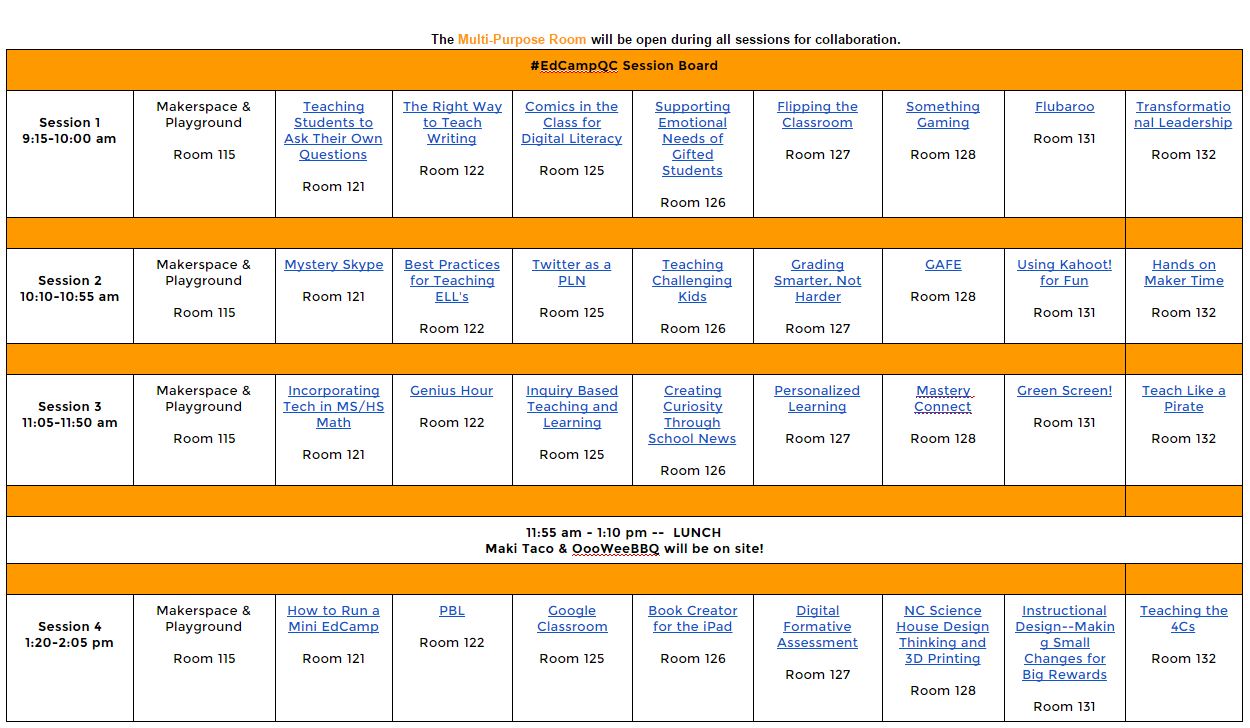
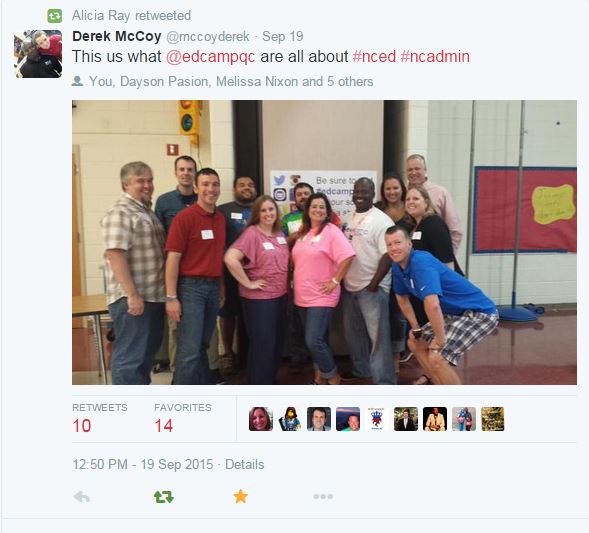
Wrong!  I’m a firm believer in giving credit where it’s due and the organizers for #edcampqc are amazing!  This team has got it together; everything seemed to run very smoothly and whoa – look at this session board (with collaborative notes) the participants created!

 sessions

I attended Something Gaming first where I learned more about ClassCraft and shared my 3dGameLab course I have created for my Battle of the Books students.  Stepping out of my comfort zone I am considering having students create their own games to show mastery of content.  We talked about the resource GameStar Mechanic which looks very exciting!  I hope to be able to incorporate this into the media center or with my Battle of the Books team this year.

Following Something Gaming, I hit up the Twitter as a PLN session.  It was the very first Twitter session I had ever attended where EVERY SINGLE PERSON was a Connected Educator on Twitter!!!  It was awesome; there was so much energy in the room!  This allowed us to take the conversation to a new level by discussing an educational revolution and how to pull more people onboard the Twitter train.  One idea was to show reluctant peers the difference between twitter for personal use and twitter that is used professionally.  Derek McCoy (follow him on Twitter: @mccoyderek) shows the difference using current feeds of two people, like Charlie Sheen vs Steven Weber (follow him on Twitter: @curriculumblog)

The third session had so much goodness packed into 45 minutes that I couldn’t possibly attend all of them, even with the rule of two feet!  This is honestly the very first edcamp that I have relied on the collaborative docs to fill me in on the conversations.  With topics like Genius Hour, Inquiry-Based Learning, Personalized Learning, Green Screen, Teach Like A Pirate, and a discussion on School News, I was torn.  I ended up in Green Screen and walked away with new ideas for this week.  Thanks to Megan Mehta (follow her on Twitter: @megan_mehta) we stopped by Starbucks before leaving Charlotte to grab green Starbucks straws and coffee stirrers to use in puppet shows with green screen! GENIUS!!!

edcampqc2

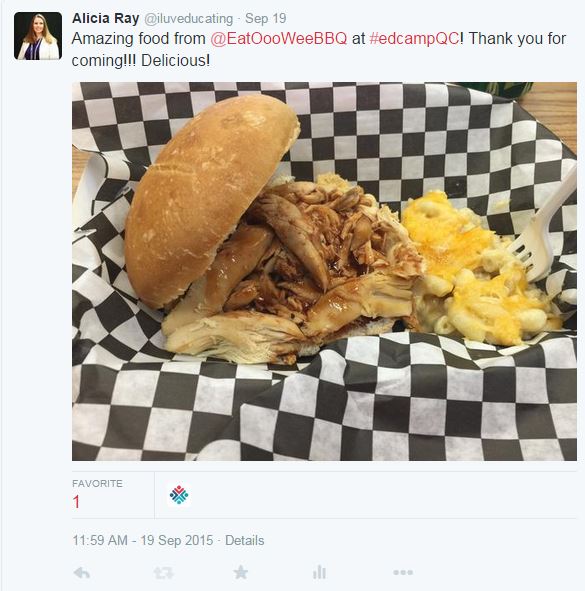
Lunch was superb.  Ooo-Wee BBQ was soooo delicious & I just had to purchase ice cream from a legit ice cream truck!  Being from a small town in the country, I didn’t have ice cream trucks while growing up.

edcampqc3

Finally, my last session was Digital Formative Assessment.  I signed up to facilitate this session.  Many of the teachers in this session learned about Kahoot! in an earlier session, so we did a mini-smackdown of Digital Formative Assessment tools including GoFormative, Kubbu, Plickers, and ThingLink.  We also touched on GooseChase, a terrific scavenger hunt app!

As if the day couldn’t get any better – I won an autographed copy of Teach Like A Pirate by Dave Burgess!  Thank you, Dave (follow him on Twitter: @burgessdave)

edcampqc9

It was an excellent day and I am already looking forward to my next edcamp experience!  These things are the best educational rejuvenation!  I get to see my fabulous Professional Learning Network (PLN) and I always leave with so many new ideas that I can share with my peers at work and implement in the classroom.  I am constantly amazed at the people that I meet and humbled to be considered a member of their PLN.  If you’ve never attended an edcamp, you should seriously find the next one coming your way, clear your schedule, and attend!  I have never been disappointed!  If you are near me – I will even drive you there; no excuses!

edcampqcpart2

My Starting Point

After years of kicking and screaming, here it is – my first official blog post.  I have pondered creating a professional blog for a while, going back and forth, deciding over and over that I won’t do it because I don’t have time, knowledge, ability, ideas, etc.  You name the excuse, I’ve made it.  What changed you ask?  It must have taken something pretty EPIC for me to attempt this blogging endeavor.

#flashback  A little over a year ago I was in my 8th year teaching in a fifth grade classroom and loving my students, but I craved more.  I had a graduate degree in Instructional Technology with no clear vision of what to do with it.  The walls started closing in on me, so when I found out in November that a media coordinator position was open in a nearby elementary school in my county I immediately applied.  I would finish my MLS in May, so it seemed perfect!  I got the job, and packed up my classroom at Christmas break.  Walking into the media center as my new “classroom” was overwhelming; I barely got through the first semester without pulling my hair out.  I wasn’t even trying to stay above water anymore; I was trying to see how long I could hold my breath while searching desperately for an oxygen tank or an air pocket underwater or anything (let’s face it, we’ve all had those moments).  Determined to start over and make my first full year in the media center a success, I went to my county’s Teaching & Learning Conference (a technology conference) where a director from my central office introduced me to Twitter as a Professional Learning Network and my whole professional career changed.  (Follow me on Twitter: @iluveducating). I have connected and reconnected with so many people who have altered my outlook.  Suddenly it felt as if the world opened up and the opportunities seemed endless.  #endflashback

Through Twitter, I have learned about and have attended my first edcamp (and signed up for four more in the next 3 months), implemented makerspaces in the media center, am part of an amazing group of educators in the North Carolina Digital Leaders Coaching Network through the Friday Institute at NC State University, and will present two sessions at NCTIES in March.

Photo of participants

(That’s me with the purple shirt, white jacket, and faux pearls – teacher salary.)

So the same director (@lucasgillispie) who introduced me to Twitter as a PLN created EPIC Teaching Academy: A Professional Development opportunity in 3D GameLab by GoGo Labs that is Engaging, Playful, Innovative, and Connected.  Forty-four people in my county are piloting this program, and I am one of them.  In this software, we are in charge of our own PD with the flexibility to choose our own paths.  We can learn about Twitter, Pinterest, and Blogging.  We can watch TEDtalks on educational reform, gaming in education, and the past, present, and future of technology.  We get rewarded for reaching various goals through badges, achievements, and awards, which brings me full-circle to kicking and screaming with refusal to start a blog.  Apparently, I’m an Achiever according to a BrainHex gaming personality indicator and all I needed was to see blogging as part of a quest to complete to make me search for various blog hosting sites, choose one, customize, and write my own blog, create my own starting point.  I have no idea what will become of my little piece of the internet, and how well I will do at updating and adding new ideas, but here goes nothing.