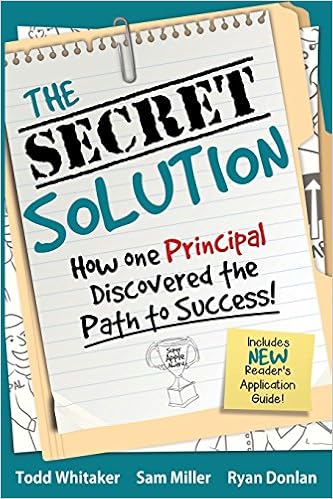
#DBC50Summer 44/50: The Secret Solution

Book 44 is unlike any other book published by Dave Burgess Consulting, Inc. This book teaches through a parable, a simple story used to share a lesson. In The Secret Solution, we join Roger Rookie on his first years as principal in a school with underperforming test results. We get a look at the inner-workings of a school, with a cast of characters that looks suspiciously like any school you’d visit. The authors, Todd Whitaker, Sam Miller, and Ryan Donlan, did an outstanding job making this story come to life by sharing the good, the bad, and the ugly of a school and allowing us to have a peak into the mind of the young principal who is finding his way in a fresh position of leadership.
In the epilogue, the authors liken this to watching an episode of The Office. It was so funny to read that because I kept thinking the whole time I was reading that the entire book should be a series like The Office where we get to see all the different personalities and their thoughts (usually beside a window in a conference room or in zoomed in camera shots of smirks on their faces).

Every character in this book related to someone I’ve worked with; I could put a face to the name. From Judy Slacker who puts a price of everything she does outside of the 7:45-3:30 workday to Karl Chameleon who bounces from group to group to the leaders of the teacher cliques like Mildred Morose and Sandy Starr. Each character is an exaggeration (and sometimes a spot-on representation) of educators across our field.

Even though this book appears to be marketed to principals, in particular, new principals or principals of struggling schools, the truths within the parable are applicable to any leadership position. As noted in other DBC, Inc books, leadership can range from being a principal, central office staff, or even a classroom teacher. If you are a classroom teacher, you are leading a group (or multiple groups) of students.

One of my biggest takeaways of this book is balance. This may not have been intended, but I kept feeling that balance is the key to being an effective leader. In the book, Roger Rookie’s pendulum swings from absent & unwilling to make the hard decisions, to a positive pollyanna who strives to only praise positivity and neglects to address negative actions, to a drill sergeant who rules with an iron fist. None of these will work because none of them strikes a balance in leadership. Leaders should be present and positive, while addressing behaviors that impede student learning and lead to negative culture.

I imagine it’s insanely tough to be an administrator, both at the school and district level.  Knowing that it is a statistical impossibility to make everyone happy, while still maintaining (or bless their hearts, building) a positive school culture and instilling a drive for positive scores and growth for accountability. There is a delicate balance that must be preserved in this role. The graphic in the book perfectly showcases how a leader should work to increase climate as they are increasing the accountability expectations.

For me, as a non-administrator, I realize that as I raise the expectations in the media center, I need to work harder to create a positive culture that makes my students and teachers want to reach those higher expectations. People will work for those they fear, but they will not love them. People will work for those they love, but they won’t respect them. The goal is that sweet spot, where leaders are loved and respected.

Another takeaway from this book is that establishing these relationships of love and respect takes time. Roger Rookie wasn’t able to come in and change anything without building relationships. Building a strong relationship takes time; it takes communication, honesty, and mutual appreciation. Only then can change begin to take shape. My first year at my current school was, by far, the worst year I’d had in education. The culture of the school was just short of toxic in many ways. There were cliques formed between teachers, administration was new (either to the school or new to the role), and students were not aware of the expectations. Coming to a middle school from an elementary school was insanely difficult. My mentor kept telling me that it was going to take time, that I needed to play the long game. He would remind me that in just a couple years I would never want to leave that place. I would often laugh in his face when he’d say that. He would grin and bear it, saying, “you’ll see… you’ll see.”

I started working at that school in 2016. This is the beginning of the third school year and it would take quite an offer to get me to leave these people now. I love and respect my principal. She is phenomenal and truly has student interest in mind with every decision she makes. She rarely says “no” to my insane ideas, so when she does, I truly step back and reflect on where the lack of student interest can be found. When I dive deep, I can usually see the deficit. She holds me accountable for my insane ideas after saying yes. I am the world’s worst to have a “great idea” then not see it through. (This is part of the reason that #DBC50Summer is so important to me to not only finish, but to finish by my deadline of the last day of summer.) Making these implementation plans is my way of making myself accountable for my learning. When we are successful, she celebrates with us!

The teachers are phenomenal. They work hard every single day to encourage students to be their best. They bring their “A-game” and expect others to do so as well. As their instructional coach and media coordinator, my calendar fills up so fast that one of their complaints is that they can’t get time to work with me. The fact that we went from several not even knowing my name, much less my role at the school to filling up my calendar for the first nine weeks of school before students even arrive on campus is telling of the change in culture. Every person is responsible for culture. Every person has grown tremendously in this regard. During a summer training, my principal looked at me with tears in her eyes and said, “They don’t need me anymore.” She was referring to the fact that the teams were co-planning independently of her asking the questions and the PBL units coming out of these PLCs were incredible. I believe that the tears were from both a place of pride and the knowledge that she is close to taking us as far as she can take us as our leader. I am proud to work at my school, and eager to see what this year brings! We made growth for the first time since 2012 this year, and we will shatter that growth at the record we’re already going. I’m excited to see what happens.

My implementation for this book is very different from the others. I already know which titles are coming in the final 6 books. Divulging my secret that I mentioned in the DBC Summer Recap 4 is coming soon. Therefore, I will partner this book with another that is coming to create an implementation for both. It seems like a scapegoat or something LaVon Babble (another character in this book) would say, but I promise it will make sense when you see the plan.

I would highly recommend this book to beginning principals or principals that are new to a school. It’s a realistic view of how leadership is established and allows us to learn from Roger Rookie’s failures (and boy, does he ever fail). The Secret Solution is a great book for anyone in a leadership role, and really the truths within the book can be applied at all levels. All you’d have to do is substitute principal for teacher and the teachers for students, or principal for director and teachers for principals, etc to receive the same lessons as principals. Hustle on to Amazon and buy your copy of The Secret Solution!

Follow along with the conversation at #SecretSolution on Twitter. You can also catch up with their authors on their websites. Ryan Donlan’s website can be found here and Todd Whitaker here. Sam Miller can be found on Twitter here. As always, the flipgrid is available here. This one sounds like fun, so check it out! Andrea Paulakovich was the originator of this amazing space for global collaboration and reflection for every DBC, Inc book and I am fortunate enough to be able to co-pilot this space!

I am super pumped about book 45 for many reasons. One is that we already know this author duo and I LOVE them from their first book together, Escaping the School Leader’s Dunk Tank! Yep! Rick Jetter and Rebecca Coda are back and they’re discussing one of my most favorite educational topics: student voice! Buckle up, grab some popcorn, and get your copy of Let Them Speak! I read this book shortly after the initial release at the end of April and whew – it’s a great one! In fact, it’s the first DBC, Inc book that I pre-ordered! I’m excited to share book 45 with you very soon!

*PS – Summer officially ends September 22, 2018 at 9:54 pm EST… do the math. These blogs will be coming fast if I want to meet my deadline. And I do.*
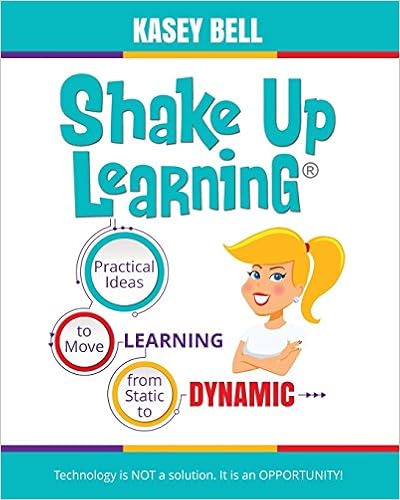

#DBC50Summer 43/50: Shake Up Learning

I’ve always enjoyed the shiny things in life. I love the feeling of “new”. I’m guilty of tossing something in our house because we just need a “new” one. (It drives my husband absolutely crazy.) I have to admit that I’m the same way with technology. When virtual reality started to become readily accessible in the classroom I was given the opportunity to participate in research with the organization, Foundry10, and I jumped on it! I had no idea how we were going to integrate VR, but I knew I wanted to try. I started out by co-planning lessons that stemmed from the use VR rather than creating ways for VR to enhance the lesson. In the Disney movie Moana, there is a song that the crab sings called “Shiny”. This song reminds me so much of technology and how many of us (myself included) gravitate toward the latest and greatest in an effort to be as shiny as possible.

Newsflash: kids aren’t that impressed with the shiny. After the first few VR experiences, my students are more difficult to impress. They’ve seen the shiny and moved on. As teachers we can’t chase “anything that glitters” – we need real ways to help propel education forward. I believe that Kasey Bell has the solution in her notion of Dynamic Learning Experiences as described in Shake Up Learning, the 43rd book published by Dave Burgess Consulting, Inc.

Reading this book was an eye-opener. This is the first book in which I’ve used the space available at the end of every chapter to share my reflections and connections to the chapter. I connected with Kasey from the very beginning, when she described her early years of teaching as a reproduction of how she was taught. I, too, gave problem after problem in math, allowing 2-3 minutes for students to work it out, then showing the entire class how to correctly answer the problem on the overhead, whitebard, SMARTboard, or under the document camera – all that technology just a waste in my classroom for years. It wasn’t until I moved past my fear of change into the realm of risk-taking that I really began to understand that I was doing my students a disservice. And now… I get frustrated that others haven’t reached that same epiphany in a more timely manner. Ironic, much?

Thinking through this book as both a teacher of students and of teachers brings new insight. Focusing on what the students can do with the tool, rather than the tool itself will be imperative as we continue to move forward one step at a time. In our makerspace, we have more tools for learning and creating than we really know what to do with. Our goal in makerspace managers is to create playlists for students and teachers about the tool by creating unboxing videos, tutorial videos, and “what do I do with this” videos. I’m excited to see where this goes and hopeful that our makerspace will be used more this year. I think people just don’t know what they don’t know. The fear of moving into this space with so many unknown tools can make both teachers and students feel a little uneasy. It is my desire to erase that fear this year.

As I read through Kasey’s book, I was continually hit with the notion of Google Keep. In my blog about Ryan Sheehy‘s book Be The One, I mention my desire to use Google Keep to keep myself organized with a checklist. I believe Google Keep is a hidden gem in the Google Suite and I want to uncover that gem for my students and teachers. This is the perfect way for my students to keep a planner, and a way for teachers to stay organized and allow students to create their own learning goals. This tool is constantly showing up in my readings, as well as in professional development and I’m feeling more and more certain that this is a tool I’d like to present to our district’s Digital Learning Leaders in October.

Kasey speaks to using Google Keep, Diigo, and Pinterest as ways to curate resources through digital bookmarking. Curation is so important for both teachers and students. I have used Google Classroom to curate resources for my students, and am thinking Google Keep is a great outlet for curating makerspace playlists, as well as available Virtual Reality content, for my teachers.

I love to learn completely new things! Sometimes I feel as though I’ve reached that point where there’s not a whole lot that impresses me or excites me with technology, as I have used or seen a tool used in multiple ways. The past few years I have attended conferences, I’ve had a lot of “me too” moments. I have been exposed to 360-videos and own the Ricoh Theta S. (We used it in our search for a new home and it helped us pick a home because we had the ability to take a virtual tour of the home. They all run together after seeing 5 or 6 of them in a short period of time.) I started my first makerspace 5 years ago and have been doing high-end virtual reality with the htc Vive for the past 3 years. My school is 1:1 Chromebooks (has been for over 5 years) and has a successful and often used Bring Your Own Device policy. We’ve had 3d printers for at least 4 years. My students have grown up with MinecraftEDU in their media center and we use game-based learning in many of my classes. Gamification is the foundation of EPIC Academy, a teacher professional development model created by my friend and mentor, Lucas Gillispie.

I don’t say all of this to sound pompous or arrogant. It’s just to say that when I hear about something I was unaware of, I get really pumped! This is one reason I loved Kasey Bell‘s Shake Up Learning so much! There are several things I learned about in this book that I’d never heard of, or with which I had limited interactions. One of those things was Google Alerts. I immediately went to set one up for my name, this blog, and #DBC50Summer. I was blown away by the customization and ability to find information about these. I even found a quote from a local newspaper that I was unaware was listed. I can’t believe this service is out there for free! Go check out alerts.google.com!

There are so many practical applications from this book! Choosing one implementation from this book was so difficult because there are oodles and oodles (yes, real words, promise) of reproducible information shared in the pages. I like the idea of choice menus, and I love that Kasey gives multiple examples for various audiences! I like the Dynamic Learning Experiences lesson plans, and I love that Kasey pulls in some spectacular educators to share their own DLE at the end of the book, as well as giving us space to write our own. I like that Kasey implements the ISTE standards and P21.org skills of the Four Cs, and I LOVE that she puts it into an easy-to-understand graphic that brings DLE to the forefront of planning.

My implementation plan comes from the idea that we should be teaching our students and teachers how to fish, not bringing them the fish daily. As an instructional coach, my ultimate goal is to work myself out of a job. I want my learners (whether they are students or teachers) to be able to sustain their own search for knowledge. In an effort to model this, I am going to take the Google Certified Teacher exams this year. I will definitely take (and expect to pass) the Level 1 exam, and would like to carve out the time to take the Level 2. Between this and creating collaborative Google Keep notes for curation among teachers, I’m hoping to begin taking the first steps to empower my teachers to find their own answers. If they are empowered to find their own answers, they will, in turn, empower students to find their own answers.

I very much enjoyed Shake Up Learning and really appreciate the message Kasey shares with educators in her book. Letting go of fear and control is necessary in creating an environment where students feel more comfortable taking risks and failing forward. I would recommend this book to any teacher and administrator who is eager to move from the way it has always been to the way it should be. I’d also recommend this book to the exact opposite audience in hopes that Kasey’s words might be the nudge needed to begin the transformation in their own classroom.

Kasey practices what she preaches by making resources available outside of her book. For more on Shake Up Learning, check out the hashtag #ShakeUpLearning and her website here. There’s no better time to start than now as she is hosting a Book Study beginning on September 27! More information can be found here. The Google Teacher Tribe podcast is a must-listen as Kasey and Matt Miller (author of Ditch that Textbook and co-author of Ditch That Homework) begin season 3 on Monday, September 17! The flipgrid is available here. Thanks to my pal, Andrea Paulakovich, for allowing me to co-pilot this incredible idea of hers to have a global collaboration space for each DBC, Inc book! I also have to say as a southerner, that these shirts are amazing! I will be ordering one as soon as I click publish here! She also shares a companion resource website within the pages of her book, but you’ve got to get the book for that! You won’t be getting it from me! Go grab your copy of the book now so you can start your journey in moving from static lessons to dynamic learning experiences!

I’ve learned enough about DBC, Inc books by now to know that even though book 44 appears to be another book for administrators, I should prepare myself to take away something epic as a non-administrator. The Secret Solution by Todd Whitaker, Sam Miller, and Ryan Donlan is up next! Just taking a sneak peak into the cast of characters provided in the first few pages has me excited to see where this one will take me!

#DBC50Summer 42/50: All 4s and 5s

As a high school student, I was pretty driven. I knew that when (not if) I attended college, I would be the first in my immediate family to attend a four-year university. My dad dropped out of high school (later obtaining his GED) and my mom took some courses at the community college, but went into the workforce and was married soon after high school graduation. Knowing that my family would be stretched financially, I tried to complete as many college courses as possible before attending the university.

Advanced Placement, or AP, courses were becoming a thing of the past in my state when I was in high school. Our state has an articulation agreement between community colleges and public state universities (like University of North Carolina at Chapel Hill, Appalachian State University, East Carolina University, etc). There is also an agreement that students currently enrolled in high school can take college courses at no cost through dual enrollment, many even renting textbooks and courses being taught on the high school campus by high school teachers who are qualified by community colleges to teach the course.

Regular courses held a GPA of 4.0 for an “A”, while honors were weighted at 5.0 and AP and college level courses were 6.0. In order to obtain the 6.0 GPA for the Advanced Placement course and college credit, students had to score proficient or above on the AP Exam. Therefore, students were opting to take college courses and show proficiency through classwork rather than through College Board exams. I left high school with something like 24 credit hours for college completed. I never took an AP class.

I had been excited about Book 42 for quite some time! Coming up on its 6 month “publish-iversary” is Andrew Sharos‘s book All 4s and 5s!

all4sand5s

Andrew straight up brings it in this book! There’s another acronym, which I’ve just about come to expect from DBC books! Knowing that Dave Burgess has a (slight) obsession with acronyms, and being that he’s the President of Dave Burgess Consulting, Inc – it would make sense that so many of the authors he publishes share an affection for acronyms. In Andrew’s book, SCORES is not just what he’s aiming for, but it’s also his acronym of choice. You’ll have to purchase his book in order to find out what his system is for increasing AP scores as an AP teacher.

And increasing scores, he does!!! To go from a 1.96 class average on the AP US History exam with an 18% pass rate to a class average of 4.45 with 100% pass rate in just 3 years… that’s incredible by any standard with any group of students! His students outscored students with much higher socio-economic status and more privilege than these kids could ever dream.

There was this point in the book that I was just highlighting. I could have highlighted every single word Andrew said. There was so much truth and I couldn’t get enough.

It was just that good. (By the way, this guy knows how to hook the reader… he sucks you into a story, then right before he delivers the punchline, he switches gears to fill you in on a backstory or whatnot. I may have skipped ahead in Chapter 4 just so I could hear what Guadalupe said to him after class the day he got emotional. Yeah, that may have happened.) I love the passion exuded in this book. You can tell that the author is truly passionate about believing all students can succeed. Not only succeed, but succeed at the highest levels in one of the notoriously toughest exams available to them.

One of my favorite quotes in the book is a reminder that we are the adults in the situation. This doesn’t always mean that we’ll have it all together, but that we are the grounding force in the classroom. This isn’t a responsibility to take lightly.

Throughout the book, Andrew talks about the culture of his classroom being “us against the test”. He speaks to the stress of taking these advanced courses and the sense of community that can be created within these students. In a survey given to my students at the end of last year, the word “stressed” or some variation was noted 15 times by 14 different students. Middle school students who are stressed about the workload they endure.

Teaching at a middle school, we don’t offer AP courses. However, we do offer a “younger cousin” (if you will) by offering high school courses while in middle school. The middle school I serve offers the opportunity for 8th grade students to take Math 1, English 1, Earth & Environmental Science, and World History. These are all 9th grade courses. These students are still responsible for learning the content and showing mastery on the 8th grade work as well. This is an incredible opportunity for these students (many who which elect to take all four advanced courses) because this translates to a semester of college courses for free through dual-enrollment on the back end!

Like Andrew says in All 4s and 5s, “AP Students are often among the most stressed out in the entire school. They are also the most overcommitted students who rarely turn down an opportunity to play, act, compete, participate, serve, or belong.”

When asked what they wished teachers knew, one student at my school replied: That we (or try/want to) have a life outside of school. Also that we can’t handle so much work at once. Stress, especially at this age, is NOT something easy to cope with. I know from personal experience.

For this reason, I love Andrew’s advice to teachers to be flexible.

Coordinate with teachers of other higher level courses to plan your tests, essays, etc around their syllabi. This is true of all content areas and not just for advanced placement.

I love this thought and believe we should all be participating in cross-curricular planning so we don’t stress students more than necessary. We have to remember that these students aren’t just going home and playing video games all evening. Many of them support their families through working a job, taking care of younger siblings, being the adult in the house for various reasons, and worrying about an essay due in this class and a large exam in another, while a culminating project is due in a third, all within the same day… that kind of stress can be avoided. Yes, they will experience this as they are adults – we all have stress like this. But their brains and emotions are not yet mature enough to handle this. Remember, even at 14, 16, 17, even 18 years old… they’re still kids.

My implementation plan for this book excites me! I used to do more of this as an elementary teacher, but then I had children of my own and wasn’t able to commit to this as much, so I dropped it all together. Now that both of my personal children are in elementary school, I am able to pick it back up and as soon as I saw Andrew Sharos mention it in All 4s and 5s, I knew this was the implementation route I had to go!

Andrew speaks to making “relationship deposits with students in academic and non-academic ways whenever we can.” We can connect with our students…”attending their games, performances, and activities after school or on weekends.” That’s exactly what I plan to do! Some of the greatest looks I’ve ever seen on the faces of my students are when I show up at their games after school. Knowing that I support them both academically and athletically establishes trust that cannot be replicated any other way. Therefore, my plan is to attend at least one game in each athletic season of my middle school students. This will be quite a feat as we have multiple sports at my school – cross-country track, volleyball, soccer, and football are happening now. Then we’ll have basketball and wrestling, swimming and golf, tennis, softball, baseball, and track and field. I think that’s all of our teams – that’s quite a bit in middle school, right? I’m so excited to cheer my students on as they take the field (court, diamond, etc) this year! Having my own daughters there and knowing that they will be yelling their support for their educational brothers and sisters (because they’re all “my kids”) makes it all the more meaningful for me, too! I can’t wait to see the dividends this pays throughout the year!

All 4s and 5s is definitely a book for planning a successful AP program in your school, but it’s so much more than that. It’s a book for any educator who wants to see the best from every student. It’s a book for educators who believe that every student can be successful. I believe any school with accelerated classes, academically/intellectually gifted, etc programs would benefit from this book, as well as classroom teachers who refuse to “teach to the middle”. I am a firm believer that if you teach all students with high expectations, they will eventually rise to those expectations. I’m excited to see the impact of Andrew’s book as it continues to make its way across the country!  I highly recommend you go grab a copy – don’t let the “AP” on the front deter you!

You can follow along with Andrew on twitter at @AndrewSharosAP and the book at @All4sand5s. Ideas are tweeted to #APTeach. I especially love the pictures of the signs in the yards of students. You can see the pride on their teachers and parents faces as well! It’s truly a team effort! There is also a chat you can join on the first Wednesday of each month at 9:00 pm EST. Use that #APTeach hashtag on Twitter to join! Be sure to check out Andrew’s website here. Vicki (@coolcatteacher) Davis interviews Andrew on her 10-Minute Teacher Podcast here. You can also search for #LeydenPride and see the incredible stuff this school and district are doing in Illinois! As always, you can join the fun (or start the fun) on the flipgrid copiloted by Andrea Paulakovich and me. Andrea sent me a DM a few days after #DBC50Summer started and she was eager to begin her own journey with the addition of Flipgrid. I was so blown away that she’d share this experience with me and I’m honored to copilot the flipgrid that was her genius idea! Use this space for global collaborative reflections on all DBC, Inc books!

*Fun story: I just realized that Andrew is in the same district as a fellow I met in 2015 named Jason Markey. Jason came to NCDLCN to present about Empowering Students and the power of a hashtag! Such a small, small world! Jason likely doesn’t remember me, but I was so inspired by the discussion that day that I immediately wanted to create a blog and write every day for 180 days and create a school and/or district hashtag. We did eventually create a school Twitter account at the elementary school I served at the time and our district has a hashtag that is used to share the awesome in our district. What a small world!

I highly enjoyed book 42. You may be wondering if I’ve forgotten the secret I was going to share in the last ten blogs. I’ve not forgotten. I’m just not ready to share it. Soon though, soon. Book 43 is up and I’m thrilled to share Shake Up Learning by Kasey Bell!