#DBC50Summer 24/50: Table Talk Math

You may remember from previous postings that before I became an digital learning coach/media coordinator, I was a fifth grade math teacher. I was initially hired to teach fifth grade students, and I taught math three times a day to three different classes. I loved it. Unfortunately, looking back I now realize that I was also a horrible math teacher. Other than the working problems on the overhead for the vast majority of our class time, I had another deficit. I was always good at math. Scary good. Because I never really struggled with math, I didn’t understand when people said they “weren’t good at math”, or when math didn’t come naturally to them. I thought doing 15 problems in the workbook would solve the issue. I didn’t realize it was a lack of mathematical reasoning and problem solving that was getting in the way for my struggling learners. I wish so badly that I had known about the resources in book 24 to help students see that math is fun and 100% applicable to their lives!

<proudly standing on soap box>

My least favorite utterance: “Oh, I’m glad you teach all of the math because I can’t do fifth grade math.” Really? Why would you even utter those words? As a grown (wo)man, you’re admitting that fifth graders can do more advanced math than you are capable of doing… yeah, that’s not impressive to share. Lose that sentence from your lexicon, please. While we’re at it… the whole “I’m not good at math”… let’s lose that one, too!

<stepping off soap box, #sorrynotsorry>
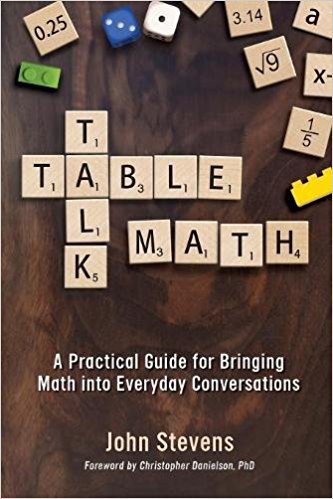
tabletalkmath

Book 24 is Table Talk Math by John Stevens (yes, THE John Stevens that co-authored The Classroom Chef with Matt Vaudrey) and it is an incredible read! I love that it is a quick, easy read, full of wonderful information and stories about John and his family! I find that this is another book that strikes me more as a parent than as a teacher.

There are several key points I’m taking away from this book. One is holding conversations with your child. I am so guilty about giving my daughters answers rather than asking them questions. I get so tired of hearing “why, mommy” when I’m at home. My sweet girls get the worst of me. I’m sure several of you that are teachers AND parents can identify with that, too (and if not, please tell me you can because it’ll make me feel like slightly less of a failure… thanks). By the time I get home in the evening (yes, evening), I’m exhausted and dreading helping with homework (thankfully my daughters’ school has an amazing principal who doesn’t allow homework beyond reading and a couple math problems), getting showers taken, supper, and bedtime. I’ve been with students all day (and I love them, don’t get me wrong, buuuut), all I want is some alone time or time to converse with an adult, and the girls want my undivided attention. This, in turn, makes me a bit snippy toward them – my patience is lacking by 5:30-6:00 in the evening. I’ve got to do better; I’ve got to BE better for them. They deserve the same time and devotion, no… they deserve MORE time and devotion than my students get from me. I am their mother! I love how John shares the stories about his children, and how he changes from “Mad Dad” to “Math Dad”. I want to transform from “Mrs. Ray” to “Mom” with more finesse each day, allowing them to have the best of me. These relaxed discussions about math are a great way to move forward with this.

Another key point is that kids should struggle and have to explain their reasoning once they reach a decision. Our kids (personal or professional) should have to think! John constantly reiterates that the answer is not as important as the process to get the answer. If we have the kids explain their reasoning behind their answer, it shows the mathematical processes happening “behind the scenes”. Oh, and timed-tests… no bueno. Research proves it’s ineffective. Stop doing it.

Finally, the piece of knowledge I’m taking away and implementing are the tons of resources John shares within the book! I’ve got to be honest and say that I’m actually cheating just a tad on this one because I’ve already shared the resources with our math teachers, as of just a few minutes before writing this post. But you know what? There are 50 books and I’m pretty sure you’ll allow me to already have one implementation complete as we move into the 2018-2019 school year, right? Please?! (And if you’re a stickler for it being implemented “in the school year”… I started back to work today as an 11-month employee and sent the email with several of the resources in the book after reading and before blogging, so technically, it’s being implemented in this school year. Boom! Also, I have a back-up plan.)

Some of my favorite resources from this book are below:

John Steven’s Would You Rather Math is a phenomenal example of authentic choices students make, both as students and adults. These choices require (gasp) math!

Andrew Stadel‘s Estimation180 website gives multiple examples for estimating, showing a benchmark then allowing students to determine an upper limit (maximum) and a lower limit (minimum) before estimating. The exact amount is listed on the website for the students (read: adults like me) who can’t handle not knowing the precise answer.

Fawn Nguyen‘s Visual Patterns website is amazing! Giving us examples of patterns and having students find the next, or “nth” term in the pattern shows sound mathematical reasoning. I love that some of the patterns can actually yield various answers.

Another site that can showcase various answers is Mary Bourassa‘s Which One Doesn’t Belong! As long as the student can give reasoning, accept the answers!  This site is a great conversation starter! I love the idea of debating answers, and that this site can be used with all grade levels!

Finally, the Fraction Talks website, created by Nat Banting, is one that I will be using with my personal children regularly! I love the use of flags as fractional representation! Building a strong understanding of fractions will help as my girls, and students, get older and begin having to see fractions abstractly.

At my school, I am in charge of putting announcements on the TVs each day. Another implementation for this book is to use these websites as part of the TV announcements! Selecting one problem each Monday and Wednesday (or Tuesday and Thursday), students can discuss math at lunch with their peers (we have a TV in the cafeteria that runs announcements all day, as well as one in the school lobby before and after school). I’m looking forward to hearing these discussions and providing math teachers an opportunity to capitalize on these conversations without sacrificing class time.

I highly recommend purchasing this book, especially if you’re a math teacher! The resources are tremendous and as a former math teacher I found myself nodding along many times. If nothing else, the footnotes provided by John Stevens are hilarious! I love his personality! Feel free to visit his website at tabletalkmath.com and join in on the conversation on Twitter at #tabletalkmath. Finally, one of my very favorite blog posts written by John is the explanation of the cover of Table Talk Math. You can find it here titled “7 Reasons to Judge Table Talk Math By Its Cover”. Clever, right?

As always, join in the flipgrid conversation using the password DBCSummer! Many thanks to Andrea Paulakovich who had this genius idea that flipgrid could be used to conduct a global book reflection on all DBC, Inc books! The space is there if you’d like to use it, and likely isn’t going away, so start sharing!

I am so excited to reach Book 25! Released immediately after Table Talk Math, Alice Keeler and the late Diana Herrington knocked it out of the park with Teaching Math with Google Apps! And oh yes, it is that good! If you are a math teacher, and you are a Google school, and you don’t own this book – you should fix that now. Right now. Check back for the blog soon!
#DBC50Summer 20/50: Instant Relevance

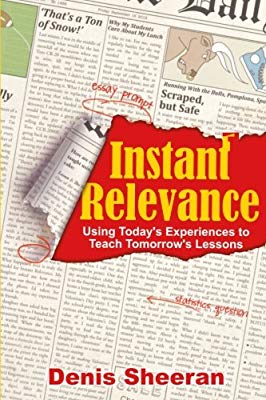
If I had a dime for every time I heard “When am I ever going to use this?”… well, I’d have more money than I have right now. The sad truth is that there are some lessons students are required to sit through and when asked that question, I won’t lie to them. They will likely never use it unless they go into a specified career field. I’ve never used it in day-to-day life. While this is the case for some pieces of our curriculum, there are far more concepts they will use regularly. It is our job as teachers to make those lessons relevant for students, so they aren’t even asking that question. It should be clear when they will use it in real life! And that’s what book 20 in the Dave Burgess Consulting line up is all about.  Instant Relevance by Denis Sheeran is an incredibly small book with an incredibly powerful message. Stop right now and grab your own copy! It’s worth it!

instantrelevance

Throughout this book, Denis shows us example after example of how to take every day experiences and integrate them immediately into your lessons. He speaks to how you must have a relationship built with students, so you will know which experiences will connect to your students. If you talk about the Super Bowl commercials to a room of students who don’t enjoy football, the lesson loses effectiveness. It is important to know your audience, and in this case, that is your students. Know them! Discover their interests, their passions. This will enable you to find connections and make learning relevant to them.

True to DBC form, “Instant” has two meanings here. It does, in fact, take the dictionary definition and apply it to education. It is also an acronym (I know, right? Impressive).  The Captain sure does love his acronyms… both in his own book and the books he publishes apparently! I’d love to know how long it took to make the connection between Denis’s ideas and the acronym INSTANT. Not sure how to make learning relevant? Just follow the acronym!

I: Infusing who you are in what you do

N: Natural flow – follow the question

S: Sudden changes to your surroundings

T: Television and pop culture

A: Awareness of your surroundings

N: National events and crazes

T: Two or more content areas

Not only is this book informative and conversational, it’s also hilarious. I totally want to meet Denis Sheeran. He made me laugh more times than I can count with his sarcasm throughout the book! I appreciate a good dose of sarcasm, that’s for sure! Denis is a math educator and many of his stories from this book relate to math lessons. However, this is not a math book! He has many other examples of relevance across content areas.

It’s not about using his examples, it’s about using his example! He wasn’t afraid to look outside education for educational content.

There are multiple quotes that popped out to me, but I’ll only share a few here.

  • “…as teachers we need to infuse our lives into our work…don’t leave these things at the door when you walk into your classroom; bring them with you. By doing so, you’ll be bringing in the unexpected possibilities and connections your students need.”
  • “Sharing stories in class opens the door, even floodgates, for our students to learn about us and become comfortable talking about their own life experiences…When you tap into your students’ lives, your class immediately becomes relevant.”
  • “Too often we place the lesson plan’s importance over the value of our students’ experience…guide our students to understanding – not for them into compliance.”
  • “There is no better way to describe the teacher-student relationship…than the words: “Meet me at my best. Then we can go together.”
  • “Instead of sidelining the topics captivating my students’ attention in favor of ones they struggle to stay awake through, I prefer to use them to instruct and connect.”

Do you notice a connection? These quotes were taken from throughout the book. The connection here is the connection. That is my implementation. I work hard to make connections with each of my students. I strive to be “that teacher” for them. I want to always notice the students who need a little extra love that day and know the stories of those around me. I want them to know my stories as well. Without making an authentic connection, it is difficult to make learning real for them. Therefore, my implementation will be to continue to connect with my students. I will continue to know them by name (focusing on learning my 6th graders’ names faster), saying hello every morning, and making the media center a safe haven for every student in the school. It is only by forming these relationships that I can meet them at their best, share the topics that are interesting to them, infuse our lives into the learning, and guide them through understanding their curriculum. Not only will I do this for my students, but also for the teachers in my building. I look forward to learning their stories, so I can make learning relevant for them as well.

Like I said, this little book is so powerful! Like Shakespeare says in A Midsummer Night’s Dream, “though she be but little, she is fierce.” Instant Relevance is a FIERCE book! One that I recommend you get now! Go ahead… I’ll wait.

The Flipgrid is available here with the password DBCSummer. Think of a lesson that was relevant for your students. Tell about that lesson; what did you do and how did your students respond? The idea for a global book study through flipgrid comes from my sweet friend, and incredible educator, Andrea Paulakovich. Go follow her on Twitter & follow her #DBC50Summer journey on her blog here. Be bold – be the first person to post your thoughts! Others will follow!

Check out Denis’s website here! His blog posts are just as awesome as his book! You’ll see his humor clearly! Multiple podcasts can be found along the side of his website. Be sure to check out the Instant Relevance podcast here! You can also follow the community on Twitter using the hashtag #MakeItReal. Join the chat using the same hashtag on Wednesday nights at 9:30 EST. Denis also has another book out called Hacking Mathematics. Check it out as well!

This is so hard to believe… we’ve finished Book 20! That means it’s time for another #DBC50Summer Recap! Watch for that post in the next day or two. In the meanwhile, check out Summer Recap 1 for information on the first ten books, and my #DBC50Summer interlude about discovering my #EDUpassions.

*Also, Denis? If you’re reading this… let your students know that I went back and removed one space after every paragraph. That’s a LOT of wasted paper, right? Although, this likely won’t be printed. At least, I hope not. But still…on principle, I went with the one space rule. (It may have hurt a little, but it’s just the sacrifice we must make for students.)

#DBC50Summer 18/50: The Writing on the Classroom Wall

With the exception of the #DBC50Summer: Discovering my #EDUpassions post, I have not blogged in nearly a week.  There’s a perfectly good reason for this…

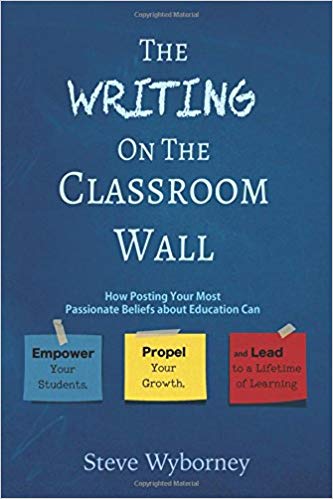
Book 18 in the Dave Burgess Consulting, Inc line up is The Writing on the Classroom Wall by Steve Wyborney.  In this book, Steve challenges us to literally put our thoughts and passions, what we deeply believe, on our walls (yes, our physical wall space in our classroom/office/hall/etc) and share with anyone and everyone what those beliefs are… yeah, that’s some kind of scary, I’ve got to admit!  And yes… I was stalling.

twotcw

I was so hesitant about this book.  I have carried it around in my book bag all week!  I spent the majority of the week in western North Carolina working with a group of phenomenal educators from across the state, facilitating workshops in an NCCAT session called Teaching Generation Z: Active and Digital Learning.  I went to my room early each night while others stayed up playing games (I love to play games!) so I could read.  I would open it, read a few pages, then realize I didn’t have the slightest clue as to what I’d just read.  Finally, I realized that I needed some “book reading prep” time, and I realized I needed to decipher my own passions before I could really delve into this book.  So last night, after an inspiring NCTIES Board Meeting I sequestered myself in my room and used the brackets approach from Launch to nail down my educational passions.  I was satisfied with the Final Four, and still feel as though they are indicative of my strongest beliefs in education.

So tonight… I knew I had to read what Steve had to say.  No more avoiding it.  I’ve got to be honest here…it was insanely challenging to read the entire thing.  Now don’t go thinking it wasn’t a “good book” because it was! It just pushed my thinking in ways I wasn’t ready for tonight. I mean, I had even prepared for reading this particular book in advance with my in-depth research to discover my own passions!  That wasn’t enough.  Steve brought his A-Game in this book!

First of all, this guy has a way with words.  He is truly a wordsmith, an artist really… the way he writes makes you slow down and appreciate what he’s trying to say.  He’s very metaphorical, so prepare to buckle down and focus while reading this one.  It’s so worth it!  Lord help us when he started talking about reflective writing.  Specifically he states

Reflective writing is a powerful process that provides opportunities to personally, deeply wrestle with thoughts and ideas that are struggling to become more fully formed. -Steve Wyborney

In that very moment, I desperately needed a Madea “hallelujer” gif to adequately express my agreement.  Blogging my reflections on each of the DBC books with a plan for implementing has allowed me to go deeper with the book than I imagined I could.  Steve also mentions (Big Idea 20 – the book is set up by sharing the big ideas that he placed on the walls of his classroom, the discussion he had with his students, and how the idea grew) the idea of designing a path for others to follow your learning after you discover something new.  Knowing, when I started blogging, that these would be publicly available, it made me pay more attention to what and how I was learning.  Steve says, “I am determined to find my learning by giving it away…it is often in the sharing of my journey that I learn the most.” Yes, yes, and yes!

In fact… there are so many quotes throughout this book that are tweetable nuggets of knowledge that I just started creating some simple quote graphics on Canva.  Check out a few of them below.

This book is really geared toward any educator who wants to dive deeper into their educational beliefs.  If you want to really think through your WHY, this book will certainly bring that out.  It was challenging to read, not because of the quality of the writing (that was phenomenal), but because of the gravity of the message.  It really stretches your thinking and makes you examine your own “Big Ideas” about education, and how you can share it with your learners.

I’m going to do something I rarely do.  I am going to take the book at “face value” with my implementation plan.  Steve challenges readers at the end of the book to post at least one Big Idea on their wall through these steps.  This is my takeaway.  This is how I will implement The Writing on the Classroom Wall... exactly in the way Steve suggests at the end of the book.  Here are HIS steps for implementing TWOTCW!  Grab a copy of the book for yourself and join me!

  1. Select an important idea.
  2. Post it on your classroom wall.
  3. Explain to your learners what the Big Idea means to you.
  4. Be prepared to let the idea impact you personally! (whew)
  5. Seek opportunities to feature the idea.
  6. Grow your set of Big Ideas.
  7. Share your Big Ideas.

Check back in the fall for a follow-up about how this adventure goes.  I’m a bit scared to dive into this one, but knowing that it will benefit my students AND me makes it worth it.  My takeaway from Teach Like A Pirate was a quote from Dave Burgess who said, “It’s not supposed to be easy; it’s supposed to be worth it!” This implementation will not be easy for me. It seems so simple, but until you’ve read this book you can’t know how personal and powerful this “seemingly simple” action will be.  I do trust that it will be worth it, though.  So I’m going to do it.

To follow along with the community, use the hashtag #TWOTCW and visit Steve’s website.  His website is full of excellent activities for math, too!  Here is a book trailer for The Writing on the Classroom Wall.  I also highly encourage you to use the space on Flipgrid to reflect and share your response to TWOTCW with the world.  As always, the password is DBCSummer.  If no one has responded yet, take a risk and be the first! This digital space is meant to serve as a global book study for those with an affinity for any DBC book.  Andrea Paulakovich had this incredible idea & I recommend following her (she’s amazing) and her #DBC50Summer journey!

Next up on #DBC50Summer is the first “sequel” book.  The authors of Book 6, 50 Things You Can Do With Google Classroom, Alice Keeler and Dr. Libbi Miller are back with 50 Things to Go Further With Google Classroom!  Grab yours and prepare to see the practical, student-centered applications of Google Classroom! So excited to share Book 19 with you soon!

Edited April 5, 2019 to add post to implementation! See how I implemented The Writing on the Classroom Wall here!