#DBCBookBlogs: They Call Me “Mr. De”

Cassie Bernall, Steve Curnow, Corey DePooter, Kelly Fleming, Matt Kechter, Daniel Mauser, Daniel Rohrbough, Rachel Scott, Isaiah Shoels, John Tomlin, Lauren Townsend, Kyle Velasquez, Coach Dave Sanders

The names of those murdered by two students at Columbine High School on April 20, 1999. Frank DeAngelis was the principal at Columbine that day and he remained principal for the following 15 years. This may go on record as the shortest #DBCBookBlog to date as I feel that anything I would say would diminish the power of this book. This book left me speechless. I cried. I mourned the loss of those lives. I felt the Rebel Pride of Columbine as I read about the recovery, the hope, and love of the community through Frank’s eyes. This is a must-read book.

TheyCallMeMrDe

There are certain events that have occurred in which I remember exactly where I was and how I felt. The mass tragedy at Columbine was one of those times. I was in middle school and as news didn’t spread quite as quickly as it does today, I found out about the shooting on the evening news. There wasn’t a lot of information available, but I remember feeling stunned that this could happen. The community of Columbine seemed so much like my own community – supportive, vibrant, and loving.

To say that anything “good” came from that day must feel like a slap in the face to those who experienced the horror. With that in mind, I will just say that I am thankful for the efforts of Frank and so many others to protect students across the country from these senseless tragedies. At my school, we now have locks on our doors that lock from the inside, a full-time School Resource Officer (SRO), video surveillance across our entire campus, a front-door buzzer, panic buttons, badges for volunteers and visitors, and more. We practice two lockdowns per year in conjunction with our Sheriff’s Department. However, with all of these safety protocols in place, these tragedies continue to occur.

While I feel as though I’m powerless to prevent this from happening to anyone else, I can be certain to be more involved in the lives of my own children. By my children, I mean both my biological daughters and the thousands of students whom I consider to be my children. I struggle to believe that children are born evil. I’m not sure what changed the two gunmen from silly little boys to murderous young men, but I can be sure to be proactive as a parent and an educator. No one knows what tomorrow holds. We can only spread kindness, hope, and love, just like Frank DeAngelis.

One of the things that stood out to me the most from reading this book is the effort Frank put in to include the names of every single person who was instrumental in the recovery and resiliency of the community. He honors the students who lost their lives by sharing their stories and being involved in countless charities and organizations. He speaks across the world and reaches out to those who have been affected by similar tragedies. Lean on others when you need support. Like Frank, it’s important to seek treatment by a professional and show your emotions. Grieve together. Share positive memories with one another. Check up on each other. If you are a spiritual person, dive into your faith like never before. These are some of the keys to Columbine’s hope, recovery, and resiliency.

Thank you, Frank DeAngelis, for sharing your story. Thank you for being raw, honest, and vulnerable. Thank you for allowing us to see you. I imagine writing this story was part of your own recovery and I appreciate your heart. Because of you, the lives of the Beloved Thirteen will continue to be remembered. Never Forgotten.

∞∞∞

No matter what your profession, no matter your political affiliation, your spiritual beliefs, every person should read this book. It’s important that the truth is shared and that these lives are remembered. Read a free preview, then order your hardcover copy here.

#DBCBookBlogs: The Revolution

“If you want to have students in your classroom, then keep teaching models from the twentieth century. If you want to have learners in your classroom, then keep reading…”

~Darren Ellwein & Derek McCoy

I spent ten years in the elementary setting. Even in my undergraduate courses, when I met middle school education majors, I would shake my head wondering what they were thinking. Why would they want to teach hormonally imbalanced children who were bigger than they were?! Those kids who were stuck between being a child and becoming an adult. I equated middle school to that incredibly awkward time in my life when I quit being “one of the guys” and became a cheerleader. This was a time before makeup and braces, a time of bangs, acne, thin, unkept hair… it was not. pretty. y’all. (And before you ask, no; there will absolutely NOT be a picture of this anywhere in this post)

So why in the world would I want to re-enter that world of awkwardness and getting picked on? When my Superintendent shared a job description with me that pretty much came straight from a dream world, he had me hooked. Then he informed me… “I’ll need you to move to a middle school”

…say what?!…

So for the past three years, I have been back in the world of middle school. Just like the authors of The Revolution (book 67 for Dave Burgess Consulting, Inc), I now believe middle school is THE place to be! I can’t imagine teaching at any other level but middle school! I love every second with these kids. They are truly going to change the world; heck, many of them are already changing the world… and they are somewhere between 11-15 years old. Darren Ellwein and Derek McCoy are both middle school principals who are revolutionizing education. But they don’t just talk the talk, they are walking the walk and they share their stories in their book!

TheRevolution

Throughout the entire book I was nodding my head, highlighting, and writing notes in the margin (by the way, I’d suggest a print copy so you can do the same). This is yet another book that I could write a few thousand words for a reflection; I’m going to try NOT to do that, though. No promises… I may get pumped up and not be able to help myself.

Darren & Derek talk about it all in The Revolution, calling those who are doing the hard work and changing education from the industrial age “Revolution@ries”! Some of the topics discussed are:

  • Classroom Management
  • Growth Mindset
  • Culture
  • Learning Spaces
  • Funding (Friendraising – oh em gee, I love this)
  • Empowerment
  • Collaboration
  • Global Learning
  • Empathy
  • Design Thinking
  • Makerspace & the Maker Culture
  • Learners as Revolution@ries
  • Revolution@ry Leaders
  • Personalized Learning (this example is on point, by the way)

When I say there’s something for everyone in this book, it’s easy to see why that’s not an exaggeration. Even though Derek & Darren are middle school principals and discuss their experiences as middle school educators, make no mistake – this is not a middle school ONLY book! This is for ALL levels of education!

Reflections & Connections

As I was reading, I made many connections. I immediately identified with the section about learning spaces. Upon arriving at the middle school, I wanted to change up the layout of the media center immediately. It screamed “old school” and I wanted to bring new life to it. I wrote a blog post about the Media Makeover a while back. It’s important to know that this space still isn’t complete! It never will be complete. As long as new students are coming into the space, things will change. Why? I get their input. Former students come in and see the changes, usually responding with “Mrs. Ray, why did you wait until I left to get the cool stuff?!” Ha! It’s ironic because every group says that, which must mean we’re doing something right! The space continues to improve and students still want to come back and visit. Even now, our space has changed drastically from the images in the Media Makeover blog. Here’s a tweet highlighting some of the changes.

Another BIG a-ha for me was the compliance –> engagement –> empowerment theme in the book! I was privileged to guest moderate a #champforkids chat (founded by Kelly Hoggard, a phenomenal educator and friend from Virginia) in September 2018. Our topic was “Engagement or Compliance” and we discussed this very idea. The idea that engagement surpasses compliance. Compliant students aren’t necessarily learning anything; they’re just playing the game well. They are answering the questions and doing what’s asked of them. There is no passion behind their eyes, no enthusiasm for learning. Engaged students are sitting on the edge of their seats practically begging for more. I don’t know about you, but when given the choice, I’ll take an engaged student any day! Then Darren & Derek throw in empowered students and I’m over here, like, “I want those kids now! As in right now!”

Part of my passion as a media coordinator is teaching students to be lifelong learners who are knowledgeable about finding relevant, reliable, safe, and accurate information in both digital and print formats. We have really dug into teaching research skills using the LAUNCH method (more on that in a later post) based on AJ Juliani and John Spencer’s book, Launch. Rather than requiring a certain topic to be researched, students have chosen their own topic and were required to find three sources that were relevant, reliable, safe, and accurate, summarize and paraphrase the information contained within those sources and have learned the basics of citing sources using APA or MLA format (and where to create those online). Yes, there are currently over 350 research projects going on at the same time right now and it’s an incredible feeling!

Implementation

This leads me to the implementation plan. In the chapter “A Final Call to Action” Darren & Derek share “It’s exciting to talk about revolution, but a revolt against the status quo doesn’t happen without action. The words on these pages have no meaning unless you put them into practice.” Sounds a lot like my favorite quote from Teach Like A Pirate by Dave Burgess.

“Inspiration without implementation is a waste.”

This quote has guided all of #DBC50Summer and #DBCBookBlogs as I am trying to implement at least one thing from each book. I’m getting the point in the school year that I’m going to need to begin thinking about the 2019-2020 school year as the year for implementations. This year is rapidly coming to a close. I believe I can squeak this one in though, because it correlates with an idea I was already trying to work out in my head.

I wanted students to be able to share the information gathered from their research with their peers but wasn’t sure how to have them present it. That’s just the problem; I was trying to put them in a box and tell them how I wanted it presented. Ugh! I know better than that! Now I’m getting out of their way and allowing them to decide how they want to showcase what they learned in their research. The sky is the limit. We have an incredible makerspace, virtual reality, Merge cubes, and we’re 1:1 with Chromebooks and Bring Your Own Device. These students can literally do whatever they want to share their information with their peers. I’m excited to see what they come up with.

Two other implementations…

I’m going to finally make myself sit down and create a list of all the items we have available in our makerspace and devise a plan for teachers to get in the space and put their hands on the materials to connect it to their curriculum. (Fit the curriculum into the learning rather than fit the learning into the curriculum, as suggested in The Revolution)

I want to create a #RevoltLAP playlist that will get me amped before going to work! Songs like Eminem’s “Lose Yourself,” Imagine Dragons’ “Whatever It Takes,” and others will certainly be in the mix. Share what revolution song gets you pumped to revolt against the status quo in the comments below! I’ll create a playlist of these songs and share via Twitter. I’ll also link it here!

#RevoltLAP

Be sure to follow the conversation on Twitter using the hashtag #RevoltLAP! I’m expecting great things to come from this book and I know you’ll want to be part of it! I’ve known Derek for years and can personally attest to him being the real deal! I look forward to meeting Darren and loved reading all about his own revolution@ry journey! Soon, you will be able to find out more about Darren and Derek on the Where are the PIRATES section of the Dave Burgess Consulting, Inc website. For now, check out Derek’s website here and Darren’s website here. I’d also suggest subscribing to both of their YouTube channels! Derek is here and Darren is here. Finally, go check out the Flipgrid space and leave words of inspiration for other Revolution@ries! We are all in this together, and we need support! A huge shoutout to Andrea Paulakovich for allowing me to copilot this space. It was her incredible idea to brought the Flipgrid to life!

#DBCBookBlogs: From Teacher to Leader

During the summer of 2016, I received a call from my Superintendent’s office asking me to meet with him the next day. I wasn’t entirely sure what this meeting was about and to say I was nervous was an understatement. I joked with him as we walked to his office that I now knew how it felt to be called to the principal’s office.

After exchanging pleasantries, he shared a job description with me that was pretty much something out of a dream. Not only would I formally combine my love of instructional technology and reading, I would be piloting a position unlike anything in our district. I would be working with students and teachers in an effort to support our first magnet program that had opened just a couple years before, in a school that had been open for 16 years.

There were tears as I realized this would mean I would have to leave an elementary school full of students (including my own daughter), teachers, and administration that I loved like family and venture into a completely new world of middle school.

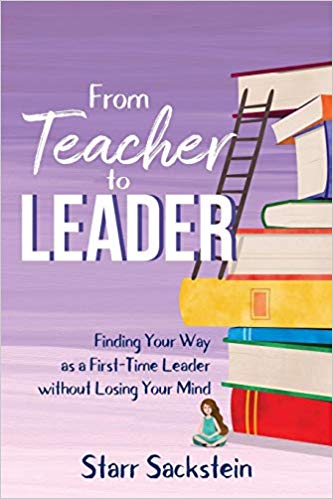
The 64th book in the Dave Burgess Consulting, Inc line of incredible books is one that I would have loved to have during this transition in my career. In the book From Teacher to Leader, author and educator Starr Sackstein takes us on a raw, unfiltered journey through her first year as a leader.

teacher2leader

From the very first chapter, I knew this book would be something special. Two quotes from page one had me fully invested in whatever Starr was ready to share from that moment on.

“Regardless of whether they stay in the classroom or go to another position, they must reimagine themselves in order to stay relevant and excited about the work they are doing.”

“From the second I decided education was my path, I never allowed good enough to be part of my story.”

Status quo, complacency, and mediocrity are some of my biggest pet peeves. I appreciate that Starr shares this same philosophy and lives it out loud immediately in her book.

Making the decision to leave the classroom was one of the hardest things I’ve ever done professionally. It was November 2013 when a media coordinator position opened in my district. Anytime a singleton position opens in a school, especially in a small district that you love, you know you have to go for it – even if it is 45 minutes from your home. So I did. Telling my students that I was leaving mid-year was devastating. I will never forget that last day of school with them. They were so proud of me for following my dreams and yet, we cried through the entire day. One student didn’t even come to school that day because he was so upset. When we returned from Christmas break, they had a new teacher and I had nearly 300 new students.

Even as I left my classroom that afternoon (nearly five hours after the students left from their early dismissal), I stood in the doorway and cried as I thought about the laughter, learning, and love shared in that room. It’s one thing to leave the classroom… I was leaving my students. I felt so selfish leaving them; I knew that if I didn’t go for it, it might be several years before another position came open. I had to do what was right for my family and me. It didn’t make it any easier to leave.

As a media coordinator, I felt the first of the feelings of isolation that Starr authentically shares with us in her book. I was a “singleton” – the only person in that position in my school. However, when I began the pilot position I mentioned above at the middle school… well, that was a whole new level of isolation. By definition, a pilot is the first. In this case, it was the first and only in a middle school. There was only one other educator in the entire state of North Carolina with the same job description (who interestingly enough was also named Alicia) and she was nearly two hours away and serving in a high school. I couldn’t share any of my frustrations with anyone at school for many reasons. I didn’t know them, there was no trust built yet, and to be honest, some of my frustrations were about one staff member or the other, or the way things had historically been done, and I certainly couldn’t air those as an instructional coach. Talk about destroying relationships before they even started! Isolated, alone, and desperately craving camaraderie and fellowship with others, I turned to Twitter.

Oh how I wish I’d had this book then! Knowing that others have felt those same feelings would have talked me off a ledge so many times. Thankfully my directors were just a phone call away. I tried building relationships that first year and planting seeds as Starr suggests. I felt like an epic failure. I couldn’t see that I was making any difference, like I was a hamster spinning in my wheel inside my big brick cage. Anytime I felt like throwing in the towel (which was about weekly), my directors would come to my rescue. I can’t tell you how many times my mentor and friend Lucas Gillispie shared the same line with me.

Play the long game. -Lucas Gillispie

Looking back on the past three years, he was right. I see the shifts that have happened at my school. While I’m not naive or prideful enough to believe it was all because of me, I am grateful to have a small part to play in those changes. I am so proud to work for the students, teachers, and community I serve and I love that I get to see many of the seeds that I sporadically threw on the ground that first year grow into some amazing experiences and terrific relationships!

Starr shares excellent advice on how to handle that first year (let’s face it… years, plural) as a leader. She shares about cultivating relationships, co-planning and co-teaching, remaining relevant, supporting teachers by meeting them where they are. The reflections from her Education Week Teacher blog “Work in Progress” are so powerful because they are truly the unfiltered version of her first year. These were her thoughts as she went through those trials and successes – reflecting and celebrating, sharing her intentions publicly.

I did quite a bit of highlighting in this book because I kept reading things that stood out to me as truth! So much of what Starr shares I can personally vouch for its effectiveness in new leadership roles. Things like showing up, modeling learning, gathering feedback, knowing adult learners, and knowing your change-makers are all vitally important in establishing yourself as a successful leader.

Starr encourages us to frequently ask ourselves if we are the type of leader we would want to work for. I love that she never asks the teachers she serves to do something she wouldn’t do herself. I fully support that and I believe teachers appreciate when leaders are willing to “do the dirty work” – I know I did as a classroom teacher. It spoke volumes to me when one of the leaders would work one-on-one with a student, or teach my class while I observed another, etc. I try to do the same for the teachers I serve.

So finally… that brings me to my implementation of From Teacher to Leader which stems from Starr’s wisdom about listening. I’ve got to be honest with you; I’m a horrible listener. My brain is always going a mile per minute and I’m so guilty of thinking about how I will respond (or even something totally off topic) while someone else is talking to me. During one of the coaching PD sessions I attended, we participated in some excellent protocols for listening.

In one, Partner A did the talking for 2 minutes while Partner B drew sketchnotes about what Partner A said. Then, for one minute, Partner B shared the sketchnote with Partner A sharing what they heard them say. Partner A then had 30 seconds to correct or extend on anything Partner B said in their restatement.

Another protocol was based solely on feelings. For three minutes, Partner A talked about something they felt strongly about while Partner B made eye contact and listening without speaking. Partner B then has 90 seconds to restate what Partner A said relaying the emotions they saw exhibited from Partner A. Finally, Partner A gives feedback about how it felt to truly be heard by Partner B. Then the roles switch.

I have to tell you that both of these were incredibly awkward. I didn’t realize how strange three minutes of eye contact with a friend would feel and how many times my mind would start to drift and I’d have to purposefully bring myself back to the conversation. It did prove to me how important active listening is and how poor I am at doing it on my own!

So my implementation is to purposefully engage in active listening with both the teachers and the students I serve. I’m not saying I’ll employ either of the protocols I just shared, but I will be more attentive and intentional about pausing the thoughts in my head and allowing what others are saying to process completely before responding. (This is going to be so tough for me… anyone else struggle as much as I do with this?)

No matter what, it’s important to remember what Starr says here! The learning happens through mistakes. Take all the learning you can from every mistake throwing perfection out the window. Leaders make mistakes, too. Being transparent in those mistakes will build more authentic relationships which leads to more successful leadership.

Man, what a book! I am loving Starr Sackstein and her vulnerabilities in sharing her story. If you’re considering making the move from the classroom, have recently made the shift, or are already in a position of leadership and are looking to grow professionally, I would definitely get From Teacher to Leader and start reading! Bet you can’t put it down!

As always, the flipgrid is available for your reflections if you choose to use it (thank you Andrea Paulakovich for allowing me to join in this brilliant idea for global collaboration on every DBC, Inc book) and I would love to connect with you on Twitter or Instagram. I definitely recommend that you connect with Starr (contact info will be updated here soon) and check out a free preview of the book here. Warning: you’ll want to purchase it! If you want more awesomeness from Starr, you can google her to find tons of podcasts, YouTube videos (including this TEDxTalk about giving up grades), and check out her other books!