#DBC50Summer: Discovering my #EDUpassions

One of my favorite things about my journey in the #DBC50Summer is reading the Dave Burgess Consulting, Inc books in the order of their release.  I have so loved seeing names of future authors before they were published as they contribute to the earlier books.  Another exciting piece of reading in order is drawing on the connections between the books released around the same time.  It has really given me an even deeper appreciation for the effort of every single team member within the DBC company.  The way common messages flow throughout the books is so impressive.  There is no way that kind of seamless transition is coincidental.  That is only achieved through hard work and attention to detail from every person involved – from the author to the editor and through the publisher.

Here’s what prompted this little #DBC50Summer interlude…

In reading Play Like A Pirate I realized that Quinn Rollins knew what his passions outside of education were – toys, games, and comics.  He brought those into his classroom with great success. Reflecting on passions, I also realized that I dabble in a bit of everything within edtech and “trends” in education, but was unsure of my true educational passions.  I am not even halfway finished with my career in education and I wanted to discover what my passions are, what could sustain my enthusiasm for teaching throughout the next 16 years.  As I come to book 18, The Writing on the Classroom Wall, I realize that it doesn’t feel right to read the book without having those passions nailed down.  How can I post my passions if I don’t know what they are?

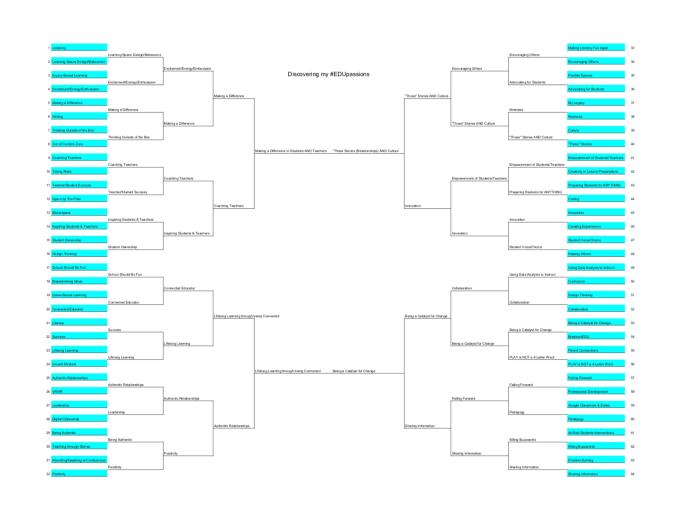
Amazingly, as I read the next few books in the line up, there was a section about discovering your passion.  (I’m seriously not making this up – go get a copy for yourself and check it out!) . Within LaunchJohn Spencer & AJ Juliani discuss the use of brackets to force a decision between two topics.  Using this idea, I found my #EDUpassions!
Screen Shot 2018-07-20 at 12.11.52 AM

The process?

First, I brainstormed any and all concepts, tools, big ideas, lessons that get me excited about teaching.  I started by thinking of tech tools and their functions, like Google Apps for Education and BreakoutEDU.  Then my thinking became deeper through coaching teachers and forming authentic relationships with those I work with.  I numbered each topic 1-64.  Using a random number generator online, I was able to put two ideas “against” each other in brackets.  While considering my passion level for each, I went with my gut when choosing which topic/idea should advance in the brackets.  A couple were tied because I honestly couldn’t eliminate one or the other OR because the two topics were so similar and fit hand-in-hand.  *I did notice that I put design thinking into the brainstorm twice, but seeing as how they ended up eliminated anyhow, I just left them.

My brackets in Google Sheets are here.  This will force you to make a copy and create your own EDUpassion brackets as suggested in Launch!  Just replace my topics with yours! The teal blue cells are my original 64 educational topics that get me excited.  I narrow them down, eliminating one of the two options until I am left with only FOUR passions!

My Final Four are as follows:

  • Making a Difference in Students and Teachers through Coaching

  • Lifelong Learning through Being a Connected Educator

  • Being a Catalyst for Change

  • “Those” Stories (you know the ones… those that make you tear up when you share them with others) and Culture

I enjoy coaching teachers.  I especially love to see the impact made on the teacher, the classroom, and most importantly, the students through a successful coaching cycle.  When the teacher and I have co-planned a lesson, co-taught it, then reflect on it together, it is easy to see the growth in their students, and in the teachers themselves.

I am very clearly a lifelong learner.  I am never satisfied with the amount of knowledge I have.  I like to look up information on topics and people, just because I like having the knowledge.  I crave gaining new knowledge!  One of the best ways to continue to grow and learn in this field is to be a connected educator.  If I weren’t a connected educator, I could have committed to reading all of the DBC books this summer, started strong, then chosen not to finish because I didn’t have anyone holding me accountable.  Or I may have still continued, persevered through the weeks I have been swamped with presentations, and completed the challenge.  Who knows?  I do know that no one else would have known #DBC50Summer was happening.  Several educators are joining in on the fun and are strengthening their skill sets and will be inspired and ready for their students to return.  Thankfully, because I am a connected educator (on Twitter, specifically), I am able to not only learn and grow on my own, but connect with other educators from across the country who also hold an affinity for DBC books and have begun their own versions of #DBC50Summer.  Almost every one of the authors from the first 17 books have reached out to me with kind words after reading the #DBC50Summer post about their book.  This has blown me away and strengthened my connection with the books, and has made me adore these authors even more!  Being connected has brought both me, and my students, opportunities they likely would not have had otherwise.

Being a catalyst for change comes from working at my school, local, state, and national levels to revolutionize education.  I greatly enjoy the work I do mentoring coaches throughout my state, serving on the NCTIES board of directors, and piloting a new position which formally marries the roles of digital learning coach and media coordinator in my district. Being able to work on the national framework for Future Ready Instructional Coaches has been incredible.  This summer I have been fortunate in that I get to facilitate professional development with teachers across the western half of my state for two weeks.

Finally, you know “those” students who have “those” stories? The ones that touch your heart and will always stay with you?  They are my passion.  Their stories, as heartbreaking or heartwarming as they are, become part of my story.  We either cry together or celebrate together, and their stories of overcoming adversity inspire me to continue my educational career.  “Those” stories are the ones that sustain me, and many educators across the world!  Playing an integral role in forming the culture in my school has become more and more important to me.  I want every student and staff member to feel valued.  I want my administration to know they are appreciated (and that I would never EVER want to walk a day in their shoes).  I believe that when your school has the right culture, there is no stopping the growth in everyone who steps foot in the building.

So, my #EDUpassions… it took a while to nail them down, but I feel confident in saying that these ARE my #EDUpassions.  These are what get me out of bed in the morning.  These are what excite me and make me look forward to the new school year.

It always comes back to the students for me.  THEY are my why.  They are my number one passion.

Forming those authentic relationships is what allows me to know their stories.  It is imperative that we build relationships with our students.  I also encourage educational leaders to build relationships with their faculty.  Talk with them informally; get to know their families; get to know their stories.  Connect with them outside of school and make developing a relationship a priority.

Now that I have these #EDUpassions planted firmly in my head, and on my heart… I can get back to #DBC50Summer reading, reflecting, blogging, and implementing!  Let’s do this!

You down with GPD? Yeah, You Know Me!

Good luck getting that out of your head!

What is GPD?  Gamified Professional Development.  Microcredentialing, badging, gamification… these seem to be the latest and greatest buzzwords in education.  Normally, I am immediately turned off by buzzwords.  For example: “21st Century Learning”… y’all, it’s 2018 – for the love of everything holy, let’s move on from that one, please!  “Innovation”… putting a worksheet in Google Classroom is NOT innovation, it’s a digital worksheet.  “Project-Based Learning”… doing a class project at the end of a unit does not merit the label of PBL.  I get frustrated because the buzzword becomes a “thing” and everyone rushes to do “the thing” without giving “the thing” any real thought or due diligence.

With that small rant behind me (I’m sure it won’t be the last though), I have to say I’m a huge fan of the move toward gamifying professional development.  For the first 8(ish) years of my career, professional development was the one thing I dreaded more than any other.  Give me all the paperwork, grades, conferences, faculty meetings, or any other <insert educational acronym here>, and I’ll do it with a smile on my face.  Give me some ridiculous professional development where I sit through an hour workshop of something someone with a higher pay grade than me thought I needed to know, and I was immediately rolling my eyes and mentally checked out.  I had numerous CEUs from professional development I’d attended, but hadn’t learned a single thing, other than how to refine my ability to pass notes more stealthily.  Then, Lucas Gillispie was hired by my district in 2014 and his first PD with us was #Education, in which I learned what I was missing in professional development.  I realized that I needed to personalize my professional development.  I immediately started using Twitter professionally and following the folks Lucas recommended following; my Twitter PD exploded from that moment.

I continued to learn from Lucas as a pilot participant in the gamified professional development he created called “EPIC Academy” in 2015.  I was immediately hooked by the aspect of a leaderboard and earning points!  Above all else, the learning that happened here was RELEVANT!  If the quest didn’t pertain to what I needed at the time, I just dropped the quest and chose something else.  I had CHOICE in what I learned.  The quests in EPIC Academy were designed to be bite-sized pieces of information.  Showing mastery of each bite led to another bite, and before you know it, you’ve created a product that shows mastery of something much bigger.

In 2016, Lucas asked me to come onboard as a quest designer for EPIC.  I was terrified as this was “his baby” and I wanted to be sure to maintain the level of awesome he had precedented, while keeping the “buzzword” aspect out of it.  I wanted to give each quest I designed the forethought it deserved, and have participants create a product that was relevant and useful to them and their learners.  I designed the quest chains for Augmented Reality and Digital Formative Assessment that year.  Since then, I have been privileged to design the quest chains for Digital Storytelling, BreakoutEDU, Digital BreakoutEDU, Teacher Productivity Tools, Classcraft, and BreakoutEDU 2.0.

EPIC Academy has taken off exponentially since 2016.  Lucas applied for, and was awarded, a Digital Learning Initiative Showcase Grant from the NC Department of Public Instruction to expand EPIC Academy, to connect and share the content to educators from across the state.  As part of this grant, Lucas designed a model for mentors to assist those in EPIC Academy.  As an EPIC Mentor, we support and encourage educators new to the gamified professional development world.

Screen Shot 2018-04-29 at 7.57.15 PM

I have watched this model flourish under Lucas’s leadership.  There are no educators in EPIC that were required to join; participation is completely optional.  With some of the latest buzzwords being “microcredentialing”, “badging”, “gamification”, I am thankful that EPIC Academy is untarnished by the effects of buzzwords thus far.  Through EPIC alone, I have gained over 8 Digital Learning Competency CEUs, but more importantly, my students and staff have been exposed to the benefits of Google Drive, Coding, Skype, Augmented Reality, Digital Formative Assessment, YouTube, Virtual Field Trips, BreakoutEDU, Flipgrid, Appsmashing, QR Codes, Game Based Learning, and much more.  My teaching has been taken to the next level, and my desire for continuing learning is piqued.  GPD is the way to create life-long learners of educators; the days of one-hour professional development is ancient history for me. So… who’s down with GPD?

The Secret to Coaching

For the past 4 years, I have had the pleasure to be part of an amazing network of educators from across North Carolina – the Digital Leaders Coaching Network.  Started in 2014 by the Friday Institute, this cadre of teacher leaders has been given tools to practice the art of coaching.  Over the past four years, we have engaged in multiple book studies, several personality tests, and more coaching scenarios than imaginable.  We have had guest speakers from across the United States and even internationally.  I have met some of the most incredible educators from across our state, educators that see themselves as leaders, educators that are the exemplar of growth mindset.  I have seen our group grow exponentially, both in attendance and in terms of professional growth of individuals that are taking part.  In 2014, there were a little over 50 educators in attendance, and there is so much interest that now we have two cohorts each year, both rocking a full house of educators!  Last year I served as a mentor in the east cohort (#eastisbeast, #bEastmode) and this year, I serve as a mentor in the west cohort (#westisbest).

There is so little professional development available for instructional coaches.  Without professional development, educators become stuck in a rut, not knowing what best practices are and how to implement change in their school.  This network has given me best practices, protocols, a professional learning network, and has changed the culture of both schools in which I have worked.  It has allowed me to grow from a timid first-year media coordinator to a confident innovation facilitator, leading a pilot that is changing the role of media coordinators in my district to formally include the role of a digital learning coach.  I teach all 400 students in my school in multiple subject areas, co-planning and co-teaching with their content area classroom teachers, as well as design and implement professional development for teachers in my school and media coordinators/innovation facilitators across my district.  I stay current with educational technology trends and bring those trends to my school through grant writing and working with research organizations.  Oh – and I also teach media classes once a month and hold open book circulation times every morning and throughout the day.  I also manage our 1:1 and BYOD initiatives in my school.  Without this network of tremendous educators, and the support of the leaders at the Friday Institute and NCDPI and NCTIES organization, so much of the change that has been implemented in my schools and district may not have happened.  This opportunity was certainly a catalyst for so much growth and forward momentum both within myself and my district.

Over the past four years, I have presented multiple times at our state technology conference (ISTE affiliate) NCTIES as a featured speaker, worked with amazing educators to share information about being a connected educator, coding in the classroom, and MinecraftEDU at NCCAT’s Teaching Generation Z seminars, accepted the challenge of piloting the Innovation Facilitator job description, and was elected to the NCTIES Board of Directors as the North Region Representative.  I was also named as a Future Ready Instructional Coach Thought Leader.  It is not a coincidence that all of this happened during my time with NCDLCN.  I felt more confident being part of this cadre, more prepared to face whatever may come my way, and more connected to those outside my district.

So with all of the time spent in the past four years of NCDLCN, what have I learned to be the number ONE secret to coaching?!  Relationships.  Everything boils down to relationships.  Relationships with your administration, relationships with your teachers, and relationships with the students.

When I first started coaching, I was so excited to change the face of education that I started as a bulldozer.  I went in and started making suggestions before I had even taken a second glance.  Rookie mistake.  I learned the hard way that I needed to work in my space first, changing what was directly pertinent to me, then building relationships and trust with administration and teachers around me.  Once I took a step back, and started informally meeting with teachers, listening to their ideas and encouraging their efforts, praising their strengths, I started to build the trust that is so vital to implement sustainable change.  Once my administration and the teachers I served trusted me, I was able to see change happen quickly.  No longer did I have teachers working with me to plan lessons because they “had” to as a mandate, but because they wanted to; they were excited to use the knowledge I could provide as a curator of resources and strategies.

How does one build relationships?  Slowly.  Spending one lunch period with a teacher, then giving them constructive criticism on a lesson is a recipe for disaster.  Informal time outside of school, emailing, social media, lunches on workdays… those nuggets of time are when the real relationships begin to form.  When you, as a coach, see a teacher excelling in an area, point it out to them!  As teachers, we (I still consider myself to always be a teacher first) are our worst critic.  To hear a fellow educator acknowledge a strength is a great motivator and relationship builder.  In my current position, it has taken me almost two years to feel as though I have a solid relationship in which I can have critical conversations with my staff without a long-lasting negative impact.

Where do your loyalties lie?  This is always a tough question!  Many times as a coach, we can become the go-between; administration needs us to share information with teachers, while teachers want us to share grievances with administration.  Do not, and I repeat, do NOT put yourself in that situation!  Make it very clear to both parties that you are not a liaison.  Your loyalties lie with the students you serve, both directly and indirectly.  One of the fastest ways to destroy a positive coaching relationship is to be seen as a coach that reports back to the administration.  With that said, when a teacher I am working with is doing something amazing, I will notify our administration.  However, if we are working through a hurdle, that stays between me and the teacher in question.  Everything we do as coaches is ultimately for the good of the students.  Placing your loyalties there can only yield positive results.

So there you have it – the secret to coaching, as gathered by multiple sources and personal experience.  Building relationships and trust, and taking preventative measures to keep those relationships intact, will propel you and your school(s) forward allowing you to see measurable and sustainable change.

What do you feel is the secret to coaching?  Comment below!  I’d love to have feedback and chat with other coaches!