#DBC50Summer 28/50: Shattering the Perfect Teacher Myth

Typically when I prepare for any session I present, I create a Google Form that allows me to get to know the participants in a quick snapshot so I can best cater the session to meet their needs. One of the questions I always ask is, “How many years have you been an educator?” with the options as ranges in years of experience. These ranges were not created by accident; they represent my shifts in mindset throughout my career. These are not indicative of every educator’s mindset, but from the reactions I’ve received while presenting, I feel like I’m not exactly alone in these shifts. See what you think!

From 0-3 years, I thought I knew everything about how to teach. I was arrogant. I had just finished my college degree in three years and was one of the youngest people ever hired as a classroom teacher in my district (I was only 20 years old). I thought I didn’t need to sit through any more professional development; I was developed enough, thank you very much.

From 4-7 years, I realized just how little I actually knew about educating. The training wheels were off, so to speak. I had a great professional learning community, but wasn’t using them for support. I struggled through these years and matured more than any other stretch of my career. I attribute massively epic fails to this growth!

From 8-10 years, I experienced what I refer to as the “honeymoon” period. I finally felt confident in my ability to teach. However, it seemed like no one realized that I might know what was I doing, so I was left alone. No observations from other teachers, little to no requests to present content to my colleagues. It was great. I just did what I knew to do and impacted students with little additional responsibility.

Then, somewhere around year 10, administration and those with a higher pay grade than me figured out that my story might benefit other educators. So I started presenting and having people come observe. By no means do I believe that I’m an expert; in fact, it’s quite the opposite. I know enough about lots of things to be dangerous. However, I’m comfortable saying that I don’t know when I don’t know and am always looking to grow and learn. (I’ve just started my 13th year – Lucky 13!)

Then I suspect, around year 16-20, I will wonder if this is what I want to do for the rest of my career. I’m invested enough to be fearful of losing retirement benefits, but am I really sure I can continue this pace for another 10-14 years. Finally, year 20 and beyond, I believe I will be calculating my time left to teach and feel that it will be bittersweet. While I love educating (thus my twitter handle @iluveducating), knowing that I will only be 50 years old when I reach retirement, I can begin traveling and hopefully continue to impact education through other avenues. Or I may not leave at all. If given the choice right this minute, I’d still get up and go every morning! I enjoy it that much!

Book 28 released by Dave Burgess Consulting, Inc is all about that perfect teacher. You know the one… comes in every day, perfect teaching outfit, beautiful classroom with perfectly laminated posters covering the wall (How do they manage to laminate so perfectly? I always have an edge that is peeling!), students are amazingly well-behaved, scores are phenomenal, all the parents love them and administration thinks they walk on water. They have no idea what Pinterest-Fail even means because everything they touch educationally turns to gold. Okay, so I may be exaggerating, but you get the point. It was the teacher I was trying to be my first three years of teaching. The veteran teachers made it look so simple. They were the epitome of a perfect teacher! The thing is… these perfect teachers… they’re unicorns, leprechauns, centaurs… they don’t exist. And book 28’s author Aaron Hogan is out to prove it in Shattering the Perfect Teacher Myth!
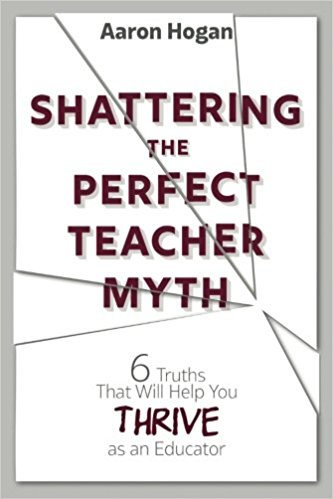
teachermyth

This book was a quick read if you just read it at the surface level. I was able to finish it in about 2 hours, but I don’t recommend that you approach the book in this manner. In fact, neither does Aaron. This is a book that you will want to read a chapter, put it down, reflect, write, sleep, then come back to it a few days later. It’s powerful and honestly, pretty heavy at some points. It’s important to note that “heavy” is not a bad thing! Aaron is pushing us to not just survive in the teaching world, but to THRIVE as an educator! In order to THRIVE, he suggests:

T – Teaching Expectations

H – Hook Your Students

R – Reject Isolation

I – Imagine It Better

V – Value Vulnerability

E – Everyday Every Day

Aaron is very clear and quick to say that these suggestions are not a “fix-it” to every problem we will face. It will not prevent failure and it will not be effortless. Because of the depth of each of these suggestions, it is really in the best interest of the reader to take bite-sized chunks of this book. (This is clearly a “do as I say, not as I do” statement right now. Just trust me. I’ll take bite-sized chunks in the future because it was fantastic and I want to really spend time on a deep dive of this one.)

In Teaching Expectations, Aaron says that we need to model, teach, reteach, review, model – all those things we’d do for content pedagogy, that we consider to just be “good teaching” – we need to be doing those things for teaching behaviors as well! I love when he flips the script and asks if we’d send a student out of the classroom for not mastering the content. Instead, we’d find ways to reteach. It’s not three strikes and you’re out for mastering content, so why do we use philosophies like that for behavior? We can’t assume students know how to behave. We must teach them and set high expectations.

Hook Your Students was awesome because it took me back to Teach Like A Pirate by Dave Burgess. We need the constant reminder to do all we can do grab our students’ attention before we even begin to deliver the content.

Reject Isolation speaks to being a connected educator. Read about Aaron’s journey on social media and how it’s impacted him as an educator. We do not have to be in a silo anymore. Social media gives us a way out; it allows us to find “our people”. I can’t imagine my life (both professionally and personally) without the amazing PLN of which I get to be a part. I love you all!

Imagine It Better was a real gut-check. Spend some time here. What can you imagine doing better? What sacred cows can be slain? When you’re trying to be innovative, everything is back on the table. I’m really looking forward to revisiting this section!

Value Vulnerability speaks for itself. I love how Aaron spins this to be not only our own vulnerability but the vulnerability of others as well. He discusses being honest in your uncertainty and quieting the whispers that happen between adults in our schools.

Finally, the part that resonated with me and has inspired my implementation plan is Everyday Every Day. This section is about building authentic relationships with students and teachers. Aaron talks about positioning yourself to get to know your students and staff. He repurposed his time in the hallways to “make it about more than just enforcing expectations”. His Selfie of the Day idea was phenomenal! I love the connections he was able to make with students and the impact it had on his school! I do very well connecting with my students. If I’m being honest, building rapport with students is one of my strengths as an educator. However, I’ve noticed that the past two years have been a struggle for me to get to know my 6th grade students. Sure I know the surface level information, but I feel guilty when they see me really connect with my 8th graders (because I’ve had them for a couple of years). While I don’t want to force the connection and I know real relationships take time, I want to build a stronger foundation with my 6th grade students. So that is my implementation for this year. I’m honestly not sure how to go about making this happen quite yet. I need to think through it a bit more. On #HiveSummit Matt Miller (author of Ditch That Textbook and another DBC book that you’ll hear about later in #DBC50Summer) suggests using Google Slides as a getting to know you activity (also read about this idea & suggested as implementation plan in Teaching Math with Google Apps by Alice Keeler and the late Diana Herrington). Michael Matera (creator of #HiveSummit – see website here – and author of Explore Like A Pirate) says he’d like to try this, and I think I might like that as well. There are 150 6th grade students coming in this year, so I need this implementation to be realistic while still making an impact. The Google Slides might just be the way to meet both criteria, but I’m going to continue investigating options of how to intentionally build a strong foundation with my 6th grade students, as well as new students who come in throughout the year.

Shattering the Perfect Teacher Myth is a yet another wonderful addition to the DBC, Inc line up. I appreciate Aaron’s willingness to share some of his epic fails and believe this book was really written for anyone and everyone in education. There were some places where I was nodding my head, while I was scratching my head in others. I’m excited to dive into this deeper in the future because I have no doubts that I will be pushed out of my comfort zone and constantly reminded that I should be intentional about the decisions I make in education.

You can follow along with the conversation on Twitter using the hashtag #TeacherMyth and I encourage you to join the chat on Tuesday nights from 9:30 – 10:00 pm EST using the same hashtag! This is a wonderful community of encouraging educators! Another terrific resource is Aaron’s blog! He also shares questions and resources from the book here. Vicki Davis hosted Aaron on the 10-Minute Teacher Podcast and you can listen here. You can also subscribe to Aaron’s YouTube channel to see some of the videos he mentions in the book. As always, the flipgrid (idea from the phenomenal Andrea Paulakovich) is available for you to share your thoughts and reflections. If prompted for a password, use DBCSummer. This space is designed to be a global collaboration and reflection space on all DBC books, so please don’t feel limited by the question, just share your thoughts! The question is only there if you need it to start conversation.

Check out my twitter reflections from my reading of Shattering the Perfect Teacher Myth.

I am so excited to finally be able to read Social Leadia by Jennifer Casa-Todd! I won this book in a #DBCChallenge and am so excited to dig into it! I had wanted it for a long time before winning it! Dave and DBC, Inc even sent me an autographed copy of the book, so that makes it even cooler! So glad Tara Martin made the Captain pose for a quick picture with my book before it was sent my way! That was a huge surprise!

Let’s go with Book 29! Blog will be up in a few days.

#DBC50Summer 23/50: Lead Like A Pirate

Settle in… this one will take a while. Seriously, go grab some coffee, a snack… perhaps you’d like a blanket? (Blankets are plentiful in my house; I’m always wrapped up in one, even on summer days!) In fact, go ahead and throw on your pajamas, tuck the kids in bed… do all the things before starting. I’ll wait…

All done? Cozy? Ready? Let’s go!

In 2011, I realized that I did not want to be a classroom teacher forever. (Hey, we’ve talked about this being judgment free here… don’t judge me!) Don’t get me wrong, I love the students; I love everything about learning with the students. I hope that if you’ve been on this journey with me for very long, that truth has been evident. However, I wanted a greater impact. I also knew that I had absolutely ZERO interest in being an administrator. I am wise enough to know that I cannot handle the stresses that come with running a building. I deeply admire those in administration and look on with fascination as each of you make the world turn so effortlessly, knowing all along that it’s anything but easy. I wasn’t sure where that left me though… in my district, you were a classroom teacher with leadership roles or an administrator or at the district office.

Somewhere along the way, I found myself serving as an instructional coach in practice, but not in title. Once I heard the label “coach” and identified with it, I hunted down all of the coaching books I could find. I took to Twitter in hopes of finding more information on this idea of being an instructional coach. (For a small glimpse into my educational journey, click here.)

In March 2017, I started reading all this hype on Twitter about something called #LeadLAP (I thought it was about racing… I am from North Carolina, right?). When I found out that it was a book that was the leadership equivalent of #tlap, I knew I had to have a copy. It was the first time I bought a Dave Burgess Consulting, Inc book immediately upon book release (it kind of started a trend… oops). It was everything and more. Lead Like A Pirate is written by Beth Houf (an amazingly passionate principal from Missouri with experience in K-8 administration) and  Shelley Burgess (Yes, the Pirate Captain’s wife, coauthor of P is for Pirate – I told you that you’d hear from her again. She is also an educational powerhouse. Can you imagine what it must be like in the presence of BOTH of the Burgess pirates? Whew! I can only handle the conviction & passion from one Burgess keynote experience at a time). This book is a must-read (yes, Beth, I went there… Must. Read. Period.) for coaches, administrators, and district leaders.

leadlap

In this multiple rereading, I found something I’d never found before. See, in Dave’s book (and keynote) he talks about the the phenomenon of everyone buying a silver Honda Odyssey on the same day he and Shelley bought a silver Honda Odyssey. Of course, everyone around him didn’t buy the minivan at the same time, but the Reticular Activating System (RAS… I’m just trusting Dave on this one) that typically filters out all the extraneous information around us is now highly tuned into the subject of interest. In Dave’s case, it was the silver Honda Odyssey. In mine, today, it was one particular word. This word was repeated multiple times in Lead Like A Pirate and is my biggest takeaway from this book.  Not only is it my biggest takeaway, it’s also my implementation plan. I’ll tell you that word in a minute, just hang tight.

This book is FULL of great wisdom from two phenomenal educators. I could pick from a number of amazing topics from this book! Everything from the quotes throughout the book from various authors and notable people throughout the ages to the challenges at the end of each section to even the call to action at the very end were inspirational. There is also a list of sample interview questions that I literally had to stop and ask myself in the middle of my reading! Shelley shares a story about giving faces to data, and I identified with that as I tell stories frequently to make a point. I like to hook people by grabbing their emotions first (yes, I did go there with the “hooks” – been a minute) before sharing the connection to data, content, etc.

As an instructional coach, I value everything about the ANCHOR conversations that Beth & Shelley discuss in the coaching section. I appreciate that they differentiate between the role of an evaluator and the joy of simply having a teaching and learning conversation with other educators in their building. I speak a little about that in an earlier blog post about The Secret to Coaching. I am thankful they speak to the loneliness of being in an administrative role. Although I’m not an administrator, I am a lone wolf in my school, and in many ways, in my district. Piloting a new position was the loneliest experience I’ve had in education, and if it had not been for my directors and my Professional Learning Network (PLN) on Twitter and Voxer, I would have left education. My administration is fabulous, but even they were unsure of how to fulfill the vision of my role at the beginning of the pilot. I felt as though I were on an island, with no one having a clue the island existed, waiting for someone to randomly discover it and rescue me. Reading about the loneliness of being an educational leader was so powerful when I read this book for the first time. Thankfully, I now have a pack of wolves that I run with, and we have one another’s backs.

While reading, I was trying to figure out which of the powerful pieces of wisdom I’d focus on within the blog, and what I’d use as my implementation from this book. My way of taking notes is on Twitter, so here are some of the tweets I shared while reading.


There were so many paths I could take with the blog for Lead Like a Pirate. But there was one path that was glaring at me during this reading of the book and it had nothing to do with any of these posts. In fact, as I think of this path, it reminds me of the saying “off the beaten path”… it’s the path less traveled; truly, y’all, this path is so covered with thorns and overgrown brush that you’d likely need a machete to cut through it. However, it’s the path that my gut is telling me to take with the reading of this book, and by now, and I’ve learned to trust my gut.

The word that I’m taking away, which is also the implementation journey I will embark on in the new school year, is first mentioned in the introduction of the book. It’s actually only four paragraphs into the book that the word first caught my eye. It’s the manner in which we search for ways to make our school amazing. It’s written again, in the first chapter, the manner in which we go about developing, maintaining, and sustaining positive culture in our schools. I find it again in the Transformation chapter, the manner in which we take traditional education to new heights for staff and students. We do “whatever it takes”, right? (great song by Imagine Dragons linked here, you’re welcome – one of my favorites and could even be considered a sort of anthem of mine, but not what we’re here for at the moment… moving right along)

Again, we find this word sharing the manner in which we should filter out ideas that don’t support our long-term vision. It’s also the manner in which we should pursue what matters most in our vision. It’s the manner in which we should seek out and nurture each person’s gifts. It’s the way in which we increase our knowledge and expertise in an area. Later in the book it’s the way in which Dave Burgess was trying to figure out how to teach others what he did that made him successful in the classroom as he was writing Teach Like a Pirate.

Eight times this word stood out to me… in fact, it’s circled every time I saw it. It’s likely written more than that, but these are the sightings that grabbed my attention. I recently purchased a shirt for #HiveSummit with this word written on it. (You should check out HiveSummit.org – it starts Aug 1, 2018 and runs through Aug 14, 2018, then all videos are removed. Trust me, check it out!) You could also search on Twitter for this word and #tlap and find the newest DBC author that was announced (I’m SUPER excited to read his book!)… do you know the word yet?

RELENTLESS(LY)

Synonyms for this word are unending, persistent, incessant, continuous, unwavering, unfaltering, tenacious, untiring… these are words I want to embody this year. I want to be relentless in the ways I seek to connect with students and their families. I want to be relentless in developing and maintaining a positive culture in my school. I want to be relentless in seeking out and noticing the good in each person I work with. Relentless is both my takeaway and my implementation because, as Dave says, “Inspiration without implementation is a waste”. What will that look like? When something doesn’t work, I won’t give up. I’ll keep trying, constantly looking for ways to improve. I will be tenacious in my drive to see teachers and students succeed. I will be unwavering in my belief that every person at my school is there with good intent wanting to make a positive difference in the lives of students. I will be persistent in reaching my goals, starting with finishing the #DBC50Summer and implementing these changes to my practice in the new school year. I will be RELENTLESS.

*And yes, Hamish Brewer, THE Relentless Principal, just announced that he is writing a book for DBC, Inc! So excited!*

I just can’t get enough of Lead Like a Pirate! If you can’t either, check out the website where Shelley & Beth continue to blog incredibly inspirational goodness frequently. You can find the book’s resources here. There are multiple podcasts featuring the Lead Like A Pirate message, such as The Wired Educator, Perspectives in Education, 10-Minute Teacher Podcast with Vicki Davis, and LeadUpTeach. You can also head over to the flipgrid and share your thoughts on Lead Like a Pirate there! As always, the password is DBCSummer. I’ve got to give a shoutout to Andrea Paulakovich who had this amazing idea that we could use flipgrid as a place for global collaboration on every DBC, Inc book!

Follow along with the lively community on Twitter using #LeadLAP and join in the chat using the same hashtag every Saturday morning from 10:30 am -11:30 am EST! This community is incredible, encouraging, and full of school leaders, and administrators (both school and district level) who want to see education disrupted and transformed in the greatest way possible, the PIRATE way! Both Beth & Shelley are active on Twitter as well, so feel free to reach out to them; they both have such a heart and passion for education and leadership! I am constantly inspired by these two ladies and look forward to continuing to learn from them!

Spoiler Alert… this isn’t the last you’ve heard of Lead Like a Pirate… just saying! Apparently the rest of the DBC, Inc family couldn’t get enough either, so keep your ears open later in the summer.

Here we are… finished with another book and moving along to the next one on the list.  The next two books were released back to back, only a day or two apart! They aren’t considered a “set” but goodness, they should’ve been!  These two books, both about math, are phenomenal additions to the DBC, Inc line! First, Book 24 is Table Talk Math by John Stevens (yes, that John Stevens from The Classroom Chef) and Book 25 (***HALFWAY***) is Teaching Math with Google Apps by none other than the Google guru Alice Keeler and the late Diana Herrington. We will reach the halfway point very soon!


#DBC50Summer 22/50: Start. Right. Now.

This book stepped on my toes. So much! If you’re like me, you may want to grab some steel-toed boots before cracking the cover on book 22 in the Dave Burgess Consulting, Inc line up! Just through my first reading of this book (there will most definitely be a second read in my not-so-distant future), I have grown tremendously and reflected on times that I was NOT the excellent educator that the authors refer to throughout the book. That’s a gut-wrenching moment when you read something powerful and think, “I don’t do that very well” or “I’m guilty of that” when reading what educators of the status quo do.

In fact, the reflections during the reading of this book were so intense that I actually blogged during the reading of the book. Until this point in #DBC50Summer, I have never done that. I’ve read the book in its entirety before writing the first word in the blog. I couldn’t wait during this book. I had to get my thoughts out before being able to focus my energy on the next section.

startrightnow

The tremendous trio that is Todd Whitaker, Jeff Zoul, and Jimmy Casas wrote Start. Right. Now. which is the 22nd book for DBC, Inc! This book is true to form in that it doesn’t disappoint.  Even the first chapter inspired some serious highlighting!

Getting into the “meat” so to speak are four tenets of excellent leaders.  Each of these produced it’s own special gut-check and I intend to identify strengths and weaknesses in each of these areas.

Know the Way

Within this section Todd, Jeff, and Jimmy articulate very clearly that excellent leaders [teachers] (they argue that it’s interchangeable and I whole-heartedly agree) know their stuff.  They know their content, they know their learners, and they know how to connect the content and the learners. I can, without hesitation, say that life-long learning is a strength for me. I know my content (media & technology) and I know my learners (both students & teachers). A powerful quote from this section is, “If you have a host of important priorities, you have no important priorities.” When we introduce something “new”, we must stop and decide of which “old” initiatives we’re willing to let go. We need to analyze what we will start, stop, and continue doing. When we say “yes” to something, we are ultimately saying “no” to something else. I am guilty of saying “yes” to too much, while not letting go of something else. I am also guilty of asking others to do too much, as well. Part of my implementation from The Zen Teacher is to say “no” to allow myself a planning period each day. From the outside, it looks selfish to do this, but in all actuality, it’s done from a place of devotion to students. I cannot do anything at 100% when I stretch myself too thin. Purposefully carving out that time in my schedule to prepare will only deepen the learning for my students in the long run.

My implementation for this section of the book is to not only uphold my implementation from The Zen Teacher, but also to become more knowledgeable in the middle school curricula. I know the standards in media and technology, but learning the standards for content areas has been a struggle for me. When I intentionally sit down to learn it, I will be able to better serve the staff and students.

Show the Way

The quotes in this section are insanely incredible! This section really got me pumped about the future and showing, rather than telling, the vision for our students and our school. Check out these powerhouse quotes from Todd, Jeff, and Jimmy!

“Top-notch educators do not wait for change to happen to them. They proactively anticipate impending changes and make these changes work for them, rather than wasting energy working against change.”

“We implore you to shoot for amazing rather than average.”

“Visionary leaders who succeed in inspiring others to participate…do so, in part, because of their genuine belief in and passion for the vision…their energy, enthusiasm, and genuineness attracts others to their vision.”

I love the reference back to George Couros’s The Innovator’s Mindset and the debunking of “innovation” as a buzzword.  The gut-check in this section is whether I am SHOWing my vision, rather than simply TELLing about it.  Right now, through these blog posts, I am telling all about what I plan to do when I return to school next month.  However, unless I actually DO the things I’m saying I will do, these blogs are nothing but a phony. Nothing but time truly wasted through the summer. Yes, they will have helped spread the word about DBC, Inc.  That was never the ultimate goal, though. The goal was to learn as much as possible in order to better the experiences of the students and staff at my school.  However, the knowledge I’ve taken in while on this journey is pointless if I don’t make visible changes for the staff and students I work with by SHOWing rather than TELLing. My implementation for this section is to purposefully integrate the things I’ve learned from the reading of each book through holding myself accountable for blogging about the impact of each book. (Did I just say that?!?!) That doesn’t mean I will literally write another blog for each and every book, but I will blog about projects and moments that showcase that the knowledge gained in various books was actually used.

Go the Way

This section was a little easier to digest for me because my toes are pretty much intact. (I guess they needed time to heal from the first two sections, whew!) I typically practice what I preach. I do my very best to be sure each person I encounter is met with positivity and a smile. Don’t get me wrong. I have bad days, just like everyone else. It’s rare to see me aggravated, but I do get frustrated, annoyed, agitated, just like everyone else. There are times that I’m angry with someone and I’ll end my frustrated comments with “but I love you, and that’s what’s important right now.” It helps me remember that I love them too, just by saying it out loud. When I was a kid, my grandmother (Nanny) owned her own tax preparation business. She would have me use the typewriter (yes, typewriter) to put address of the IRS and NC Department of Revenue on 25 envelopes per day. As I got older, she allowed me to begin answering the phone. As I answered, she wanted me to smile. She would tell me that the people on the other end could tell if you were smiling or not. I believe that to be true today. I believe that when you talk on the phone, write an email, engage in social media, you should be smiling. The smile comes through in your writing and your tone.

My implementation for this section is to not be afraid to hold those crucial conversations. As an instructional coach, this is the hardest part of my job. Upon reflection, I know that it shouldn’t be. I’m not being ugly or condescending toward anyone, but am constantly trying to keep the students best interest in mind. A boring classroom is never what’s in the best interest for students. Therefore, crucial conversations, truthful, transparent, open conversations to better both parties as educators, shouldn’t be something I fear. Rather, it should be viewed as an opportunity for growth and to be a catalyst for change for everyone involved.

Grow Each Day

I participate in Twitter chats, I attend edcamps, I actively seek out ways to grow my practice. I’ve got this one in the bag… or not! Feedback… critical feedback is so hard for me to accept. Always has been so difficult for me to hear that something I’ve done wasn’t “good enough”. Of course, it’s not being presented to me as “not good enough”. I’m being told that it’s “an area of growth”, or that I could “change x, y, and z to make it better”. The whole time, all I’m hearing is that it wasn’t “good enough”. I have learned that before I attend an observation post-conference, I need to get in a certain mindset.

I need to go into these conferences with humility, grace, open-minded, and with the expectation that I will learn something new. After reading this section of Start. Right, Now. I realized an important truth. Why in the world am I not going through my day-to-day life like that?

I’m my own worst critic. I automatically assume the worst in most cases. When I hear that something truly wasn’t my best, it hurts. However, after taking the time to digest the feedback and observe my experience through someone else’s eyes, I almost always end up agreeing that they were right; it wasn’t my best, and therefore it wasn’t “good enough”. Asking for feedback is not a problem, it’s the accepting feedback that I need to work on improving.

My implementation for this section of the book is to purposefully ask for, and accept feedback from the best of the best. Surrounding myself with excellent educators will make me better. There’s no way that it can’t make me better. Getting feedback from them and internalizing it will make me better for my students and staff. That’s a win-win. I just have to put my pride to the side. (Yes… I rhymed… on purpose.)

Final Thoughts

Start. Right. Now. pushed me in ways that I wasn’t expecting. Todd, Jeff, and Jimmy showed me what excellence looks like, and make me want to pursue that excellence relentlessly. I want to be excellent. Because of that, I will be rereading this one soon after completing the #DBC50Summer challenge. My favorite part of the entire book is the Teach 4, Lead 4, Learn 4 at the end of each section. In these sections, the authors give us 4 teacher leaders to follow, 4 educational leaders to follow, and 4 ways to continue the learning. In this same spirit, I offer my own Teach 4, Lead 4.

Teach 4

  1. Phil Strunk (@MrPStrunk): This middle school history teacher constantly shares his passion on Twitter, making me want to be better every day. He is the founder of #waledchat and an inspiration to all who follow him.
  2. Michael Matera (@mrmatera): As a middle school social studies teacher, Michael gamifies his course, which allows his students to be the ones in charge of their learning. He is the author of Explore Like A Pirate, Book 10 in the DBC, Inc line.
  3. Shaunda York (@shaundateaches): This elementary school teacher’s success is a bit personal to me. She completed her student teaching in my classroom many moons ago. I knew, even then, that she had it… she had the passion and enthusiasm to make her a favorite among students, parents, and administrators. Shaunda is an exceptional teacher who is views changes as opportunities! Follow her!
  4. Susan Jachymiak (@msjachymiak) have so enjoyed following Susan’s journey on Twitter as she created #newteacherjourney and landed her first classroom teaching job. I look forward to seeing so much awesome stuff come from her this year! Go ahead and follow her because great things are coming from this one!

Lead 4

  1. Lucas Gillispie (@lucasgillispie): Spot #1 on this list must go to my district director of digital learning and media. Without his support and encouragement, I would’ve left education a while ago. Lucas not only shares the latest trends in education, in many cases, he creates the latest trends. The creator of the WoWinSchools project and a leader in gamified learning, he is one you’ll want to follow (if you aren’t already).
  2. Allyson Apsey (@allysonapsey): This amazing principal is one I would follow across a desert. She is authentic and encourages growth at every possible turn. She is the author of The Path to Serendipity (you’ll hear more about it later in the #DBC50Summer). Her passion and energy are contagious. Kindness and thoughtfulness is put into every word she tweets. I adore this lady!
  3. Sean Gaillard (@smgaillard): Sean is a middle school principal with a heart for education. He is constantly connecting others and inspiring educators to find their personal best, then deliver it daily. His encouragement is unending and, as the creator of #CelebrateMonday & #TrendthePositive, it’s easy to see why people gravitate to his positivity! Oh, and he’s also the author of book 49 in the DBC, Inc line – The Pepper Effect!
  4. Cristina Dajero (@cristinadajero) & Kelly Hoggard (@khoggardGRT): Yes, I cheated a bit here.  But if you follow these two, you’ll see that they are joined at the hip anyhow, so it only makes sense to add them together. These educators are leaders in every sense and I am constantly uplifted by them. Kelly is the creator of #ChampforKids and Cristina is the creator of #LoveLiteracyLearning.

Be sure to join us on flipgrid and share how you Know the Way, Show the Way, Go the Way, and Grow Each Day! The password is always DBCSummer. My dear friend Andrea Paulakovich (Go follow her now!) shared this amazing idea while we were beginning our individual #DBC50Summer journeys. It serves as a space for global sharing related to each DBC, Inc book! Epic stuff! Also, check out the following resources for Start. Right. Now.

Dave Burgess’s Blog on Start. Right. Now.

Todd Whitaker’s Website

Jeff Zoul’s Website

Jimmy Casas’s Website

Educators Lead Podcast with Jeff Zoul

I am SOOOO excited about Book 23! I’ve been looking forward to this since starting the #DBC50Summer journey! It’s finally time! Teach Like A Pirate was transformative for me, making me want to be a better educator, creating experiences for students! It has been Lead Like A Pirate that encourages me daily as an instructional coach! I am pumped to finally get to share my reflections on this book by Shelley Burgess and Beth Houf on my blog!  Stay tuned!