NCCAT – Teaching Generation Z

IMG_3143

The best week of my entire summer was spent at the North Carolina Center for the Advancement of Teaching (NCCAT) as part of the advisory group for a week of sessions called Teaching Generation Z.
IMG_3206

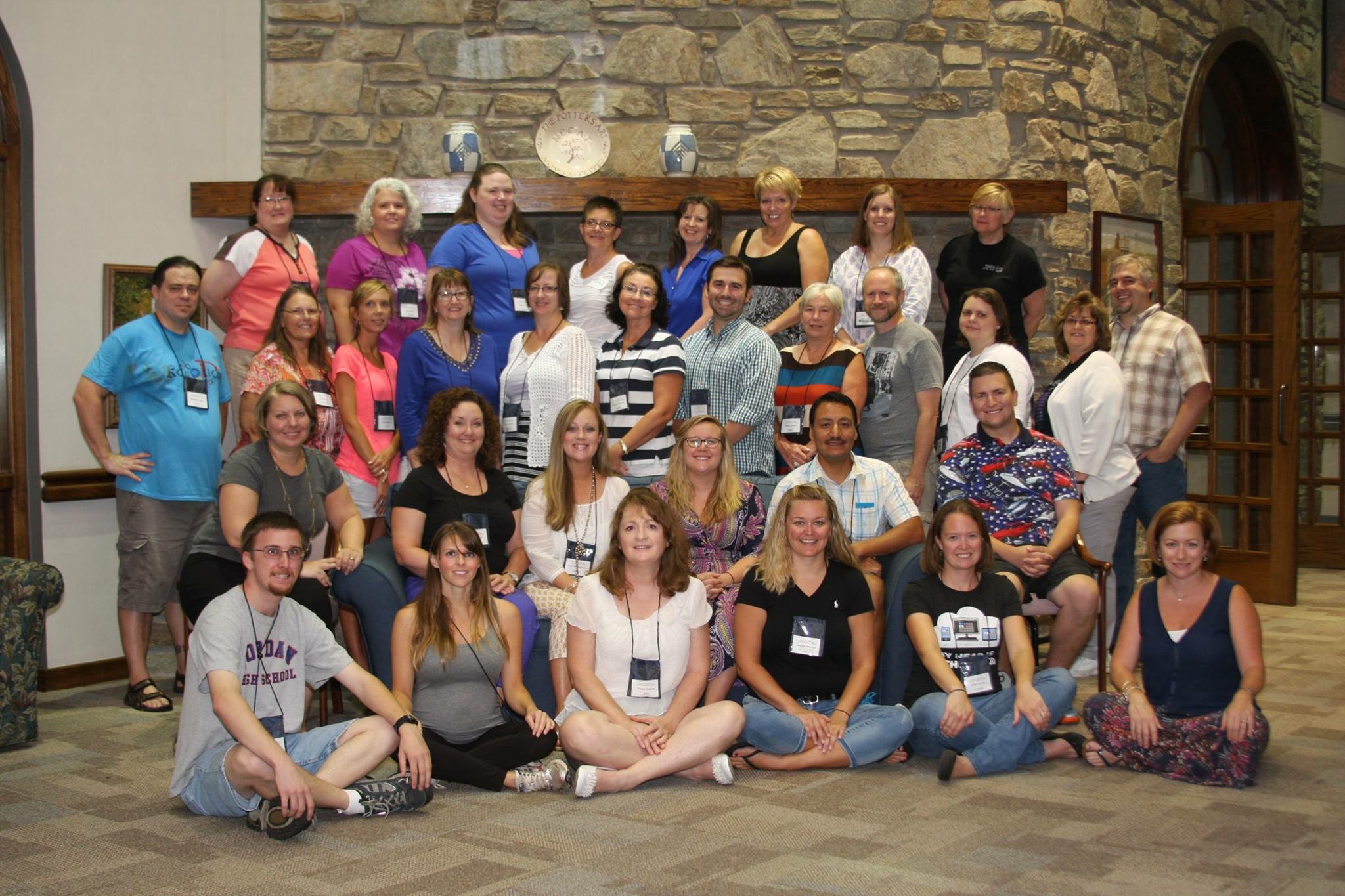
This idea was the brain-child of Jonathan Wade (@edtechwade) and was coordinated by Darcy Grimes (@DarcyGrimesNC).  Throughout the week, 10 educators from around North Carolina discussed topics that are relevant to today’s classrooms, such as game-based learning, Minecraft, gamification, the use of Green Screen, the learning management system Canvas, Aris, and others.

advisory group

Throughout the week, we were inspired by many exciting ideas for engaging the students of generation Z.  There were so many new apps and websites that I could add to my #edtechsummer that I decided to simply post them all here, along with presentations from each of the presenters.  As if NCCATGENZ wasn’t enough awesome packed into each day, our group had the honor of teaming up with the other group on campus, TeacherQuest.  Those participating in this group were learning to design their own games with Daniel O’Keefe (@dokeefe) from the Institute of Play (@instituteofplay)!  Each day the NCCATGENZ group play-tested the games created by TeacherQuest.  These games gave us even more outstanding ideas to bring back to our classrooms.

Monday:

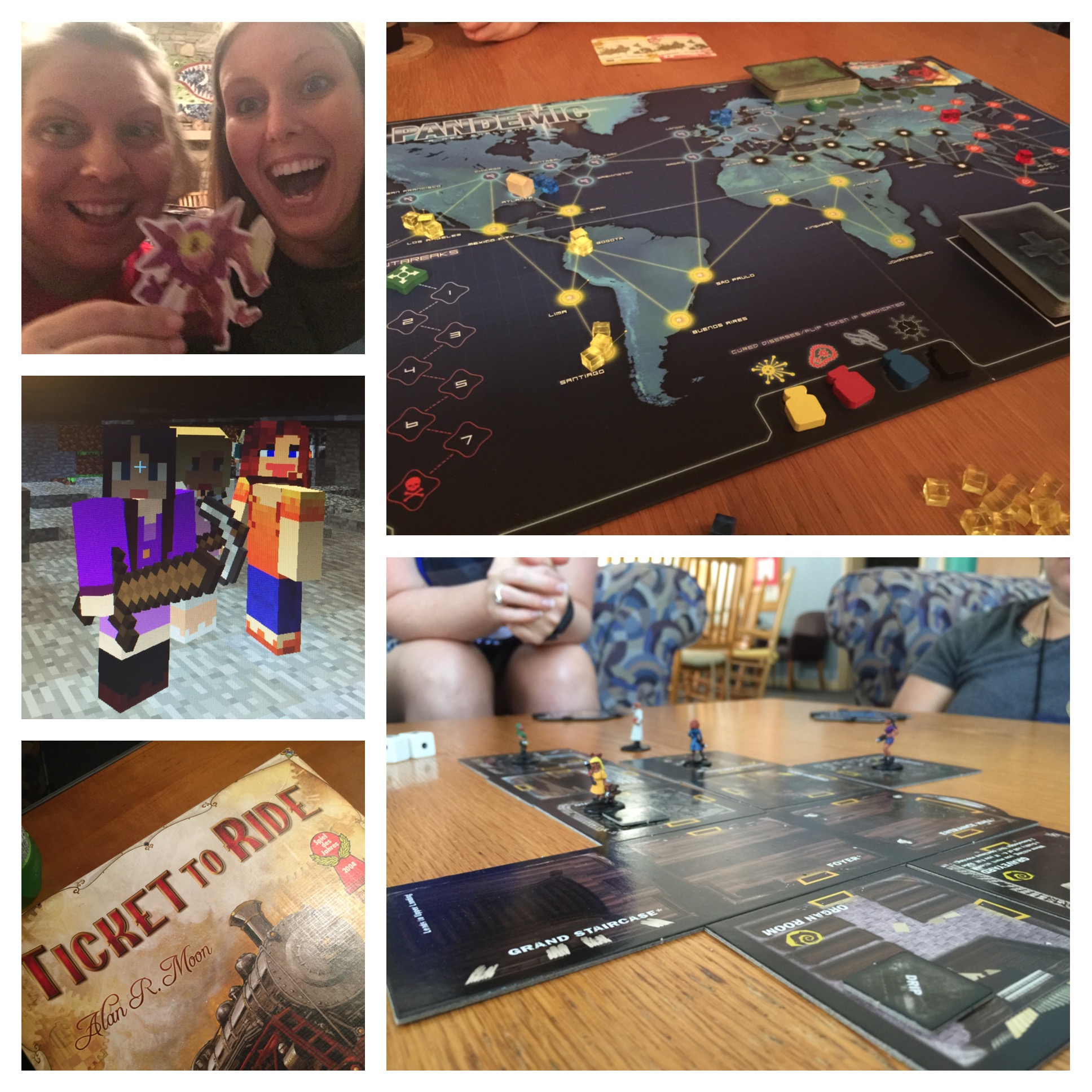
After a 3 hour drive through the beautiful mountains of North Carolina, I arrived at NCCAT, checked in to my room, and met with my colleagues and new friends in the commons room.  We congregated here to be given a quick tour of the facilities and were led to the conference rooms in the main building.  From there we participated in a geocaching, alternate reality Campus Quest using the app Aris.  Jason Lineberger (@teachertechccs) created a quest that led us to create a haiku while touring the grounds of NCCAT.  We then ate dinner in the dining hall and met back in the conference room for a SMACKDOWN of epic proportions!  I honestly could have gone home right then with more edtech tools than I could use this year!  Every night after we wrapped up in the conference room, many of us met in the commons area for board games and card games.
IMG_3140

Tuesday:

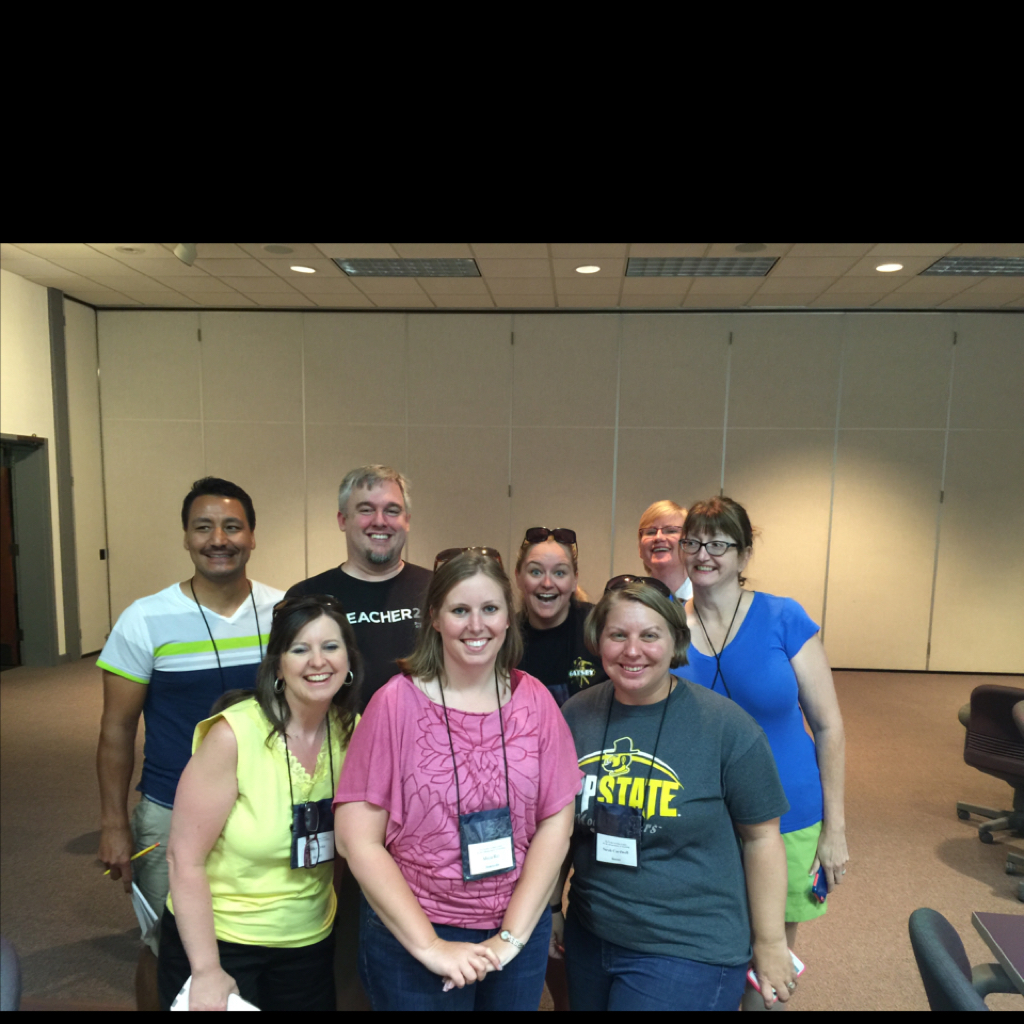
We discussed the difference between Game-Based Learning and gamification and built our working vocabulary for the week with Lucas Gillispie (@lucasgillispie).  Then we participated in a GooseChase created by Sarah Cardwell (@sarahwcardwell) to build relationships and learn about one another.

IMG_3151

Next we play-tested with the TeacherQuest group and played variations of Musical Chairs.  Megan Mehta (@megan_mehta) taught us about using a green screen in the classroom and we were able to experiment with Green Screen using green bed sheets and the app Green Screen by Do Ink.  After lunch and a time for reflection, participants were given a choice between my Digital Formative Assessment presentation and Cathy Musci’s (@CathMus) SAMR Presentation.  Jason Lineberger shared more alternate reality games with us and showed how he set up the Aris game from Monday.  Before dinner, Sarah Cardwell, Darcy Grimes, and I talked about the power of social media and growing your PLN.  After another delicious meal, Darcy and Megan shared Mystery Skype and we participated in a mock Mystery Skype session by splitting up the group, choosing a state, and answering yes or no questions about the location of our state.  Skype has a fabulous presence in the classroom and more information about how to use Skype in your class can be found online.  More gaming in the commons area ensued!

IMG_3170

Wednesday:

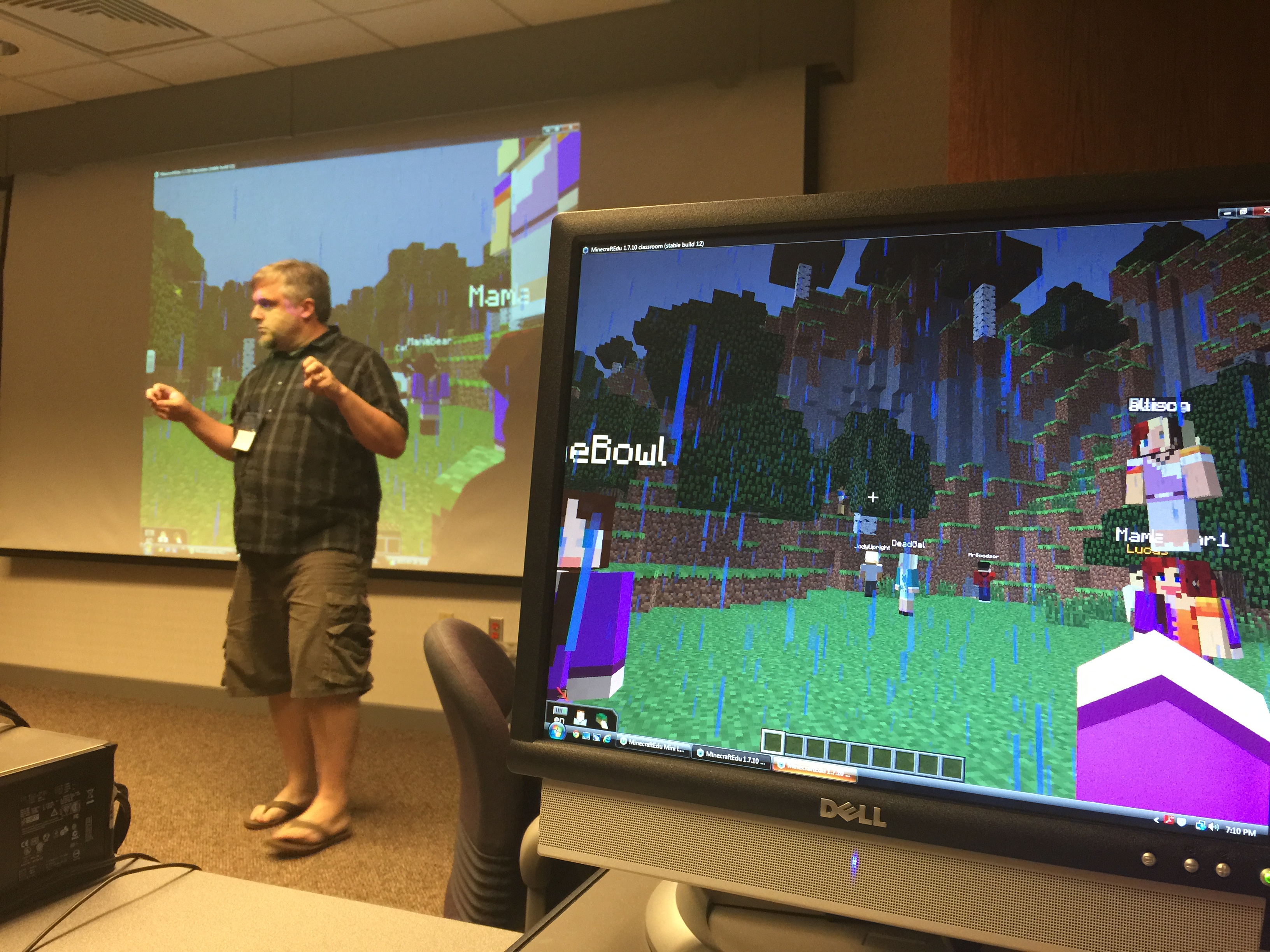
As a highlight to my professional career, I was privileged to present Digging into Learning with Minecraft with Lucas Gillispie.  (Google him – Go ahead, I’ll wait)  Truly, I was more of a Vanna White as I clicked for the next slide in the presentation and helped a few friends who were stuck in a hole they had dug in Minecraft while interjecting a few coherent points.  Nonetheless, let it go down as a moment in history for me – being deemed worthy of presenting with your mentor is always a blessing.

minecraft

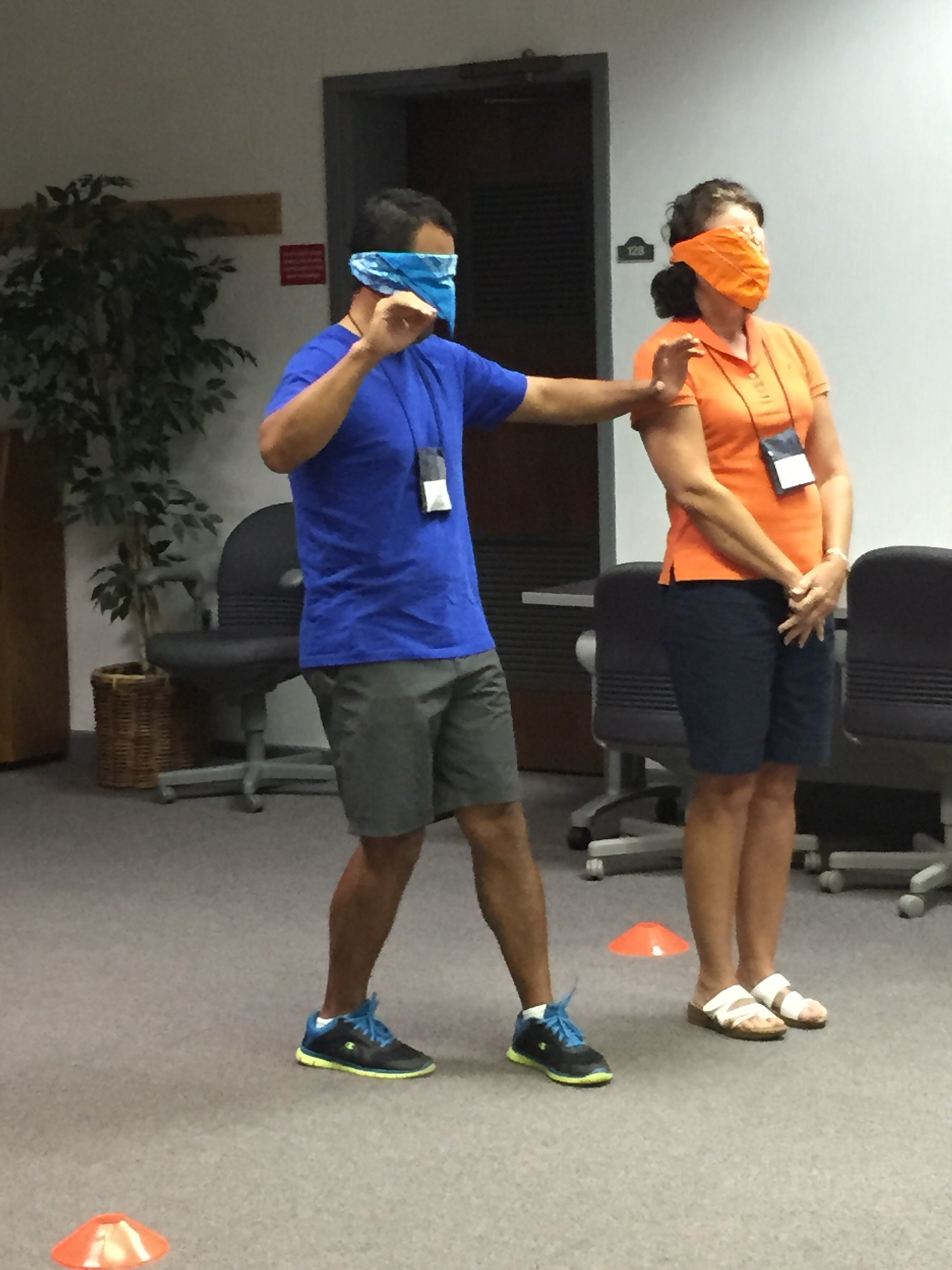
After a quick break, we play-tested with TeacherQuest again.  This time we did games with a taste of trust and betrayal.  In one we were split into two teams, blindfolded, and two directors told us where to move to avoid the “mines”.  We had to choose which one to trust as one was on our team telling the truth and the other was trying to sabotage us by making us walk into the mines.  It was very cool, and a great team-building game.  My friend and colleague Pedro Caro (@karop3) was on my team.  Neither of us stepped on a mine as we sashayed to the left three steps (yes, that was a true direction we were given)!
IMG_3186 IMG_3189

After play-testing, we joined back with our NCCATGENZ group to listen to Heather Wilson (@mhmshistory), Lisa Montgomery (@lmontgo), and Chris Goodson (@goodson) as they discussed their adventures with Minecraft and the evolution of game-based learning in their schools.  I was blown away with their examples and experiences and can’t wait to get my MinecraftEdu club going in a huge way this fall! After lunch and a reflection period, we played a bit of Oregon Trail and Where in the World is Carmen Sandiego, and we were introduced to Mission US, an amazing web-based game from PBS that allows students to BE a part of history through a “choose your adventure”-like game.  Wednesday evening we were allowed to have unstructured time which, for us, turned into… you guessed it – games!

Thursday:

We kicked off the morning with Sarah Cardwell as she gave us an in-depth look at Canvas, the learning management system that works well with PowerSchool and SchoolNet here in North Carolina.  Then we play-tested one last game with TeacherQuest.  These games were my favorite as they truly had an educational feel to them, but not enough to make them boring – perfect for my students!  One game used word parts and word associations to have students guess the meaning of an unknown word.  If we guessed correctly, we rolled the dice and moved up that number of lines toward the prize.  Whoever reached the prize first won the game!  I love the idea of using this with metaphors/similies and other figurative language, as well as content vocabulary and higher level vocabulary in reading. Winning this game was particularly fun!

winning

Megan Mehta then shared her knowledge of personalized learning and OpenEd with us, and then we had lunch.  After lunch, Lucas talked about Game-Inspired Learning.  To be honest, I’m not sure what all was said because I was so focused on finishing the spreadsheet to earn all the badges, but I plan to revisit that particular presentation.  I feel sure it was amazing! (HAHAHA!)  After hearing about Stakeholder Buy-In from Chris, Lisa, and Heather, my friend and amazing teacher Elaine Waters (@62waters) showed how she gamified her entire social studies/history class using 3DGameLab by GoGoLabs.  She was awesome!  I remember doing the NCCAT online course on 3DGameLab with her and am in awe of how she ran with it and is inspiring her students to love history through making it a game.  She also showed a clip of Lord of the Rings, which makes her super-cool in my book anyway!  To end our sessions, Lucas led us as we played survival mode in Minecraft with one another.  Then, of course, we stayed up really late enjoying our last night of board games together!
IMG_3237IMG_3245

Friday:

We ate breakfast in the dining hall and did the whole evaluation thing, watched a cool Animoto slideshow that Darcy made, then checked out the NCCAT store before leaving.  I had not planned on purchasing anything all week, but couldn’t help myself – I had to buy a t-shirt.

On the way home I reflected on how amazing NCCAT is and how inspired I became while there.  As educators, we need a place like NCCAT; somewhere to safely explore lesson ideas, share with other professionals, research innovative strategies, and grow ourselves which will, in turn, grow our students.  This week has motivated me to be a better media coordinator for the staff at my school and for all of my students.  I learned so much more than I ever imagined I would this week!  Being around like-minded professionals and seeing the amazing things they are doing in their classrooms was the best part of the week.  I am hoping to be part of the Advisory Group for NCCATGENZ 2.0 and feel sure I would walk away from that experience as excited as I am now!  Watch out world; these educators are prepared to Teach Generation Z!

Presentations (more to be added as approved by presenters):

8 Ways to Assess Without Tests (Digital Formative Assessment) – Alicia Ray

Social Media – Darcy Grimes, Sarah Cardwell, Alicia Ray

Canvas Introduction – Sarah Cardwell

GooseChase – Sarah Cardwell

SAMR – Cathy Musci

Augmented Reality Resources – Jason Lineberger

Video Games and Learning: A “Game-Changer”

As part of EPIC Teaching Academy (a game-based PD opportunity in my school system), I just watched this short video from James Paul Gee. I could go into his credentials for days, but just Google him. I did; I was impressed. My assignment was to write a brief reflection… a brief reflection doesn’t suffice the power of the words in this short video.  Alas, a blog post about this video, which was truly a “game-changer” for me.

A video game is only a set of problems.  It doesn’t matter what the problems are. You must solve the set of problems in order to win.”  Thinking back to my childhood, Super Mario Brothers was the first video game I remember playing.  If it froze, or went to the snow screen, I’d just blow in the cartridge, reinsert the game, and voila!  While playing the game, my mission was to rescue the princess.  I learned quickly which blocks to hit when I jumped and which tunnels had those obnoxious fire-breathing plants coming out of them.  I learned where to jump, and where the vines to climb for extra points were hidden.  I solved the set of problems before me; even though I was frustrated at times and had to walk away and regroup, I’d always return to try again.  Shouldn’t we want our schools to be like that?  I want my students to be frustrated; I want things to get hard for them.  More importantly, I want them so engaged that they want to come back and try again.

“It has to be successful in teaching people to play it because it will go broke if it doesn’t…We have evolved an almost perfect way to teach these incredibly complex games.”  If we, as educators, are not successful in teaching our students to “play school”, what happens to their future?  What about those students who are good at “playing school”, but really haven’t learned anything along the way, except how to take a test?  I have seen those tests; I have taken those tests.  Even without understanding what I was reading, I could eliminate two answer choices.  Does that mean I knew the material?  No, it means I’m a good test-taker.  On the flip side, what about those “bad test-takers”?  Are they really struggling with the content, or are they struggling with the test?

And to the assessment discussion…

“Assessment and testing is what drives our current school system; if you’re not happy with how schools teach today, they teach that way because of the tests we have.”  If we change the test, we change the system.  I actually believe that testing can be a good thing.  In the book How We Learn by Benedict Carey, Carey underlines how testing is one of the best ways of learning, if it is done correctly.  Multiple formative assessments performed at various intervals with immediate feedback is the key, not a high-stakes summative multiple-choice test.

“Let’s say a kid plays Halo on hard… for 30-40 hours and he finishes Halo.  Would you be tempted to give him a Halo test? No, not at all.  You’d say the game already tested him.”  You actually trust the design and learning of Halo more than the design and learning of the algebra class.  Think about these video games and apply the concept of formative assessment to each level.  Did a lightbulb just go off in your head?  It should have.  In video games, you gain a small bit of knowledge and begin to apply it.  Chances are, gaining the knowledge comes through failure.  I gained knowledge about the fire-breathing plants in the tunnels in Super Mario Brothers by getting hit by one of the fire balls and dying.  I avoided them from that point forward (until I learned to kill them with my own fire… and kill them I did.).  I had immediate feedback – I either died, avoided the plant, or killed the plant.  I continually used that knowledge throughout the rest of the game.  When I first started playing World of Warcraft, I wanted someone to tell me how to play.  I was told, “let the game teach you”.  I didn’t understand that, until it started teaching me; I learned through small formative assessments along the way.  I used what Gee describes as “situated and embodied learning “.  I solved problems with what I knew about that quest.

“Schools in America, for the first time in history, have genuine competition.  That’s because companies large and small are selling 24-7 learning, customized to you, outside of school.”  Our competition is no longer other countries’ educational systems, but the two within our own country.  We have “skill and drill schools” where basic numeric facts and literacy are being taught, and we have “21st century schools [where] kids are producing their own knowledge.”  I’m not saying that video games is the only way to teach; I’m not planning to change my entire media center into a room for gaming.  I am saying however, that video games have created a perfect venue for educating students.  Critical thinking and problem solving are embedded in games.  As educators, why would we NOT use them?

NCTIES2015

It has been nearly 2 weeks since the NCTIES conference in Raleigh, but it has taken that long to take all the amazing things I learned and sort them into a blog post.  I had heard about the “big technology conference” in Raleigh for years, but never had the opportunity to go.  I was determined this year that I would go, even if it meant taking personal days and paying for everything myself.  I was told that if I submitted a proposal to present and it was accepted, NCTIES would give me complimentary registration for the conference.  I created two proposals in the hopes that one would get accepted.  To my surprise, both were accepted and NCTIES took on a whole new priority for me.  My district does a Teaching and Learning Conference in the weeks before school starts back each year, and I was asked to be on the planning committee for the 2015 conference.  I was beyond thrilled; my proposals had been accepted and I had a way to get to Raleigh!

From the beginning, the conference was amazing!  The Opening Keynote was Kevin Honeycutt, who is energetic, enthusiastic, and passionate about education.  I laughed and I cried within the first 15 minutes.  The first session on the schedule for me was my own session – Makerspaces on a Shoestring Budget.  The session was designed for elementary teachers and media coordinators who knew nothing about makerspaces and wanted to start one as soon as they got back to their school for free!

Upon wrapping up my session, I wanted to hear more from Kevin Honeycutt, so I went to his session about adding Art to STEM.  I love the idea of letting students be in charge of their own learning and allowing them to incorporate their own artistic nature into projects they complete.  I stopped by a student showcase and had a second grader tell me about 3-D printers and LittleBits.  Talk about reality-check… if a second grader can explain it & why it matters to her learning, my students should be doing it.

After lunch, I went to a session that validated my personal philosophy, then I taught my second session.  For this one, I partnered with my Exceptional Children’s Teacher, who is exceptionally amazing!  Our session, 8 Ways to Assess Without Tests, was designed to show educators that paper/pencil, multiple-choice tests are not the way to show student mastery.  Instead, use some engaging Web 2.0 tools to do formative assessments.  Each of the 8 ways we discussed has an analysis function, so teachers can focus more on the excitement of the students rather than the ‘assessment’.  Teachers can analyze the data rather than spend all their time collecting the data and scoring it.  My last session of the day was on Coding in the Media Center.  I had approximately 300 students participate in Hour of Code last year using code.org, so I was excited to hear about other coding programs and how other media coordinators were using it.  The presenters, Robin Williams and Pam Lilley, are friends of mine from the NCDLCN, so it was great to support them and learn something at the same time.

My brain was overloaded after Day 1 of NCTIES.  I went to eat with the TLC Planning Team, then went to the Digital Jam to meet up with my NCDLCN friends and network with others.  It was a great time of card games, networking, and relaxation.

The next morning, I was geared up and ready for Day 2.  The session in which I learned the most was Teaming with Media/Technology for Inquiry in the Elementary Classroom.  These two ladies from Rowan-Salisbury Schools had terrific ideas for implementing inquiry-based, problem-based, and project-based learning in a truly collaborative fashion with classroom teachers.  I am so excited to use these ideas in the coming weeks and prepare for next school year!  Finally, I hit the Best of the Web session with Richard Byrnes and Lucas Gillispie’s EPIC Academy session on Personalized Gamified PD.  Finally, I went to Learning with a Twist of STEAM presented by Steven Anderson (@web20classroom).

Speaking of Lucas Gillispie, he created a whole new layer of fun at NCTIES this year.  In an effort to force people out of their comfort zone and meet new people, he created a Conference Quest for anyone who wanted to spice up their experience.  We did quests like “give a random stranger going the opposite way on the elevator a high-five and have a witness sign the back of this card” and “put money in the vending machine for the next person who visits the machine”.  Some required signatures, some required you to tweet a picture with the hashtags #ncties15 and #cq and some even required someone else to tweet a picture with those hashtags!  Go ahead… search Twitter for #cq and see what comes up – we had a blast!

This whole experience was a time of professional and personal growth.  When I started teaching nearly 10 years ago, I never expected I would find myself attending the biggest technology conference in our state, much less presenting sessions at it.  It went well though – I survived & met amazing people who attended my session as an additional perk, and who knows… I just might do it again.