Wait a minute, what? This is supposed to be book 49! What is going on here?
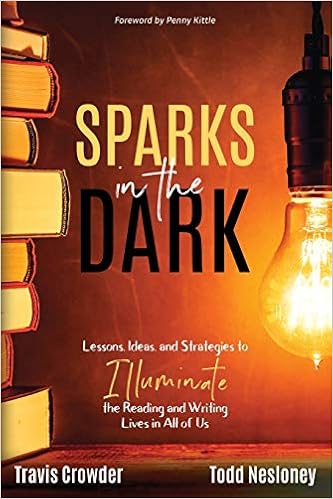
I’ll tell you what’s going on. I stinking read the rest of Sparks in the Dark this evening and I am so pumped up by Todd Nesloney and Travis Crowder! (Travis apparently is another hometown hero – had no idea he lived in NC until the end of the book; did I miss that somewhere? Home field advantage – I’ve got to come see you, Travis!)
I thoroughly enjoyed the first 7 chapters of this book and it was mostly about reading and integrating that into every content area and why reading is so important to our students. Well, then I read the last 6 chapters and I’ll be darned if I wasn’t inspired by their words on writing and now I’ve got to reflect and write an implementation plan for that.
Yes, you heard that right… This book is so doggone good that I’ve got to write two posts, reflecting and connecting to the text, then create another implementation plan – just based on (as Travis and Todd say) “illuminating the writing lives” in my students! Well-done, fellas; well-done!
As a child (I couldn’t have been more than 9 or 10) I sat at my old Windows computer (which required DOS prompts) and wrote chapters about realistic fiction. They were typically a knock-off of adventures in The Babysitter’s Club series by Ann Martin.
I kept a diary that I wrote in every night from the time I was in 1st or 2nd grade and distinctly remember writing a heartfelt post about the day my mom and dad officially split up and my dad walked out the door, when I was in 5th grade.
In 4th grade (Mrs. Byrd’s class), I wrote a lengthy answer to an essay question about changes in transportation in North Carolina on a social studies test. It is the first time I recall writing and enjoying writing at school. She was so impressed with the answer that it became an exemplar, which blew me away.
In 7th grade, we were required to write in a journal each week. Fridays were days for writing and we chose from 101 writing prompts and just wrote whatever we desired. Mine started out focused on the boy I had a [not-so-] secret crush on at the time. (I was 12, give me a break!) They evolved into more thought-provoking pieces of current events, as well as imaginative writing.
From there, school killed my love of writing. It became a chore.
When my ex-fiance and I broke off our engagement, I picked up writing again. I shared my “deepest, darkest secrets” in my journal (because calling it a diary felt so juvenile). I wrote my feelings, my apprehension about this new future, completely separated from the future I had imagined for years. When I met my husband for the first time, I wrote about him the night I got home. I wrote about the feeling that “this might be the one.” (Yes, I knew from the moment I met him, as did he… we were engaged in 6 weeks, married within the year, and through good, bad, and sometimes incredibly ugly we’re celebrating 12 years in December.)
Then social media kicked in. I found facebook (oddly enough) to be an outlet. It wasn’t as “deep-dark secret” as my journal had been, but it was a place to chronicle my life’s events. I would share my love for my job, day-to-day events, and yes, even what I ate at night (especially if it was Outback Steakhouse, one of my very favorites). I wrote about heartbreaks and shared with my family and closest friends – when we miscarried babies in not one… not two… but three different pregnancies, when I lost my Nanny (one of my biggest cheerleaders), and when my husband lost his job months after our youngest daughter was born.
Now… it’s blogging. This is my space. (See what I did there… y’all remember that? Whew – blast from the past!) It’s where I share my thoughts. Don Murray was so right when he says (as quoted in Sparks in the Dark), “You write to discover what you want to say.”
So my implementation plan is completely different from anything I’ve done to this point. I’m telling y’all… this book has grabbed my soul! It’s stirred something deep down. It’s awoken a passion that I didn’t realize I had; something completely different from what the math teacher in me would have ever admitted to having a passion for. Writing. It’s not about writing to a prompt. It’s not about answering the question of the day, or answering an essay question on a test. Like reading, it’s about choice. Choosing what you want to write about. It’s about getting your thoughts on paper (or screen, pick your poison). It’s about reflection. My best reflections have come through writing. Not verbal conversation with others. But through my own quiet time, after my family is asleep… when I sit in the middle section of our sectional wrapped up in a blanket with my heavily-stickered MacBook Pro in my lap. When I write. That’s when I discover what I want to say. Sometimes there are (what feels like) a bazillion typos. You may notice them. I do, too. I will eventually edit. But right now, it’s all so raw. I just want to get it out.
This implementation plan isn’t for me. It’s not even really for my students. It’sfor you.
I challenge you to write. I challenge you to share your writing with others. Maybe it’s a journal (I don’t recommend sharing your deepest-darkest secrets with just anyone though… just sayin’). Maybe it’s a Google Doc. Maybe it’s a writing notebook. Maybe… just maybe it’s a blog. Whatever it is, write. Write to figure out what you believe. Figure out your passions. Figure out who you are. I’m 33 years old, and I am just discovering who Alicia Ray really is. Sometimes, she scares the crap out of me. Sometimes, I feel like she’s not enough. Sometimes, I love her. But she’s always me. And the best way to share her, this voice inside my head, is through writing. So, to you… go right now… Write. I’d love it if you’d give me a peek into your head. Please tag me when you share your post (if that’s the route you take)!
I’ve not finished the book. I had to stop reading. So many ideas were swirling in my head that I couldn’t continue without getting part of these thoughts written down. I promise I’ll finish it. Surely, if you’ve been with me since the beginning of #DBC50Summer, you trust that I will uphold the integrity of #DBC50Summer by reading every word of every book. I will finish book 48. But it won’t be tonight. I can’t.
I have decided that Todd Nesloney is my spirit animal. Seriously – the parallels in our educational walk are insane… right up to where he becomes an administrator. I’m going to let you keep that one for both of us, okay, Todd? In previous blogs, I mentioned my journey in education. I was hired after three interviews with the same administrator (two face-to-face and one over the phone) as a fifth grade math teacher on a three-teacher team. I taught math to three sets of 20-22 fifth grade students. I had one small 20-25 minute block of SSR time (self-selected reading or silent sustained reading – pick an acronym meaning) and rarely conferenced with students. Why? Teaching reading was the job of our ELA teacher. Not. My. Job. (I, too, Todd, was wrong.) I used that time to grade papers, conference about Accelerated Math or Superstars Math, or troubleshoot the problems our Accelerated Reader program was having (ugh). It was the most dreaded part of my day, and I didn’t mind letting students know that I hated it. How arrogant I was! Then I transitioned to become a math and science teacher on two-teacher team. After two years of that, I was self-contained, teaching all subject areas in fifth grade. Only then, did I view myself as a reading teacher. How I wish I could go back and change my mindset then!
When former students hear that I work in a media center, I usually receive one of two reactions. A sideways glance and “oh really?” or a flat out “No WAY! I never imagined you in a library!” That’s how bad my disdain for teaching reading was coming across to students. I realize the impossibility of my next statement, but boy do I wish I had Sparks in the Dark by Travis Crowder and Todd Nesloney (coauthor of Kids Deserve It and author of Stories from Webb) when I was in the classroom!
This beautiful book eloquently states all that is right with reading and writing in the classroom! Every classroom, not just ELA, should be reading and writing daily! With intentionality. When I taught math and when I taught math and science, I should have been incorporating reading and writing. In a math methods class in college, I took a course that required writing every step to a problem in a problem set in paragraph form. We were to explain our chosen problem like we were explaining complex math to a kindergarten student. It was our responsibility to read the responses of our teammates, because we then presented their responses to the class. We wrote, read, and talked… in math. Never once did we draw diagrams unless we could specifically describe those diagrams in paragraph form. It was the hardest class I took in my undergrad coursework, but also the most meaningful. (I never used the information while teaching math, but I should have. Looking back, I realize that I did my students a huge disservice.)
I’m only on chapter 8, but I had to stop and share my takeaways thus far.
Takeaway 1: These fellas have passion for reading and writing in the classroom. Travis and Todd share their own failures, not only with us as readers, but with their students through written word. I had never considered writing for my students. I should definitely try that and see what happens! I did share the #DBC50Summer Explained post with them during media as an introduction to goal setting and reading as a choice. After they read the post, I asked them who the author was. Most had no idea. When I pointed out the URL was from aliciaray.com, several requested time to reread the article (or let’s be real, read it for the first time because they were now invested). Several immediately bookmarked my blog which blew my mind that they would be interested in these posts. I even shared that it was all “teacher-y stuff” but they didn’t seem to mind bookmarking anyway. (If any of you are reading this, hi and I love you! Do you have a book near you?)
Takeaway 2: Students deserve and crave choice and voice in their reading and writing. I have had a revelation in the past 5 years in the media center… I despise reading quizzes and book reports. I hate what it does to students’ love of reading. I’ve watched my own child devour a book and after watching her eyes light up as she tells me about it, I ask her if she’s doing to take a test on it the next day. It’s like flipping a switch. The light goes out. She’s no longer excited about the book. When did we get to that point as educators? Can’t they just read to enjoy reading? When did the enjoyment of reading a book become superseded by a need to reward students with arbitrary kids’ meal prizes or reward trips that parents still have to pay for after their child earned it (many times at the last moment due to peer pressure)? Traditional book reports do the same thing. Having authentic conversations about what a child is reading, giving them the opportunity to discuss their books with their peers… that will create a love of reading. Travis and Todd agree!
Takeaway 3: The quotes… oh the quotes from this book. Whether it’s the quotes from the likes of Penny Kittle, T.S. Eliot, John Maxwell, Virginia Woolf, Maya Angelou, etc at the beginning of each chapter, or the quotes interspersed within the chapter, this baby is full of amazing quotes! Here are some of my favorites:
“My reading scores were improving… [but] none of my students were leaving my classroom with a love of reading and writing. Change was necessary.”
“Change isn’t meant to be easy. If it were, everyone would love and seek out change.”
“When students see your genuine passion and interest, it will pique theirs.”
“Reading is part of a well-rounded life.”
“I find it exciting to work with children who claim to hate reading because much of the time the problem is they simply haven’t found a book that grips their heart or reaches their soul.”
“Providing time for children to read in every classroom shows the students just how important reading is and that, yes, your math teacher reads, too.”
“Our children are seeking to be understood while simultaneously seeking to understand. They have questions about current events and the choices that people make…we need to provide a safe space for them to discuss their fears, their worries, their uncertainties.”
“Arm us with books. Because the pen is mightier than the sword.”
See… powerful stuff, right? That’s not even close to all I’ve highlighted and written notes beside! What power reading and writing have for our students, and for us! If I’ve learned nothing else from #DBC50Summer, it is that truth. Reading and writing has proven to be an insanely powerful practice, and one that I will continue to pursue now that I’ve found my voice again. I will move from professional development books to middle school books and some young adult and picture books and continue this practice of reading and blogging. I believe it’s important for me to practice what I preach, so I want my students to be able to reference my publishing the blogs to a public audience as a positive example of digital footprint, citizenship, goal-setting, and writing for a purpose.
I have so many ideas of implementation plans swirling that I cannot possibly pick one right now…. and I’ve not even finished the book yet. I just had to stop and reflect! I can, however, share some of the possibilities with you.
Little Free Library – Our carpentry class made these for each elementary school three or four years ago and we supplied the LFL with discard books and Scholastic dollar books. I’d love to lead the initiative to create one for each of our middle and high schools this year.
Implementing a time in the media center to reflect on books as they return them. What did they like or not like? Should we keep the book in the media center or not? We are just recreating a reading culture at my school and many of the books (especially fiction) are not checked out very much. I have analyzed our collection over and over again, but this time, I will do it with the most important voices – the students’. They will help me decide which books to discard and which books we need to add to our collection through book suggestions.
We are doing a book tasting as part of a much larger Project-Based Learning experience next month. Stay tuned for a blog post with epic pictures and step-by-step directions for implementing at your school if you choose to do so.
For the first time ever, our students are given full freedom in book selection in the media center. In the past (in elementary school), every book was leveled and students could only check out books on their level. When students arrived at middle school, I do not level books, but I did require that students choose one fiction and one nonfiction book for a total of two books checked out at a time. I’m releasing control (whew – scary, but it’s the right thing for students, so I’m doing it) and allowing students to check out any three books they’d like. Of course, I’m encouraging them to read a variety of texts and to step out of their comfort zone in genres to try something new, but the ultimate decision is theirs.
Students are setting their own reading goals this year. Each quarter they are committing to reading “x” number of books before the end of the quarter. We discussed length of books being a factor, reading speed, genre, etc and that every book counted equally. So whether they read a picture book or Divergent, it counts as one book. Because there is no competition between students, only trying to reach your own goal, students were encouraged to create a realistic goal for themselves and share it with me. They then created a flipgrid video that shared their goal and their plan for reaching the goal using the following sentence frame: My name is __(tell your name)__ and my reading goal is to read ___(tell how many books)___ books by October 31. I will reach my goal by ___(share your plan)___. Finally, we will revisit these goals halfway through the quarter, evaluating our progress and at the end of the quarter will share on flipgrid whether they reached the goal and what their next quarter’s goal will be.
There is no reward for reaching their goal other than the satisfaction of reaching their goal and reading tremendous books. There is no consequence for not reaching their goal; we will just make plans for how to reach the goal next time. Finally, there is no quiz, project, report, etc to prove they have read or not read.
Crazy, right? But we’re trying it. Giving them complete ownership will hopefully create a desire to read like never before. Check back in early November for an update on how it’s going. Students had approximately 6 weeks left in the quarter when they created their goal. I am impressed that only 9% of students committed to only reading one book (zero wasn’t an option – they are expected to read something) in six weeks, while 50% of students created a goal of reading 3-8 books in this same time period. That’s an average of a book per week. If my students reach that goal, I will be super pumped! Reading a book per week is a HUGE upgrade from where we are now!
I’m excited to work alongside my administration and teachers to promote a love of reading, writing, and learning in our school. This book is exactly what we need as we partner with our students to create a literacy plan that empowers students to make their own goals and lead the way with reading and writing. It’s going to be awesome! I look forward to finishing the book tomorrow before starting book 49!
In the meantime, go get a copy of Sparks in the Dark and get inspired to implement great changes in your school in regards to reading and writing with purpose and excitement. Be sure to follow Travis and Todd on Twitter at @teachermantrav and @techninjatodd, respectively. Follow the hashtag #SparksintheDark for awesome conversation and ideas to integrate reading and writing into every content area. Check out Todd’s website here and Travis’s website here for more resources, including blogs! The podcast below from Vicki (@coolcatteacher) Davis is an amazing look into the book and the hearts of these two astounding educators! *I highly recommend 10-Minute Teacher Podcast – always! Great resources, conversation, and doesn’t take up a lot of your time. Win-Win-Win!*
Finally, hop over to the flipgrid and share your own story of a time when you saw sparks in the dark! This may be how you create a lifelong love of reading and writing in your school, classroom, or district. It may be a story about a student who finally “got it” and fell in love with literacy because of “that book”. Share with us! Andrea Paulakovich (creator of this amazing flipgrid space and the idea of global collaboration on all DBC, Inc book on flipgrid) and I would love for you to add your thoughts to the flipgrid!
Speaking of book 49 (which I will begin ONLY after I finish the last few chapters of Sparks in the Dark– remember, we’ve established that trust now, yes?)… Sean – it’s time! It’s FINALLY time! I have the best story about my friend Sean, and how we met and mutually connected to Dave Burgess in 2015! I cannot wait to share that story with you when I finally get to read, connect, reflect, and create an implementation plan for his book that released this summer! I’ve been waiting for this moment all summer, Sean! Book 49 is called The Pepper Effect and is written by my friend (and “neighbor”), Sean Gaillard!
I keep waiting to come across a Dave Burgess Consulting, Inc book that I don’t like… one that doesn’t inspire me as much as others. I honestly keep thinking as I begin every “new” book (one I’ve not read yet), Will this be the one? The one that I have to make a tough decision if I blog truthfully or if I sugarcoat my interest level. I know I sound like a broken record because I have literally said to purchase every single one of these books. Book 47 continues the tradition of excellence, and even raises the bar a bit.
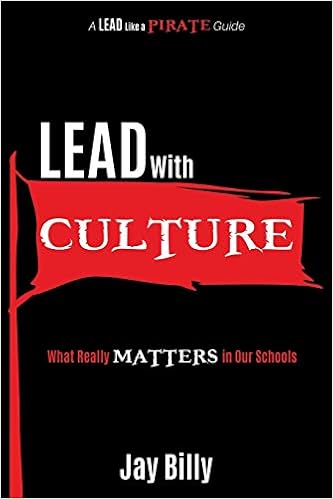
Jay Billy is a Pirate through and through. It is evident in his tweets and his passion is even more impressive through this book. He was given a mighty task. One that I actually thought no one could achieve… be the first Lead Like A Pirate guide book released by DBC, Inc. Pave the way for future guide books related to the content in the Teach Like A Pirate leadership equivalent. That is pressure. Real pressure. Lead with Culture is the perfect way to kick off a series of guide books.
First of all, I need to put Jay Billy in my pocket and carry him around with me. I love, love, love my administrator. I’m just going to put that out there before I say this next thing…. I would work for Jay Billy in a heartbeat. I’d even teach Kindergarten if that’s what it took. (That. Is. Huge. Those that really know me – go ahead and pick your jaw up off the floor.)
His energy, enthusiasm, passion… it can’t help but to create a positive culture. I imagine that rainbows erupt from the sky every morning to await arrival of students and teachers at his school. Unicorns prance in the fields nearby allowing students to run their fingers through their mane while staring into their souls. Fairies flutter by with pixie dust to sprinkle good cheer on everyone. Students move from class to class on puffy clouds of inspiration.
Okay, so maybe not that surreal, but pretty dang close. Jay leads us on a deep-dive of what really matters in our schools. He speaks to culture, joy, kindness, intention, honesty, passion, and more. Not only does he outline why it matters, but he shares how to improve those areas in your own school through examples of things he does in his school. This is why the implementation plan is so difficult here. I could pick something from every doggone chapter to implement and then sit back and watch what happens.
One of the things I love most is that Jay makes you feel as though you can be successful in changing the culture of any school. And it doesn’t have to come at the expense of accountability scores. Dave Burgess tweets this about those false dichotomies (having either this OR that).
The school I serve is fantastic. I love that we are working every day to shatter the “traditional” educational model. Our ELA teachers are taking students to the Science Institute to make stories come to life, history teachers are allowing students to experience Ancient Egypt through virtual reality escape rooms, math teachers encourage students to apply concepts of linear, quadratic, and exponential functions to build roller coasters in Minecraft (then ride them in virtual reality, experiencing them to scale), and science teachers weave hands-on labs with context clues to decipher content vocabulary. All the while, encore classes like art, chorus, band, physical education and health, Project Lead the Way 1 and 2, and computer science discoveries are incorporating content from core subject areas and giving students opportunities to explore passions and connect the arts to all they do. It’s an amazing, inspiring place to work.
Not everyone sees it that way. Our school has been the underdog in many struggles. We were “the second” middle school built within 6 miles in a rural community. To have two middle schools that close is uncommon. Two elementary schools feed into our STEM magnet middle school. One school is 74% free and reduced lunch, while the other qualifies for free lunch for every student in the school. Mix that in with a full-inclusion magnet population. Very different socio-economics, students brought in on a shuttle bus so a shorter school day due to transportation, six classes built into the schedule per day rather than the traditional four at our other middle schools, so each staff member teaches approximately 100-110 students per day. Just a few years ago, we were a school with a NC Report Card rating of “D” and until this year we had not met growth since 2012. It was the school that people raised their eyebrows when you mentioned you worked there… often accompanied by a “ooooh, and how’s that going?”
Culture has improved by leaps and bounds in the past two years. Our administration has created a culture of yes and she encourages us to think out of the box. She sets high expectations and supports us as we strive to reach those high expectations. If a teacher has a need, she moves things around to make it happen. We still have a long way to go.
As in many schools, when the loudest voice is negative, it overshadows all of the awesome that is going on. Sometimes, our loudest voices can be negative. We’re working to shift that and change the conversation. I want to seek out the positive voices this year, even if they are quiet as mice. As I read Jay’s book, I was overwhelmed with ideas and had no idea how to incorporate them all. Because they are ALL worth bringing into #DBC50Summer implementation!
My favorite part of this book is the space for reflection after each chapter. Jay gives us three action items that correlate to the topic he just covered. These are the Leadership Treasure Hunt (Find This), Navigating the Seas (Think about This), and Charting the Course (Take Action). So to incorporate as much of Jay’s wisdom as I possibly can, I am going on a treasure hunt!
When I was a young girl, my Nanny (what I called my dad’s mom and one of my very best friends and biggest cheerleaders) and Papa had a camper in the nearby mountains of North Carolina. We would spend several weekends there throughout the year until my Papa passed away when I was ten years old. As my Nanny and I took leisurely walks on the trails nearby, we would sing a classic children’s song…
We’re goin’ on a bear hunt
(We’re goin’ on a bear hunt)
We’re going to catch a big one,
(We’re going to catch a big one,)
I’m not afraid
(I’m not afraid)
What a beautiful day!
(What a beautiful day!)
I can just substitute treasure hunt for bear hunt, and I’ve got my implementation plan! Each of the Leadership Treasure Hunt items from Lead with Culture will be found through the 2018-2019 school year and recorded! Once I find these treasures, in true Lead Like A Pirate fashion, I will drop an Anchor of Appreciation as applicable. Here’s my BINGO card to keep me accountable for appreciating and implementing something from each chapter.
Lead with Culture by Jay Billy is another must-have from the DBC, Inc collection! Jay’s YouTube channel can be found here. You can find more information on his book here. Jay is active on Twitter and you can follow the community using the hashtag #CultureMatters and #LeadLAP. Jay is featured on multiple podcasts. Check them out with a quick Google search. Some great options are PodcastPD, Aspire, and DisruptEDtv. Join the #LeadLAP chat on Saturday mornings at 7:30 am PST/10:30 am EST by using the #LeadLAP hashtag! It’s a terrific community and Jay is a regular there! Definitely add your thoughts to the flipgrid! This space was created by the incredible Andrea Paulakovich as a global collaboration effort on all DBC, Inc books! I’m just fortunate enough to co-pilot the space! Also, you’re going to want to see Andrea’s in-depth #DBC50Summer post on Lead with Culture! She is so impressive! Check it out here! Be sure to get a copy of the book so you can spread the awesome that Jay offers through bettering your own school culture! Even if it’s an amazing space to work and you have your own field of unicorns and puffy clouds and fairies with pixie dust, Jay reminds us that “greatness is a moving target” – keep improving & strengthening that culture!
THREE MORE BOOKS TO GO! Three more days to do it in! I sure do hope I can do this! My biggest problem is that my blogs are posted incredibly late at night because that’s my quiet time. Everyone’s asleep and I’m able to think more clearly. I will have to interrupt this pattern in order to finish by 9:54 pm EST, which is the official beginning of Autumn! Book 48 is by an author we know and love for Kids Deserve It and Stories from Webb! Todd Nesloney is back and this time we get to meet Travis Crowder; these two educators co-authored Sparks in the Dark! This will kick my brain into high gear for literacy and encouraging a life-long love of reading and learning! I’m excited to get to it!

 Educational Hindsight