#DBC50Summer 17/50: Kids Deserve It

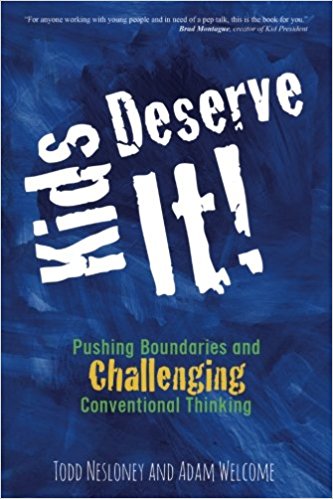
Kids. Deserve. It. Take a minute and consider that. Whatever good there is out there, kids deserve it.  Whatever opportunities there are out there, kids deserve it.  Whatever bright future we can show them, kids deserve it. Whatever silly scheme we’re cooking up next in the classroom, kids deserve it.  Kids deserve every bit of our best, and not one ounce less.  That’s what book 17 is all about.  Adam Welcome and Todd Nesloney co-authored a book that took the world by storm.  This book reminds me of my why every time I open the cover. It’s obvious that it has done that and more for so many educators as Kids Deserve It has a tremendous community on Twitter full of passionate educators who push boundaries and challenge conventional thinking.
kdi

I did not have a desire to be a teacher when I was a kid in the same way many teachers did.  When I was a girl, my best friend wanted to play school all the time.  Because she was my friend, I obliged… however, I dreaded it every time.  I grimaced when she’d mention going to her garage because I knew that meant pretend worksheets, sharpening pretend pencils, or sitting in our pretend desks.  I always, always let her be the teacher.

See, I really didn’t like school.  I was GOOD at it, but I didn’t like it.  I enjoyed the social aspect – I was the kid that always talked, no matter who you sat me beside.  I was the one who would be hiding a book I was reading in my desk while you went on and on in math class; I would doodle in my notebook making you think I was working until you came over and saw the hearts and squiggles everywhere.  I was never a behavior problem, unless I felt backed into a corner or embarrassed in front of my peers.  I made excellent grades, and would happily tutor a friend if you asked me to. But I didn’t go running into school every day excited for what was to come.  I didn’t go home in the afternoons and play school with my teddy bears, Sandy, Smokey, and Brownie (don’t judge… don’t you dare judge, ha).  My parents weren’t teachers; in fact, I was the first in my family to graduate from college.  I don’t have an “a-ha” moment of when I decided to be a teacher.  I couldn’t tell you why I chose to go to school to be an educator.  I just remember putting it on a pathway form I was filling out for the guidance counselor one day, and thinking… okay, I’ll go be a teacher then.  There were no sparks, no fireworks, no heavens opening and angels singing. Just an ordinary day.

It wasn’t until I was around students of my own that I realized my “why”.  THEY were my why.  I needed to be around the kids.  They make me come alive.  I can be having the worst morning of the worst week and walk into a classroom of kids… and it changes me.  I become a different person when I take on the “Mrs. Ray” part of my life.  My daughters would tell you that I’m not the most patient person. I’m not one who enjoys loud sudden noises.  I do not like spontaneity at all; I NEED a plan! We frequently ride in the car with no music on because “mom needs some quiet time.”  But when I’m at school… I am insanely patient, I love to surprise kids with wild antics, and I play music on Pandora the entire day.  I thrive on the creative chaos that learning brings! Students bring out the best in me.  You can even see it in pictures.  If I’m around my students, there is a glow on my face in pictures.  I quite literally come alive when they are around.  My students are my why.  And I believe wholeheartedly that they deserve every good thing in life I can give them.

This book speaks to my soul.  There is a story that I can relate to every single chapter.  I picture a student’s face, an experience we created in the classroom, a phone call home to a parent who desperately needed to hear some good news about their child.  Unfortunately, I also think of all the ways I have failed my students in the past 12 years.  The doors that I slammed, the times that I was too tired to bring my “A-game”, the effort that I CHOSE not to put into a lesson.  This book makes me want to be better – not just as an educator, but as a person.  Many of the things Adam and Todd speak of are just things that good, kind-hearted, empathetic, loving humans do for one another.

It’s about going the extra mile to notice a kid in need, to praise them when they deserve it, to be their cheerleader, to find out why they behave the way they do.  It’s inspirational in every sense.

I could literally implement one thing from every chapter – actually one thing from every story within the chapter – that Adam and Todd share.  Many times I’m thinking Wow, that’s a great idea!  I could do that! after reading a story within a chapter.  Sometimes it’s affirming because I think Oh man, that’s like this time I did this… and I can relate to their story with an experience of my own.  In light of this being my third reading of Kids Deserve It, there are three things I want to implement for #DBC50Summer.

1. Phone Calls Home: I love to call parents and tell them a story of how incredible their kid is!  Last year I noticed one of my 8th graders walking another 8th grader with special needs down the hall.  As always, I waved from the fishbowl of a media center and the two young men walked in the door to say hello.  We struck up a short conversation in which I found out that the 8th grader with special needs was upset about something happening with his Chromebook and his friend was trying to help him figure it out.  We got him a loaner Chromebook and assured him that his Chromebook would be repaired soon and I’d get it back to him as soon as I could.  When the two teens left the media center, I immediately looked up the phone number of the 8th grader who was helping and called his mom.  She was so touched by the phone call, and it made my day better because I had focused on a good deed that one child did for another, rather than a Chromebook being broken.  I wanted to pay it forward as well.  This year, I want to make it a priority to call 5 parents a week to personally give them an example of when their child was an exceptional human being.  Because I don’t teach academics in a classroom setting, I get to call about everything BUT grades!  How awesome is that?! I can’t wait to make these calls and document the reactions!

2. Ride the Bus: I want to ride each bus in the morning and in the afternoon at some point this year.  When I started my first media position at an elementary school several years ago, we took a workday and rode the bus routes as a staff to see where many of our students lived.  It was an eye-opening experience.  I love the idea of being on the bus to greet students as they come to school.  It also allows me to see their homes.  We have four buses, two of which we share with the high school, so I look forward to seeing former students as well.  I’m not sure how I will implement this yet, as I have two daughters of my own that need to get to school, in the opposite direction of my husband’s job.  I will make it happen though, one way or another.

3. Shadow Students: There were times last year that a student would walk in the door and seem a bit “off”.  There were days I would stand in the halls during class change giving high fives and hugs and notice that a student wasn’t walking with their “best friend” that day.  I try to notice those things and speak to those students throughout the day to check in on them.  I want to make that a priority this year.  I want to be “in their heads,” so to speak.  I want to build a relationship with students that will allow me, with one glance, to tell that something is off and speak to them.  One way I plan to do that is to shadow students in classes.  I want to get the full experience of being a middle school student, going to their classes, completing the work, eating lunch with them, everything. (I draw the line at using the student restrooms though… I will still be using faculty bathrooms. Just saying.) By shadowing students, I will be more empathetic to their lives and use the experiences to continue to remember that they deserve my best, and the best of their classroom teachers as I coach them.

There are so many things that can be said about this book.  I could go on and on about the amazing things Adam and Todd bring to education.  Their passion and enthusiasm is contagious.  Their focus on the student, not just academically, but the WHOLE student is to be admired and should be replicated by every educator.  Why?  Because Kids Deserve It.

Both men have gone on to write books that will show up later in #DBC50Summer and I am so excited to read those for the first time.  I know they will be just as inspirational, if not more so (Wait…is that possible?), as Kids Deserve It.

As always, you can follow along with the learning, sharing your thoughts and reflections on the Flipgrid.  The password is DBCSummer and all credit for the idea goes to my incredible friend Andrea Paulakovich, an educator in Kansas.  Andrea had an amazing thought that we could create a space to globally share reflections and ideas as a worldwide book study for any of the DBC books!  See, told you she was incredible!  You can follow her on Twitter here and follow her #DBC50Summer journey here!  If there aren’t any posts on the Flipgrid yet, be a trendsetter.  Make the first video!  Be bold!

The Kids Deserve It movement can be found globally on Twitter using the hashtag #KidsDeserveIt.  You can join the chat, with the same hashtag, on Wednesday nights at 9:00 pm.  You may also choose to follow the KidsDeserveIt account on Twitter for updates and information.  Checking out the website is a great place to get your hands on more goodness from Todd and Adam like the blog and the KidsDeserveIt Show with SUPERSTAR educators like Dave Burgess, Shelley Burgess, Brad Gustafson, Erik Wahl, Ben Gilpin, Jennie Magiera, and the list goes on and on!

After you grab your own copy of the book, you should check out these videos of the authors as well!

Todd Nesloney: TEDxTAMU – Kids Deserve It

Adam Welcome – Kids Deserve It Keynote

Todd & Adam on Classroom 2.0

Are you ready for Book 18? The Writing On The Classroom Wall by Steve Wyborney is coming up next! I’ve never read this one and am so excited to see what it’s all about!  The subtitle of this book mentions posting about passionate beliefs & by the title, I’m guessing we’re putting those on the walls of our classroom. Guess I better figure out what those passionate beliefs are before I start placing them on walls… Still trying to figure those out from Play Like A Pirate! I’m still struggling through the process of discovering three passions. Guess I’d better start some official brainstorming & narrow it down using Launch‘s methods before reading Steve’s book…

#DBC50Summer 16/50: Launch

When you open a book and literally start nodding in agreement with the very first sentence, you know you’re in for a wild ride.  That’s exactly what Book 16 in the Dave Burgess Consulting, Inc line up did!  Launch by John Spencer and AJ Juliani could not have come at a more perfect time this summer!  Big things are in store after reading this one!

launch

This book is everything I want my daughters experiencing in their education.  It describes everything I want the media center to be for students… really, everything I want SCHOOL to be for students.  I’ve never really gotten into any of the “design thinking” protocols because they are so wordy… everything-“tion”… ideation, creation, reflection – my students needed a translaTION to understand half of it.  None of the ones I had seen really fit for middle school students; they were either too elementary or too difficult to understand.  Our school has been trying to find a new engineering/design process to implement and immediately upon seeing the LAUNCH cycle as described by John & AJ, I texted my principal.

The plan of implementation for this book will be school-wide!  The School Improvement Team (SIT) met last week; on the agenda was reviewing and selecting a design process as our current process is 10 steps long and just too much for our students. They didn’t see anything they were married tom so they began creating a mash-up of a few of the processes they saw, but it’s not been finalized!  With that in mind, I hope to have the opportunity to present the LAUNCH cycle to our SIT team as an option for our school’s design process.  I immediately fell in love with the process and the ease in which it can be implemented, and I believe our staff will too.

L – Look, Listen, Learn

A – Ask Tons of Questions

U – Understand the Process or Problem

N – Navigate Ideas

C – Create a Prototype

H – Highlight and Fix

LAUNCH to an audience.

At the end of last year, my principal requested that we begin thinking about a way to bring a focus of research skills back to our school.  When I saw that the U in LAUNCH relates directly to various types of research I all but squealed with joy!  The research methods discussed by John and AJ are exactly what I want my students to walk away knowing.  Research isn’t always about looking online or looking in a printed article or book.  Research is about learning.  It can happen in the form of an interview, watching multimedia, even action research with observation or through a hands-on experiment and collecting data.  This book came at the absolute perfect time, and I am so excited to share all I learned with my school!  The resources that John & AJ have made available are incredible!  Check out the website for their book here, as well as the individual websites of the authors – John’s is here and AJ’s can be found here!  I could spend hours just looking at the websites!

In the off-chance that my school does not choose to implement the LAUNCH cycle, I have a backup implementation plan (because that’s just how I roll; I’ve got a backup for the backup, but no need to share that one just yet).  As a backup plan (and likely implemented regardless of LAUNCH cycle implementation), I will pursue a Global Day of Design in May using the information given here.  This is an incredible opportunity for students to use their knowledge and unlock creativity in exciting ways.  I believe that being part of something much larger than our school will engage our students in meaningful ways.  Last year we held our first official Maker Faire event.  It was a terrific event, but I believe the Global Day of Design will bring about more creative products with a bigger purpose behind their creations than just the event in question.  I love that the LAUNCH cycle “ends” (we all know design thinking never really ends, but you understand, yes?) with launching to an authentic audience.  This is more than just a presentation, but actually seeing the design in action!  I believe this is a spectacular way for students to have real meaning behind their design, rather than the hypotheticals they are usually presented with.  I know my blogs being read by many of you has forced me to put much more thought into them.  Imagine how much harder our students will work when they know someone, other than their teacher and peers, are using their products.

Finally, Launch speaks multiple times about the power of challenges, risk-taking, and failure.

  • “…design thinking isn’t about abandoning the standards.  It’s about raising the standards and challenging students to think at a deeper level.”
  • “You will fail. It’s going to happen… failure is a part of the process for innovative teachers.  Each mistake is simply another iteration on the journey toward success…the only way you blaze a trail is by taking risks and failing forward.”
  • “Design thinking encourages creative risk-taking with the goal of eventual mastery.”
  • “It was the first time I had heard students talk about ‘failure’ in a positive light; they realized that creating big goals gave them the opportunity to fail forward.”
  • “…we want kids to embrace mistakes as part of the learning process… each mistake is a chance to figure out what works and what doesn’t work.  When students have the permission to make mistakes, they define success as growth and learning.  They recognize that failure isn’t really failure at all”

Each of these quotes stood out to me.  Creating a safe culture where it is okay to fail is of utmost importance when implementing design thinking.  It is what I hope our media center has become in the two years that I’ve been there.

I want students to know that it’s okay to mess up, that it’s great to make a mistake, that failure isn’t final.

Launch was such a powerful book to me!  I created multiple BookSnaps and posted them on Twitter, check them out!


Be sure to join the #LaunchBook community on Twitter as they discuss Design Thinking, creativity, and bringing out the maker in every student.  Follow both John & AJ on Twitter, at @spencerideas and @ajjuliani, respectively.  The Flipgrid is available, as always, as a space for global collaboration in reflection and implementation of the book!  In this Flipgrid, tell about a time you failed in the classroom!  What did you learn from it? How have you improved your teaching practice because of it?  It’s a safe space, so share, share, share!  We can learn from one another here!  The password is DBCSummer, as usual.

Andrea Paulakovich, a dear friend and vital member of my PLN, joined in the #DBC50Summer and suggested the spectacular idea of adding Flipgrid as a way to share ideas!  She’s super awesome – you should follow her at @apaulakovichIRT & her #DBC50Summer journey here!

Launch inspired another book by John Spencer and AJ Juliani titled Empower.  This book is part of the publishing company IMpress.  You can read more about IMpress here.  So why don’t you head on over to Amazon and purchase your own copies of both of these awesome books Launch AND Empower?!?!  I was blown away by Launch and look forward to rereading with my peers at work as we, hopefully, implement the LAUNCH cycle in design thinking.  I will certainly be reading and blogging about Empower once I complete the DBC books.

*Side Note: Within this book is a step-by-step process to uncover your passions… seriously, I’m not making that up!  This is another thing I fell in love with, as I plan to go through it to see if I can discover my educational passions (see Play Like A Pirate post).  How incredible would it be for our students to go through this process, too?!

The 17th book (my favorite number, coincidentally) is none other than Kids Deserve It by Adam Welcome and Todd Nesloney.  This book… well, wow… no words. Just go get it, while I reread it and try to form the words needed to describe it in the blog. Not sure it can be done. Grab your copy and settle in! You will quickly remember your WHY while you read that one!

#DBC50Summer 15/50: The Classroom Chef

In May of 2006 I graduated from Appalachian State University in Boone, North Carolina with a degree in Elementary Education and a concentration in mathematics.  I wanted to teach math, and only math.  I had absolutely no interest in teaching kids how to read (ironic that I now work in a media center).  I enjoy reading (obviously… um, hello #DBC50Summer, haha), but the process of “how to read” was lost on me the entire time I was in college.  When I was hired for my first teaching job in a small town in northwestern North Carolina, I was overjoyed to teach math exclusively, three times a day, to 5th grade students! When I saw the next book in the line up, I was thrilled to get it and read about my favorite subject area (more on that little misconception about the book soon enough)!

During my undergrad coursework, I was required to take multiple math methods courses, one of which was insanely difficult taught by a professor who rode a motorcycle and requested a classroom with whiteboards or chalkboards on every wall.  The assignments in this class were always the same. Problem Sets of 6-8 math problems (on white computer paper, mind you) were given to groups of 3 or 4.  Each person had to solve at least two problems before the next class period.  We had to write up how we would solve the problem with examples in order to be able to explain the process to a kindergarten student, even if it was a 5th grade concept.  Upon returning to class, we had to present our problems to the class in detail using the chalkboards or whiteboards that were on the walls.  I hated that class.  It was tough; it made me think.  I had to discover mathematical reasoning and problem solving for myself for the first time in my educational career.  It was also the class that was the most beneficial of any math class I ever took.  I even went on to take the next course she taught, which was taught in the exact same format.  She allowed us to struggle.  Because of that, I understood math.

classroomchef

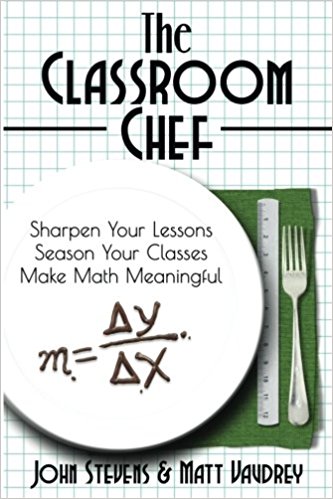
John Stevens and Matt Vaudrey coauthored the 15th book in the Dave Burgess Consulting, Inc line up.  This book, called The Classroom Chef, focuses on ways to make math meaningful to students.  Because of my mathematical background, I was beyond excited to crack the cover on this book!  I expected to be taken back to my days in the classroom teaching students math concepts.  I did not expect to be blown away by the insanely amazing lessons John & Matt describe in this book!  The restaurant theme runs throughout the entire book from setting the table to appetizers, entrees, and dessert!

In Dave Burgess’s post “Table Talk Math: Finally a Math Resource for Parents is Here!” Dave refers to The Classroom Chef as Teach Like a Pirate “with every single example straight from a math classroom”.  This assessment is spot on!  However, I have to stop and mention one little thing…

Don’t let the fact that this book specifically says “math” on the cover deter you from getting a copy!  Just as Dave’s book sharing examples from a high school social studies class doesn’t make it a “social studies only” book, John & Matt’s book sharing math examples doesn’t make it a “math only” book!  This book is for everyone, no matter your content or grade level!

See, the book isn’t just about a subject, it’s about a shift in education.  It’s about preparing a lesson, not lesson planning.  It’s about making your content meaningful to students.  It’s about giving students time to struggle with an idea.  When students discover the answer themselves, it’s much more meaningful to them, thereby allowing them to remember it longer.  Whether our students are struggling with the FOIL method in math, with discovering how people impact erosion in the environment in science, why we went to war in Korea, or what would have happened if Romeo & Juliet had lived in today’s time period… students need to experience struggle & failure in every class.  We must create a space in which students feel like failure is okay, as long as they take the opportunity to correct their mistakes.

Within the pages of this book, John & Matt present multiple ideas to make math fun!  Again, this doesn’t only apply to math, though.  Just because the focus of this book is math doesn’t mean that math is the only course that can use a little injection of fun!  Fun quickly became “the F word” and educators tend to steer their educational ship clear of that.  I, personally, want to run my little educational pirate ship straight up to Fun and invite it onboard!  In fact, I don’t even want to be on the ship unless Fun is on it with me! Otherwise, it’s just another lonely old boat ride around the island.  I think this recurring theme of bringing fun back (Did you just sing Justin Timberlake? Because I did!!) in the DBC books are a piece of what keeps me coming back book after book.  Multiple books, just within the first 15, mention making school fun/amazing/exciting again.  Each of the following books (linked to their respective #DBC50Summer blog) revolves around this common theme.  School should be fun!  It shouldn’t be easy.  There are ways to use your brain, think critically, fail, and still have fun!

When I think of DBC books, my mind automatically shifts to Teach Like A Pirate and all of the “Like A Pirate” books, Kids Deserve It, Innovator’s Mindset, etc.  Before reading it for #DBC50Summer, if I’d been asked to name the DBC books, I would have struggled to remember this one.  After reading it though, it will likely be partnered up with Teach Like A Pirate in my head! I will be recommended it to EVERY ONE!  I want my children in classes where teachers are preparing a lesson, not lesson planning!  I want to know that my daughters have been served an appropriate multi-course educational meal.  And not just in math!

The obvious implementation for this book would be to pull in my friend, Holli Hudson, who teaches 7th and 8th grade math at my school.  We have co-planned (or should I say… co-prepared) and co-taught some incredible lessons together!  She read this book earlier in the summer, and she’s already been brainstorming for our first planning session.  Next year we’re preparing an immersive lesson in which students will engage in a book tasting in the media “cafe” with books they can actually purchase with Mustang Money and decide if they have enough money after subtracting the amount of any discount they may have earned, along with adding the tax.  Sounds cool, right?

However… that’s not my implementation for this book.  Instead, I’m going to encourage my accelerated classes to sign up for three times to bring students to the media center and facilitate BreakoutEDU sessions with me.  For those that aren’t aware, BreakoutEDU is an immersive learning game in which students must think critically to decipher clues to reveal or receive the combinations to multiple locks on a hasp on a box.  They must do this as a clock is counting down and with only two hints that can be used.  Last year every content area teacher in the building signed up for BreakoutEDU sessions, except 3 of my 4 accelerated classes.  This is why I want those classes to try it out.  It is widely known that many times our advanced students despise struggle and challenges more than any other student.  They just want to the answers so they can spit it back out on a test, feel accomplished, and move on.  I felt that way, too.  It will be good to watch the playing field be leveled a bit while they struggle through a BreakoutEDU game.

Discovering teachers’ love for implementing BreakoutEDU was actually a direct result of an epic failure!  Our htc Vive virtual reality headset had a broken lighthouse station (the part that allows you to walk around, which basically rendered the headset useless until repair) which derailed multiple experiences for about four-six weeks when we could get the replacement part.  I didn’t want to lose the momentum I had built with teachers signing up for time in the media center and the collaboration occurring between the teachers and me, so I suggested a BreakoutEDU game to a science teacher, who immediately jumped onboard.  It was so difficult for her to watch the students struggle through their first experience with BreakoutEDU.  No one in the class broke out of their box.  By the end of the year, nearly every content area teacher had brought their students to experience BreakoutEDU because the buzz about how awesome it was had reached their room.  Students were begging to do more, even after some students did 5 or 6 different games last year. Students thought much more critically and, as Matt & John mention in the book, they solved a problem (as opposed to being problem-solvers).  They figured out what to do when they didn’t know what to do.

Through the creation of a safe place to fail in our media center at school, it is my hope that I have encouraged risk-taking, critical thinking, and a desire to solve problems in both my students and my teachers.

I thoroughly enjoyed reading The Classroom Chef, and I look forward to diving deeper into the Classroom Chef website, linked here.  On the website, you can find shirts, book study documents, and a menu which serves “take-out” (additional math resources).  John’s website is pretty awesome, as is Matt’s.  You’ll find many of the math lessons from the book linked on Matt’s blog.  You can also check out the #MTBoS community on Twitter to connect with other math teachers sharing ideas!  You may also want to follow the community in #ClassroomChef or the account of the same name.  Finally, the Flipgrid (thanks to Andrea Paulakovich for the incredible idea of using Flipgrid as a global book study) is ready for your thoughts!  Share using the passcode DBCSummer.

Well…what are you waiting for?  Go get your copy of DBC’s 15th book, The Classroom Chef!

*Edit: I goofed!!!  It happens!  Messed up the order of release dates on previous version of post! OOPS! The correct Book #16 is Launch by John Spencer and A.J. Juliani!  This is the era of DBC, Inc in which the releases started happening back to back in rapid fire.  I LOVE that I am struggling to figure out which one was first – it means that the demand for conversation, authentic, TLAP-style educational/professional development books had skyrocketed!  So…what an incredible problem to have!  So many amazing ideas coming from the home of Dave & Shelley Burgess that the information couldn’t get to us fast enough!  I am beyond excited to read about Design Thinking and bringing out the maker in every student!  I firmly believe we should be creating creators and not consumers and this book looks like a great addition to the DBC, Inc line up!  Let’s get it done!