#DBCBookBlogs: Empower

Immediately upon finishing LAUNCH by John Spencer & AJ Juliani, I knew I wanted to read their second book, Empower, as quickly as possible. Finally, I was able to find time to read it and I was not disappointed. Some sequels start out where the first left off, but Empower doesn’t simply pick up where LAUNCH left off; it adds a whole new layer of aspirations for our students.

LAUNCH taught us to engage students in design thinking and how to relate this student-centered design thinking process to every content area. Empower shows us how to shift our thinking from student-centered to student-owned.

empower

From the foreword from George Couros (author of The Innovator’s Mindset and co-owner of IMpress with his wife, Paige and Dave & Shelley Burgess) to the invitation to innovation on the final page, this book was a powerful read. John & AJ share why it is not enough to simply shift the educational environment from compliance to engagement. We must extend this vitally important shift for students to empowerment. Students should not be answering our questions, but asking their own questions and then seeking to find the answers. If we want lifelong learners (and I genuinely hope that is the quest for all educators), we need to help students take those reins. It’s not enough to tell them we want them to set goals for themselves, we should give them the freedom to actually set them.

There are many moments in this book that I felt a mic drop from John & AJ. One moment that I felt a mic drop was when AJ and John share the shift from ‘making the subject interesting to tapping into student interests’. I love AJ’s story about Mr. Flynn and how Mr. Flynn’s interest in AJ ultimately pulled out the maker in him by empowering him through a programming class. The rap created by AJ & veteran teacher Jen Smith further illustrates the difference between making a subject interesting and tapping into students’ interests.

The description of the tourist teacher was a perfect description of me teaching in my early years. I was driving the bus and the kids were along for the ride. If the students found something they were interested in and wanted more information, I had to keep going so we’d stay on topic and on time, according to my schedule. While I understand that there is content that must be taught and time constrictions to teach it, we must rid ourselves of this model teacher. It’s not easy. In fact, just this year (my 13th in education), I was able to give students more choice and voice than ever before through passion projects in the media center. I was able to do this because I gave myself permission to let go of control and release the power to my students.

Yes, some failed miserably. Some didn’t turn a thing in, and some wasted time. Many expressed that they learned more than they thought possible and that they enjoyed the learning! There are facets of this experience that I will certainly change in the future, but one thing will remain the same – they will own the learning. And they will own it without being graded. They will feel the freedom of taking risks.

Another mic drop moment was the discussion of the difference between fail-URE and fail-ING. AJ and John highlight George Couros saying that we shouldn’t celebrate the failURE of our students, but the act of resiliency and the grit of getting back up again.  AJ and John talk about reframing failing as success through iterations. I think of it as a productive struggle. Every time our students experience a Breakout from BreakoutEDU, I see the productive struggle. It is so tough to watch their content teachers as we co-teach in these experiences. They desperately want to help the students as I encourage them to let the students struggle with it. The victory is so much sweeter when they have achieved it all on their own. Many of our students are beginning to believe this is true, as well. I know this because they use their hint cards less than they did initially. It’s so much to celebrate success with students, especially when they have achieved that success on their own!

A true craft in writing is using an analogy to describe difficult concepts and these two authors have proven that they are artists. The comparison of differentiation, personalization, and empowerment shown through ice cream examples is brilliant. It’s worth purchasing the book just to read this short section. I want to take a teacher field trip to a Baskin Robbins, Cold Stone Creamery, and Sweet Frog (our own fro-yo spot) to make these connections with our teachers!

Finally, I love the section about the stages John shares as students move from consumers to creators.

  • Exposure (Passive Consuming)
  • Active Consuming
  • Critical Consuming
  • Curating
  • Copying and Modifying
  • Mash-Ups
  • Creating From Scratch

As always, I intend to implement at least one thing from this book. Because I work with both students and teachers, I have a lot of flexibility in my implementations and interpretations of the books I read. I have chosen to go a bit off the beaten path with this one, mostly because I can. Also, I feel that it is in the spirit of the book to do something a bit different. The premise of the book is empowerment and what happens when students own their learning. I am perfectly comfortable sharing that I am still a student. I will always be a student. My learners are also teachers, who are also students. So this implementation will go a bit “top down”, if you will.

I have facilitated somewhere in the vicinity of 50 various breakout experiences from BreakoutEDU with teachers and students in our school over the past two years. (With many breakouts being repeated in classes 3-4 times per day, this results in somewhere between 150-200 total experiences.) Some are digital and some physical. All have been copied straight from the BreakoutEDU platform. In a few cases, I have tweaked clues to better suit our students, but I have never created a BreakoutEDU entirely on my own. My implementation is to create my own BreakoutEDU for one of my media classes and empower teachers (and students) in my building to create their own for their content areas. Following the LAUNCH cycle, I will launch this Breakout to an audience by submitting it to the platform for BreakoutEDU and encouraging teachers to do the same.

It’s going to be messy, however I believe it will be a success!

Empower is the first book released under the IMpress label! Check out this website with an incredible toolkit and more information on maker projects and the Global Day of Design! This is good stuff! The sketches within the book are stunning, and really bring the message to life! I highly recommend grabbing a copy of this incredible book by John Spencer and AJ Juliani! Here’s to hoping they share another book of their incredible knowledge together with the world! Until then, check out their blogs – here is John’s and here is AJ’s. Both of them have also written their own book; AJ wrote The PBL Playbook and John wrote Making Learning Flow. Both are certainly worth a read as well!
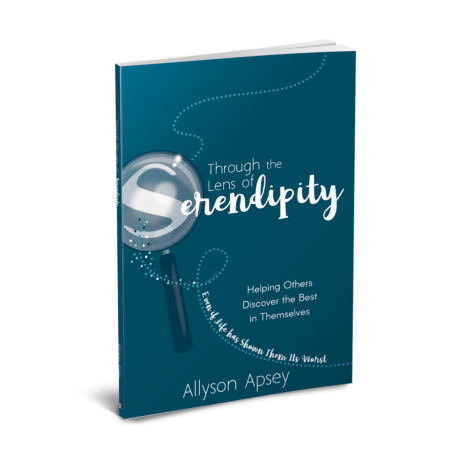
#DBCBookBlogs: Through the Lens of Serendipity

A little over a year ago a serendipitous treasure was shared with the world. I struggle with self-doubt and a constant desire to be better, to be more. I constantly fear that I’m not enough; not enough as a friend, not enough as a mom, not enough as a wife, not enough as a daughter, an aunt, a sister, and the list goes on and on.

Then Allyson Apsey came into my life with her first book, The Path to Serendipity. That book forced me to change my self-talk and visualize an inchworm moving ever-so-slowly toward its destination. It is this visual that reminds me that “All [I] need to do is move inch by inch toward the person [I] want to become; that is enough. [I am] enough.” In all the beautiful, powerful quotes through Allyson’s first book, this one impacts my day-to-day life in a most profound way. I still struggle with self-doubt, but I’m moving toward the person I want to become.

Naturally when Allyson shared that she had finished her third book (yes, she’s a writing machine – check out her second book, The Princes of Serendip), I was ready to click pre-order immediately. In early January, Allyson tweeted out that she was offering the opportunity to endorse her newest book… and I went all “I volunteer as tribute”! The incredibly amazing Hans Appel and I were selected to endorse the new book and I immediately sat down to read what would become the 70th book released by Dave Burgess Consulting, IncThrough the Lens of Serendipity.

#SerendipityEDU

Here is my endorsement (with 100% more clickable links, ha):

“First, she astounded us with her authenticity in The Path to Serendipity, then she gave us The Princes of Serendip, an exceptional picture book for social-emotional learning. Allyson Apsey amazes yet again with this timely masterpiece on trauma-informed practices. She shares actionable, practical ways to show compassion and empathy to everyone around us. Whether in education, or in any other career field, this book gives readers the tools needed to understand how to HANDLE others with care. Through the Lens of Serendipity should be on every bookshelf, highlighted and tabbed, to be referenced again and again.”

When I received the print copy last week, I was so excited to do just as I recommended in the endorsement… highlight and tab all the things! I’ve got to tell you… reading it way back in January was an honor; however, I needed this book at the very moment it arrived at my back door (yes, my delivery folks rock out here in rural North Carolina). This book has such valuable information on trauma-informed practices that are really just good practices in general. She shares this information through stories about students and scenarios involving fictional characters, and the acronym HANDLE. (I have to say that I love this because Dave Burgess shares how he likes to put “handles” on his material so others can pick it up in his #tlap sessions.)

Allyson has such a heart for social-emotional learning, trauma-informed practice, and becoming our best selves and it is evident in every word she writes. I’ve not met her face-to-face yet, but I’m fairly certain her heart is quite literally made of gold. Truly.

I could share so many thoughts & stories as I reflected & connected throughout this book, but instead, I’d like to just share some quotes that really stood out to me. I believe you will see how beautiful Allyson’s soul is through this alone.

“…understand your personal needs so you can be your best self and therefore more effectively help others.”

“No one’s life is perfect. ‘Perfect’ just doesn’t exist.”

“If you knew that person’s story, would you treat them differently? My guess is that if you were to look at everyone you meet with compassion, their behavior and your own would significantly change.”

“When we treat students the way they have always been treated, they will behave the way they have always behaved.”

“The supports that allow people affected by trauma to heal and grow are good for all people… trauma sensitivity is people sensitivity.”

Implementation

Although there are a dozen or more impactful quotes I could continue to add, this is the one I will implement because “inspiration without implementation is a waste” (courtesy of The Captain in Teach Like A Pirate).

“The only person you can control is you… you cannot change others. Only they can decide to do that. You can only change yourself… if you wait for the world to change for you, you may wait forever.”

Allyson shares this piece of advice she gave her son after a particularly rough day he had as a young child at school. How profound and true! I needed this the moment I saw it. It’s amazing how every time I reread a book, a new truth jumps out at me. This one not only jumped out, but it held on tight. It reminds me of the Emotions Deflector from The Path to Serendipity. There’s an old saying that you can lead a horse to water, but you can’t make it drink. The horse must decide to drink the water of its own free will. There is something resembling freedom that I feel when I am reminded that I cannot control others. It helps me to not feel responsible for their actions, because I am not in control of their actions, only my own.  (“I am the one thing in life I can control” -Aaron Burr “Wait for It” — Hamilton runs on repeat through my head now, thanks to my students.)

The lesson applies to many aspects of my life. As an instructional coach, I can share best practices. I can model them. I can support the teacher through co-planning and co-teaching. I can rinse and repeat, but until that teacher is ready to change, it won’t happen. That’s not to say I should quit trying to help and support positive change. But just realizing this truth depersonalizes the struggle for me. As a wife, I cannot expect my husband to change some of his annoying habits, just as he cannot expect to change mine. (Bless him; I’m sure I have more things that annoy him than vice versa.) I can’t control him. I cannot make anyone do anything. I cannot change anyone.

But do you know what I can do? I can have compassion for others. I can give grace freely. I can show others my heart. I can speak positively and (as Toby Mac says), I can speak life into those I encounter. I can choose to believe that I am enough. I can discover my best self, so I can be a better educator, wife, mother, and friend. And thanks to Allyson’s newest book, I have many tools to do just that.

Follow along on Twitter with the conversations around this book using the hashtag #SerendipityEDU. Also, you simply must check out this TEDx Talk that Allyson just did! While you’re at it, have you seen Allyson’s website? Check it out here! Her blog is powerful and she shares terrific resources!

Finally… oh my goodness… are you thinking of a group of colleagues that you believe would love this book? You should read it together! BOOK STUDY!!! Are you nervous about facilitating a book study? Or don’t have the time to pull together questions and resources? Y’all… DBC has you covered! They have just introduced an amazing new section on their website specifically for book studies! You just have to see it; it’s that amazing! There are activities and reflection questions already created for you! Seriously! So thankful for this incredible resource, which saves educators time and makes facilitating book studies a breeze! And yes… the book study for Through the Lens of Serendipity is ready to go! So grab some copies of the book, some friends, and have fun! Remember to share your learning on Twitter using the hashtag #SerendipityEDU!


#DBCBookBlogs: Learner Centered Innovation

Back in 2017, George & Paige Couros teamed up with Dave & Shelley Burgess to create a division of Dave Burgess Consulting, Inc. IMPress introduces us to books that dive deeper into the message of The Innovator’s Mindset & continue to showcase what George first brought us in DBC’s ninth book. (See the big announcement on a blog by Dave here.) As of this blog, there are seven books published under the IMPress label.

I am breaking a rule of mine by reading Learner Centered Innovation by Katie Martin first. I have typically read the books in order of their release (this is the second release from IMPress), but I had an amazing opportunity to meet Katie Martin at a What Great Educators Do Differently conference a few weeks ago in Houston, TX. (Blog about this experience is here.) Because I was meeting her, I wanted to dive into her book. I never expected it to take weeks to read it, but more about that in a moment.

LCinnovation

To discover what this book is about, simply read this quote from Katie:

“Many of today’s kids will have to create their jobs and forge a new path. The world has changed so dramatically and will continue to do so at an exponential rate, and, to best serve our students, educators and institutions must evolve with it, or we will leave our students behind.”

-Katie Martin

Katie begins by sharing the beauty of two words: “What if”

She immediately pulled me in by pointing out the traditions in education (as related to the industrial age model) and how that is preventing innovation from taking root in more than just pockets around our schools, district, state, and world.

Evolution of the Teacher’s Role

She shares that our role as educators has evolved. It made me stop and consider if I have evolved with the times. Do I teach like my teachers taught me? Some of my very favorite teachers did the “traditional” courses… desks in rows and columns, the teacher at the front of the room using the whiteboard or overhead to display information, and the students taking all the information in from that teacher. Perhaps their classes weren’t edge-of-your-seat excitement, but I knew those teachers cared about me.

Early in my career, I definitely taught as I’d been taught. I still use storytelling (like my amazing 4th grade teacher), humor (like my 7th grade social studies teacher), and student choice (like my 8th grade ELA teacher).

Katie shares that one of our most prominent roles should be that of an activator. Here are some of the definitions I found for activate:

  • to encourage development or induce increased activity; to stimulate
  • to trigger, to actuate, to set off, to enable
  • to excite
  • to remove the limitations of by providing a license; to unlock
  • to bring a player back after an injury

Even down to the sports definition, I want to be an activator for students! I want to encourage them, stimulate them, enable them to do more than they ever thought they could and then get them excited about doing it. I want to remove their limitations by unlocking endless potential in their minds and hearts. I want to make school fun again, bringing them back to the place of creativity and imagination that so many of our “traditions” in education squash like a bug on a windshield. I want to be an activator.

Testing or Learning?

Katie says, “We will never achieve the results we want by focusing on performing well on a test.” Let me repeat that for those in the back…

“We will NEVER achieve the results we want by focusing on performing well on a test.”

-Katie Martin

Guess what that means? All that time spent painstakingly going over released test items… better spent doing Project-Based Learning where those same problems are relevant to students. All the time spent reading and highlighting short passages using question stems from “the test”… our time is better spent allowing students to select their own reading material & having (wait for it) conversations with them about what they’re reading. You want to use question stems? Ask the questions and don’t expect an A, B, C, or D response.

I’m preaching to me right now, too. Do you have any idea how much time I spent reviewing at the end of each year I was in the classroom?! I flew through curriculum so I could be sure to have enough review time before the standardized test. What if I’d just ensured that students learned the content (and so much more) thoroughly the first time? Imagine the possibilities.

Here’s what I think (and it appears to align with Katie’s beliefs, too)… standardized testing isn’t the bad guy here. It’s the overemphasis on them that gives them a villainous role in education. Think about it… I’m thankful that my students in rural, high-poverty, small town North Carolina are expected to learn the same content and perform at the same level as rich, suburban kiddos. It wouldn’t be fair for the standards to be different for those groups of students; set the bar high, I’m okay with that! However, when we focus so much on the outcome of those tests rather than the process and growth, I have a problem.

This test season take the time to have fun! Play games, make learning authentic, give students an audience like never before… I truly believe that “the test” will take care of itself if students are having a good time while learning the content.

Professional Learning Communities

I remember hearing about PLCs for the first time many years ago. The idea that teachers were to work together to create lessons with common assessments and “share” students was insane to us. Until that point, we were in competition due to the aforementioned test scores. Several teachers didn’t want other teachers to know what they were doing successfully because that teacher might use it and (God forbid) the students down the hall might perform better than their own. If you’ve been in education long enough, you remember this and you know I am speaking truth.

Our PLCs turned into exactly what Katie talk about in her book. It was a checklist. The questions she shares… the exact questions we had to answer each week. It became a running joke because we knew those questions by heart the same way we knew the script for the end-of-grade testing by heart.

Thankfully, I was part of a PLC that was exceptional. We worked together, co-planned lessons, shared everything, switched up students for flexible grouping as needed, and when one teacher’s students performed better on a given objective, that teacher taught our students, too! I knew every student in 5th grade’s name and to be honest, I see some of those students now (many are high school/college age) and I honestly can’t remember if they were on my roster or not because I taught them as much as those in my class. It took a lot of time to get to that place; we had arguments, petty things mostly. We got on one another’s nerves. It wasn’t all rainbows and roses, but we were a rocking PLC. We celebrated birthdays together; our kids played together; we laughed together and cried together. We even did graduate school at the same time. The three of us left the school one after the other. I truly believe it’s because we didn’t want to do the job without the others; we had experienced a true PLC and struggled to replicate it. One became an administrator and moved to a high school during the summer months, I left halfway through the year to begin my journey as a media coordinator, and the third left at the end of that year to move to a middle school library position.

Katie’s book reminds us that the same things we know that are true about building relationships with our students is true of our colleagues. “We are more willing and able to hear critical feedback when it is coming from someone who we perceive cares about us as individuals, sees our strengths, and is willing to invest the time to help us grow.”

««»»

It took me over three weeks to finish this book. If you’ve been around for any of #DBC50Summer, you know that means something. Katie’s book covers so much ground. It’s all interwoven and connected to everything that has the potential to make education what it should be for children (and adults). In many ways, after reading this, I don’t even know that we need to do anything but submit this book to Congress and tell them that THIS is how we should be doing school and begin implementing it nationwide. I have to tell you… when you get your own copy of this one, carve out time to really read it. It’s not a “light” read; you need your brain fully activated (see what I did there) while you’re reading it. I have notes all over the margins of this book and didn’t even use a highlighter because I knew I’d need three or four of them as I read.

««»»

Implementation

This implementation will begin next year. I still have several implementations of #DBC50Summer and previous #DBCBookBlogs to do and only a few weeks left to do them. In the implementation post Creating a Stronger Foundation, I shared that I created a template for 6th grade students to tell me about themselves. In Learner Center Innovation, Katie shares about a teacher who stopped asking students about their favorite color, etc and instead asked for an open-ended list – “The Top Ten Things I Need to Know About You”. I’m 100% doing this! I can keep the template I had created, but add ten slides at the end with students putting one thing I need to know about them on each slide. They can add pictures, videos, etc to that slide if they’d like. I love the open-ended nature of this as it will allow me to get to know them better and deeper much faster!

Remember to get your own copy of Learner Centered Innovation by Katie Martin! It’s the second book in the IMPress line, a division of DBC, Inc. You won’t regret it! And if you have the chance to see Katie in action, I highly recommend going! She is also an amazing presenter! Follow along with the conversation on Twitter using the hashtag #LCinnovation!