#DBC50Summer 18/50: The Writing on the Classroom Wall

With the exception of the #DBC50Summer: Discovering my #EDUpassions post, I have not blogged in nearly a week.  There’s a perfectly good reason for this…

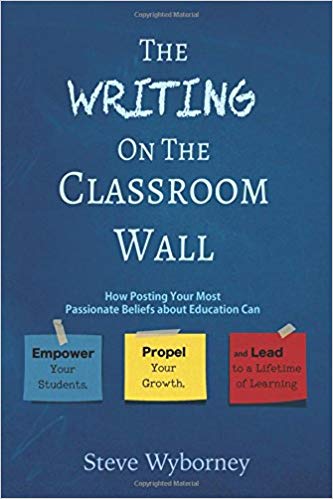
Book 18 in the Dave Burgess Consulting, Inc line up is The Writing on the Classroom Wall by Steve Wyborney.  In this book, Steve challenges us to literally put our thoughts and passions, what we deeply believe, on our walls (yes, our physical wall space in our classroom/office/hall/etc) and share with anyone and everyone what those beliefs are… yeah, that’s some kind of scary, I’ve got to admit!  And yes… I was stalling.
twotcw

I was so hesitant about this book.  I have carried it around in my book bag all week!  I spent the majority of the week in western North Carolina working with a group of phenomenal educators from across the state, facilitating workshops in an NCCAT session called Teaching Generation Z: Active and Digital Learning.  I went to my room early each night while others stayed up playing games (I love to play games!) so I could read.  I would open it, read a few pages, then realize I didn’t have the slightest clue as to what I’d just read.  Finally, I realized that I needed some “book reading prep” time, and I realized I needed to decipher my own passions before I could really delve into this book.  So last night, after an inspiring NCTIES Board Meeting I sequestered myself in my room and used the brackets approach from Launch to nail down my educational passions.  I was satisfied with the Final Four, and still feel as though they are indicative of my strongest beliefs in education.

So tonight… I knew I had to read what Steve had to say.  No more avoiding it.  I’ve got to be honest here…it was insanely challenging to read the entire thing.  Now don’t go thinking it wasn’t a “good book” because it was! It just pushed my thinking in ways I wasn’t ready for tonight. I mean, I had even prepared for reading this particular book in advance with my in-depth research to discover my own passions!  That wasn’t enough.  Steve brought his A-Game in this book!

First of all, this guy has a way with words.  He is truly a wordsmith, an artist really… the way he writes makes you slow down and appreciate what he’s trying to say.  He’s very metaphorical, so prepare to buckle down and focus while reading this one.  It’s so worth it!  Lord help us when he started talking about reflective writing.  Specifically he states

Reflective writing is a powerful process that provides opportunities to personally, deeply wrestle with thoughts and ideas that are struggling to become more fully formed. -Steve Wyborney

In that very moment, I desperately needed a Madea “hallelujer” gif to adequately express my agreement.  Blogging my reflections on each of the DBC books with a plan for implementing has allowed me to go deeper with the book than I imagined I could.  Steve also mentions (Big Idea 20 – the book is set up by sharing the big ideas that he placed on the walls of his classroom, the discussion he had with his students, and how the idea grew) the idea of designing a path for others to follow your learning after you discover something new.  Knowing, when I started blogging, that these would be publicly available, it made me pay more attention to what and how I was learning.  Steve says, “I am determined to find my learning by giving it away…it is often in the sharing of my journey that I learn the most.” Yes, yes, and yes!

In fact… there are so many quotes throughout this book that are tweetable nuggets of knowledge that I just started creating some simple quote graphics on Canva.  Check out a few of them below.

This book is really geared toward any educator who wants to dive deeper into their educational beliefs.  If you want to really think through your WHY, this book will certainly bring that out.  It was challenging to read, not because of the quality of the writing (that was phenomenal), but because of the gravity of the message.  It really stretches your thinking and makes you examine your own “Big Ideas” about education, and how you can share it with your learners.

I’m going to do something I rarely do.  I am going to take the book at “face value” with my implementation plan.  Steve challenges readers at the end of the book to post at least one Big Idea on their wall through these steps.  This is my takeaway.  This is how I will implement The Writing on the Classroom Wall... exactly in the way Steve suggests at the end of the book.  Here are HIS steps for implementing TWOTCW!  Grab a copy of the book for yourself and join me!

  1. Select an important idea.
  2. Post it on your classroom wall.
  3. Explain to your learners what the Big Idea means to you.
  4. Be prepared to let the idea impact you personally! (whew)
  5. Seek opportunities to feature the idea.
  6. Grow your set of Big Ideas.
  7. Share your Big Ideas.

Check back in the fall for a follow-up about how this adventure goes.  I’m a bit scared to dive into this one, but knowing that it will benefit my students AND me makes it worth it.  My takeaway from Teach Like A Pirate was a quote from Dave Burgess who said, “It’s not supposed to be easy; it’s supposed to be worth it!” This implementation will not be easy for me. It seems so simple, but until you’ve read this book you can’t know how personal and powerful this “seemingly simple” action will be.  I do trust that it will be worth it, though.  So I’m going to do it.

To follow along with the community, use the hashtag #TWOTCW and visit Steve’s website.  His website is full of excellent activities for math, too!  Here is a book trailer for The Writing on the Classroom Wall.  I also highly encourage you to use the space on Flipgrid to reflect and share your response to TWOTCW with the world.  As always, the password is DBCSummer.  If no one has responded yet, take a risk and be the first! This digital space is meant to serve as a global book study for those with an affinity for any DBC book.  Andrea Paulakovich had this incredible idea & I recommend following her (she’s amazing) and her #DBC50Summer journey!

Next up on #DBC50Summer is the first “sequel” book.  The authors of Book 6, 50 Things You Can Do With Google Classroom, Alice Keeler and Dr. Libbi Miller are back with 50 Things to Go Further With Google Classroom!  Grab yours and prepare to see the practical, student-centered applications of Google Classroom! So excited to share Book 19 with you soon!

Edited April 5, 2019 to add post to implementation! See how I implemented The Writing on the Classroom Wall here!

#DBC50Summer: Discovering my #EDUpassions

One of my favorite things about my journey in the #DBC50Summer is reading the Dave Burgess Consulting, Inc books in the order of their release.  I have so loved seeing names of future authors before they were published as they contribute to the earlier books.  Another exciting piece of reading in order is drawing on the connections between the books released around the same time.  It has really given me an even deeper appreciation for the effort of every single team member within the DBC company.  The way common messages flow throughout the books is so impressive.  There is no way that kind of seamless transition is coincidental.  That is only achieved through hard work and attention to detail from every person involved – from the author to the editor and through the publisher.

Here’s what prompted this little #DBC50Summer interlude…

In reading Play Like A Pirate I realized that Quinn Rollins knew what his passions outside of education were – toys, games, and comics.  He brought those into his classroom with great success. Reflecting on passions, I also realized that I dabble in a bit of everything within edtech and “trends” in education, but was unsure of my true educational passions.  I am not even halfway finished with my career in education and I wanted to discover what my passions are, what could sustain my enthusiasm for teaching throughout the next 16 years.  As I come to book 18, The Writing on the Classroom Wall, I realize that it doesn’t feel right to read the book without having those passions nailed down.  How can I post my passions if I don’t know what they are?

Amazingly, as I read the next few books in the line up, there was a section about discovering your passion.  (I’m seriously not making this up – go get a copy for yourself and check it out!) . Within LaunchJohn Spencer & AJ Juliani discuss the use of brackets to force a decision between two topics.  Using this idea, I found my #EDUpassions!

Screen Shot 2018-07-20 at 12.11.52 AM

The process?

First, I brainstormed any and all concepts, tools, big ideas, lessons that get me excited about teaching.  I started by thinking of tech tools and their functions, like Google Apps for Education and BreakoutEDU.  Then my thinking became deeper through coaching teachers and forming authentic relationships with those I work with.  I numbered each topic 1-64.  Using a random number generator online, I was able to put two ideas “against” each other in brackets.  While considering my passion level for each, I went with my gut when choosing which topic/idea should advance in the brackets.  A couple were tied because I honestly couldn’t eliminate one or the other OR because the two topics were so similar and fit hand-in-hand.  *I did notice that I put design thinking into the brainstorm twice, but seeing as how they ended up eliminated anyhow, I just left them.

My brackets in Google Sheets are here.  This will force you to make a copy and create your own EDUpassion brackets as suggested in Launch!  Just replace my topics with yours! The teal blue cells are my original 64 educational topics that get me excited.  I narrow them down, eliminating one of the two options until I am left with only FOUR passions!

My Final Four are as follows:

  • Making a Difference in Students and Teachers through Coaching

  • Lifelong Learning through Being a Connected Educator

  • Being a Catalyst for Change

  • “Those” Stories (you know the ones… those that make you tear up when you share them with others) and Culture

I enjoy coaching teachers.  I especially love to see the impact made on the teacher, the classroom, and most importantly, the students through a successful coaching cycle.  When the teacher and I have co-planned a lesson, co-taught it, then reflect on it together, it is easy to see the growth in their students, and in the teachers themselves.

I am very clearly a lifelong learner.  I am never satisfied with the amount of knowledge I have.  I like to look up information on topics and people, just because I like having the knowledge.  I crave gaining new knowledge!  One of the best ways to continue to grow and learn in this field is to be a connected educator.  If I weren’t a connected educator, I could have committed to reading all of the DBC books this summer, started strong, then chosen not to finish because I didn’t have anyone holding me accountable.  Or I may have still continued, persevered through the weeks I have been swamped with presentations, and completed the challenge.  Who knows?  I do know that no one else would have known #DBC50Summer was happening.  Several educators are joining in on the fun and are strengthening their skill sets and will be inspired and ready for their students to return.  Thankfully, because I am a connected educator (on Twitter, specifically), I am able to not only learn and grow on my own, but connect with other educators from across the country who also hold an affinity for DBC books and have begun their own versions of #DBC50Summer.  Almost every one of the authors from the first 17 books have reached out to me with kind words after reading the #DBC50Summer post about their book.  This has blown me away and strengthened my connection with the books, and has made me adore these authors even more!  Being connected has brought both me, and my students, opportunities they likely would not have had otherwise.

Being a catalyst for change comes from working at my school, local, state, and national levels to revolutionize education.  I greatly enjoy the work I do mentoring coaches throughout my state, serving on the NCTIES board of directors, and piloting a new position which formally marries the roles of digital learning coach and media coordinator in my district. Being able to work on the national framework for Future Ready Instructional Coaches has been incredible.  This summer I have been fortunate in that I get to facilitate professional development with teachers across the western half of my state for two weeks.

Finally, you know “those” students who have “those” stories? The ones that touch your heart and will always stay with you?  They are my passion.  Their stories, as heartbreaking or heartwarming as they are, become part of my story.  We either cry together or celebrate together, and their stories of overcoming adversity inspire me to continue my educational career.  “Those” stories are the ones that sustain me, and many educators across the world!  Playing an integral role in forming the culture in my school has become more and more important to me.  I want every student and staff member to feel valued.  I want my administration to know they are appreciated (and that I would never EVER want to walk a day in their shoes).  I believe that when your school has the right culture, there is no stopping the growth in everyone who steps foot in the building.

So, my #EDUpassions… it took a while to nail them down, but I feel confident in saying that these ARE my #EDUpassions.  These are what get me out of bed in the morning.  These are what excite me and make me look forward to the new school year.

It always comes back to the students for me.  THEY are my why.  They are my number one passion.

Forming those authentic relationships is what allows me to know their stories.  It is imperative that we build relationships with our students.  I also encourage educational leaders to build relationships with their faculty.  Talk with them informally; get to know their families; get to know their stories.  Connect with them outside of school and make developing a relationship a priority.

Now that I have these #EDUpassions planted firmly in my head, and on my heart… I can get back to #DBC50Summer reading, reflecting, blogging, and implementing!  Let’s do this!

The Secret to Coaching

For the past 4 years, I have had the pleasure to be part of an amazing network of educators from across North Carolina – the Digital Leaders Coaching Network.  Started in 2014 by the Friday Institute, this cadre of teacher leaders has been given tools to practice the art of coaching.  Over the past four years, we have engaged in multiple book studies, several personality tests, and more coaching scenarios than imaginable.  We have had guest speakers from across the United States and even internationally.  I have met some of the most incredible educators from across our state, educators that see themselves as leaders, educators that are the exemplar of growth mindset.  I have seen our group grow exponentially, both in attendance and in terms of professional growth of individuals that are taking part.  In 2014, there were a little over 50 educators in attendance, and there is so much interest that now we have two cohorts each year, both rocking a full house of educators!  Last year I served as a mentor in the east cohort (#eastisbeast, #bEastmode) and this year, I serve as a mentor in the west cohort (#westisbest).

There is so little professional development available for instructional coaches.  Without professional development, educators become stuck in a rut, not knowing what best practices are and how to implement change in their school.  This network has given me best practices, protocols, a professional learning network, and has changed the culture of both schools in which I have worked.  It has allowed me to grow from a timid first-year media coordinator to a confident innovation facilitator, leading a pilot that is changing the role of media coordinators in my district to formally include the role of a digital learning coach.  I teach all 400 students in my school in multiple subject areas, co-planning and co-teaching with their content area classroom teachers, as well as design and implement professional development for teachers in my school and media coordinators/innovation facilitators across my district.  I stay current with educational technology trends and bring those trends to my school through grant writing and working with research organizations.  Oh – and I also teach media classes once a month and hold open book circulation times every morning and throughout the day.  I also manage our 1:1 and BYOD initiatives in my school.  Without this network of tremendous educators, and the support of the leaders at the Friday Institute and NCDPI and NCTIES organization, so much of the change that has been implemented in my schools and district may not have happened.  This opportunity was certainly a catalyst for so much growth and forward momentum both within myself and my district.

Over the past four years, I have presented multiple times at our state technology conference (ISTE affiliate) NCTIES as a featured speaker, worked with amazing educators to share information about being a connected educator, coding in the classroom, and MinecraftEDU at NCCAT’s Teaching Generation Z seminars, accepted the challenge of piloting the Innovation Facilitator job description, and was elected to the NCTIES Board of Directors as the North Region Representative.  I was also named as a Future Ready Instructional Coach Thought Leader.  It is not a coincidence that all of this happened during my time with NCDLCN.  I felt more confident being part of this cadre, more prepared to face whatever may come my way, and more connected to those outside my district.

So with all of the time spent in the past four years of NCDLCN, what have I learned to be the number ONE secret to coaching?!  Relationships.  Everything boils down to relationships.  Relationships with your administration, relationships with your teachers, and relationships with the students.

When I first started coaching, I was so excited to change the face of education that I started as a bulldozer.  I went in and started making suggestions before I had even taken a second glance.  Rookie mistake.  I learned the hard way that I needed to work in my space first, changing what was directly pertinent to me, then building relationships and trust with administration and teachers around me.  Once I took a step back, and started informally meeting with teachers, listening to their ideas and encouraging their efforts, praising their strengths, I started to build the trust that is so vital to implement sustainable change.  Once my administration and the teachers I served trusted me, I was able to see change happen quickly.  No longer did I have teachers working with me to plan lessons because they “had” to as a mandate, but because they wanted to; they were excited to use the knowledge I could provide as a curator of resources and strategies.

How does one build relationships?  Slowly.  Spending one lunch period with a teacher, then giving them constructive criticism on a lesson is a recipe for disaster.  Informal time outside of school, emailing, social media, lunches on workdays… those nuggets of time are when the real relationships begin to form.  When you, as a coach, see a teacher excelling in an area, point it out to them!  As teachers, we (I still consider myself to always be a teacher first) are our worst critic.  To hear a fellow educator acknowledge a strength is a great motivator and relationship builder.  In my current position, it has taken me almost two years to feel as though I have a solid relationship in which I can have critical conversations with my staff without a long-lasting negative impact.

Where do your loyalties lie?  This is always a tough question!  Many times as a coach, we can become the go-between; administration needs us to share information with teachers, while teachers want us to share grievances with administration.  Do not, and I repeat, do NOT put yourself in that situation!  Make it very clear to both parties that you are not a liaison.  Your loyalties lie with the students you serve, both directly and indirectly.  One of the fastest ways to destroy a positive coaching relationship is to be seen as a coach that reports back to the administration.  With that said, when a teacher I am working with is doing something amazing, I will notify our administration.  However, if we are working through a hurdle, that stays between me and the teacher in question.  Everything we do as coaches is ultimately for the good of the students.  Placing your loyalties there can only yield positive results.

So there you have it – the secret to coaching, as gathered by multiple sources and personal experience.  Building relationships and trust, and taking preventative measures to keep those relationships intact, will propel you and your school(s) forward allowing you to see measurable and sustainable change.

What do you feel is the secret to coaching?  Comment below!  I’d love to have feedback and chat with other coaches!