#DBC50Summer 26/50: Shift This

You know the saying “It’s all downhill from here”? I just spent the last little bit in an internet time warp looking up what that meant. It’s one of those rabbit holes. There is discussion online (apparently, a LOT of discussion online) about whether this is said in positive or negative connotation. I’ll spare you the details, but I choose to see it as a cyclist who has made it over the highest hill in a race, meaning things will get easier from here on. That’s what I thought would happen when I reached halfway in #DBC50Summer. I’d reached the top of the #DBC50Summer hill and could see the “end” (waaaaayy off in the distance). It’ll be easier now that I’m halfway, right?

Things. Are. Definitely. Not. Easier.

I am continuing to be stretched and challenged as an educator to truly know my educational beliefs as I read these books published by Dave & Shelley Burgess! I’m having to be more thoughtful about creating an implementation plan for these books that is realistic and attainable, while still making big waves. (Because, you know, Pirate ships do that – Pirate Pun, check!)

Book 26 was an empowering book! I’m currently ready to run through the halls yelling to the top of my lungs that I’m making changes and I want everyone on board. I’m ready to use my word from Lead Like A Pirate and be relentless in not accepting the status quo from teachers or students that I have the pleasure of serving. Shift This by Joy Kirr was so incredible that I have actually read it TWICE since last night. With that said, just go ahead and get your copy now! Seriously, it’s that good.

shiftthis

Here’s a little tidbit about me. I don’t like confrontation, in any form. I very much dislike arguments. I am a people pleaser (Yes, me too, Joy!) If someone confronts me face-to-face, I typically just bow out of the conversation with the quickest escape route I can find. If I do manage to find the guts to stand my ground, it usually ends with me stumbling over my words and tears. Mine. It’s embarrassing to be honest. If the confrontation is digital, I avoid that person like the plague until it blows over (or an appropriate amount of time has passed).

This book equips me with so many options for coaching teachers, and dealing with the dismissal and pushback that will likely happen (which in my eyes feels like confrontation – remember I take everything personally even though I shouldn’t). Finding a teacher’s comfort level in making changes in their classroom is so important. Allowing teachers to be in charge of their own changes makes change seem less intimidating. That leads to a higher success rate through sustaining said change. Thanks to Joy, I now have 4 scaffolded levels of change for topics that are very near and dear to my heart. These topics include:

  • Classroom Environment
  • Classwork
  • Homework
  • Grading
  • Social Media
  • Student-Directed Learning

Each of these includes small changes that feel “safe” while making a ginormous (yes, I’m choosing to use that word) impact on student empowerment and lifelong learning. I could easily see where I was in regards to the sliding scale of shifts on each topic and could find a shift I can make in the new year to make an even greater impact. I love that Joy repeatedly states that this was not an overnight large-scale change! She mentions frequently that the changes she has implemented in her classroom are from YEARS of small changes. I also respect that Joy speaks about the next step she is going to make as well! It shows that she’s not done growing and changing, and I appreciate that so much!

This book is like taking a snapshot into Joy’s classroom, seeing it from Point E to Point L, with the understanding that the story was already in play (Point A to Point D) and it continues to evolve now (Point M to Point “Retirement”). I’m sure even at this point, Joy is making small shifts for the her school year and that’s incredibly powerful to me!

I have got to meet this lady. We share so many educational philosophies and through my first reading of the book, I spent the majority of the time standing on her soap box with her, agreeing with every passionate sentence she wrote (sometimes even agreeing out loud). I would love to sit and discuss these beliefs about student empowerment, grading, homework, etc with Joy! There would be a lot of nodding. That’s for sure!

The second time I read the book, I read it through the eyes of an instructional coach. I could literally place every teacher I work with on the sliding scales included with each topic and can see what small change could be made in the coming school year. I want the teachers to be comfortable with the changes because, as Joy says, “Whatever you do has to work for you. If you are not comfortable with something, the students won’t get out of it what you hope for them.” Through discussion and reflection (both with students and within themselves), these changes can be tweaked to meet the needs of their classrooms.

Here are some quotes that I absolutely loved from the book!


One of the things I love most about the DBC, Inc books is that the resources shared within the book, and readily available after reading the book, are abundant. Joy’s book is no different. She includes links to all kinds of goodness via tinyurl.com in her book! I’m looking forward to diving into these links even more, as I know they will provide “a-ha” moments beyond what I read (which is already impressive).

As I mentioned, I can seriously make an implementation goal for every single section within the book. For example, in regards to grading… I have the luxury of not assigning grades to students as I am the media coordinator but I do provide feedback. Joy makes me want to shift this to have students select the work they’d like to turn in for feedback. That small shift gives students choice and allows me to see their best work. I appreciate that!

The implementation goal I choose to complete is related to social media. As I read the section of the book about social media shifts: lurking, then sharing I couldn’t help but laugh out loud. Joy and I have very similar stories about our first experiences on social media. (I, too, came home from a conference and spent hours checking out the hashtag when I got home, Joy!) I have reached a point in social media where I’ve been thinking what’s next? as I already share my own content and blog and get new resources and have an amazingly supportive Professional Learning Network (PLN). Joy gives me the next step though, and it is so obvious for it to be the next step (couldn’t see the forest for the trees kind of obvious)… hand it over to the students. Give them the opportunity to blog and tweet out their own content! The best part about this… my principal and I just had a similar discussion this week in which we’ve decided to generate a social media team of students who will get the ball rolling with student-led blogging and social media. We’ll get to see the school from the eyes of our students, and we’re both so excited about what this will look like at the end of the year! The initial social media team will work out the kinks, set the parameters (with some guidance from the principal and I on policy and student safety) and teach other students how to write a blog and share on social media. This group of students will also fulfill one of the implementations from Your School Rocks, which was to create a school hashtag (we had one, but I didn’t put two and two together, so I’m sure the students hadn’t either… now the new one will be clearly stated and shared). We are allowing the students to use their voice by sharing their hashtag ideas for our school, then vote on their favorite to select one! It’s going to be awesome!

I am excited with and empowered by this book! You should visit Joy’s website which has incredible information, including the resources for the book, blogs about shift stories where teachers have shared their stories about their own small shifts leading to big changes, and podcasts with Joy including The Wired Educator. The community on Twitter uses the hashtag #ShiftThis (Be careful with that one, ha! Joy has a funny story about that!) and the chat will resume on August 21, 2018 at 8:00 pm EST! We will meet (almost) every Tuesday night after that. I have the privilege of moderating the chat on December 4, 2018 about Shifting Mindsets! True to Joy Kirr fashion, she is shifting how she moderates Twitter chats, so click here for more information about that small shift! I’m expecting it to lead to massive impacts!

As always, the flipgrid is wide open for global collaboration! Share a story about a small shift you’ve made and how it impacted your classroom. If you should need a password, use DBCSummer to access the grid. A massive thank you to Andrea Paulakovich, a superstar educator from Kansas, for sharing the genius idea to open a global collaboration space for every DBC book!

Book 27 is Unmapped Potential by Julie Hasson and Missy Lennard, the Purposeful Principals! I just purchased this book at the beginning of July, so I’m thrilled to read it for the first time! Look for the blog soon!
 

#DBC50Summer 24/50: Table Talk Math

You may remember from previous postings that before I became an digital learning coach/media coordinator, I was a fifth grade math teacher. I was initially hired to teach fifth grade students, and I taught math three times a day to three different classes. I loved it. Unfortunately, looking back I now realize that I was also a horrible math teacher. Other than the working problems on the overhead for the vast majority of our class time, I had another deficit. I was always good at math. Scary good. Because I never really struggled with math, I didn’t understand when people said they “weren’t good at math”, or when math didn’t come naturally to them. I thought doing 15 problems in the workbook would solve the issue. I didn’t realize it was a lack of mathematical reasoning and problem solving that was getting in the way for my struggling learners. I wish so badly that I had known about the resources in book 24 to help students see that math is fun and 100% applicable to their lives!

<proudly standing on soap box>

My least favorite utterance: “Oh, I’m glad you teach all of the math because I can’t do fifth grade math.” Really? Why would you even utter those words? As a grown (wo)man, you’re admitting that fifth graders can do more advanced math than you are capable of doing… yeah, that’s not impressive to share. Lose that sentence from your lexicon, please. While we’re at it… the whole “I’m not good at math”… let’s lose that one, too!

<stepping off soap box, #sorrynotsorry>

tabletalkmath

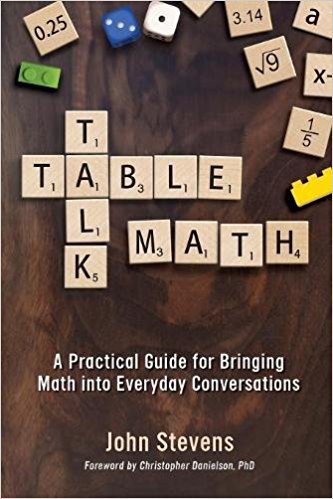
Book 24 is Table Talk Math by John Stevens (yes, THE John Stevens that co-authored The Classroom Chef with Matt Vaudrey) and it is an incredible read! I love that it is a quick, easy read, full of wonderful information and stories about John and his family! I find that this is another book that strikes me more as a parent than as a teacher.

There are several key points I’m taking away from this book. One is holding conversations with your child. I am so guilty about giving my daughters answers rather than asking them questions. I get so tired of hearing “why, mommy” when I’m at home. My sweet girls get the worst of me. I’m sure several of you that are teachers AND parents can identify with that, too (and if not, please tell me you can because it’ll make me feel like slightly less of a failure… thanks). By the time I get home in the evening (yes, evening), I’m exhausted and dreading helping with homework (thankfully my daughters’ school has an amazing principal who doesn’t allow homework beyond reading and a couple math problems), getting showers taken, supper, and bedtime. I’ve been with students all day (and I love them, don’t get me wrong, buuuut), all I want is some alone time or time to converse with an adult, and the girls want my undivided attention. This, in turn, makes me a bit snippy toward them – my patience is lacking by 5:30-6:00 in the evening. I’ve got to do better; I’ve got to BE better for them. They deserve the same time and devotion, no… they deserve MORE time and devotion than my students get from me. I am their mother! I love how John shares the stories about his children, and how he changes from “Mad Dad” to “Math Dad”. I want to transform from “Mrs. Ray” to “Mom” with more finesse each day, allowing them to have the best of me. These relaxed discussions about math are a great way to move forward with this.

Another key point is that kids should struggle and have to explain their reasoning once they reach a decision. Our kids (personal or professional) should have to think! John constantly reiterates that the answer is not as important as the process to get the answer. If we have the kids explain their reasoning behind their answer, it shows the mathematical processes happening “behind the scenes”. Oh, and timed-tests… no bueno. Research proves it’s ineffective. Stop doing it.

Finally, the piece of knowledge I’m taking away and implementing are the tons of resources John shares within the book! I’ve got to be honest and say that I’m actually cheating just a tad on this one because I’ve already shared the resources with our math teachers, as of just a few minutes before writing this post. But you know what? There are 50 books and I’m pretty sure you’ll allow me to already have one implementation complete as we move into the 2018-2019 school year, right? Please?! (And if you’re a stickler for it being implemented “in the school year”… I started back to work today as an 11-month employee and sent the email with several of the resources in the book after reading and before blogging, so technically, it’s being implemented in this school year. Boom! Also, I have a back-up plan.)

Some of my favorite resources from this book are below:

John Steven’s Would You Rather Math is a phenomenal example of authentic choices students make, both as students and adults. These choices require (gasp) math!

Andrew Stadel‘s Estimation180 website gives multiple examples for estimating, showing a benchmark then allowing students to determine an upper limit (maximum) and a lower limit (minimum) before estimating. The exact amount is listed on the website for the students (read: adults like me) who can’t handle not knowing the precise answer.

Fawn Nguyen‘s Visual Patterns website is amazing! Giving us examples of patterns and having students find the next, or “nth” term in the pattern shows sound mathematical reasoning. I love that some of the patterns can actually yield various answers.

Another site that can showcase various answers is Mary Bourassa‘s Which One Doesn’t Belong! As long as the student can give reasoning, accept the answers!  This site is a great conversation starter! I love the idea of debating answers, and that this site can be used with all grade levels!

Finally, the Fraction Talks website, created by Nat Banting, is one that I will be using with my personal children regularly! I love the use of flags as fractional representation! Building a strong understanding of fractions will help as my girls, and students, get older and begin having to see fractions abstractly.

At my school, I am in charge of putting announcements on the TVs each day. Another implementation for this book is to use these websites as part of the TV announcements! Selecting one problem each Monday and Wednesday (or Tuesday and Thursday), students can discuss math at lunch with their peers (we have a TV in the cafeteria that runs announcements all day, as well as one in the school lobby before and after school). I’m looking forward to hearing these discussions and providing math teachers an opportunity to capitalize on these conversations without sacrificing class time.

I highly recommend purchasing this book, especially if you’re a math teacher! The resources are tremendous and as a former math teacher I found myself nodding along many times. If nothing else, the footnotes provided by John Stevens are hilarious! I love his personality! Feel free to visit his website at tabletalkmath.com and join in on the conversation on Twitter at #tabletalkmath. Finally, one of my very favorite blog posts written by John is the explanation of the cover of Table Talk Math. You can find it here titled “7 Reasons to Judge Table Talk Math By Its Cover”. Clever, right?

As always, join in the flipgrid conversation using the password DBCSummer! Many thanks to Andrea Paulakovich who had this genius idea that flipgrid could be used to conduct a global book reflection on all DBC, Inc books! The space is there if you’d like to use it, and likely isn’t going away, so start sharing!

I am so excited to reach Book 25! Released immediately after Table Talk Math, Alice Keeler and the late Diana Herrington knocked it out of the park with Teaching Math with Google Apps! And oh yes, it is that good! If you are a math teacher, and you are a Google school, and you don’t own this book – you should fix that now. Right now. Check back for the blog soon!

#DBC50Summer 23/50: Lead Like A Pirate

Settle in… this one will take a while. Seriously, go grab some coffee, a snack… perhaps you’d like a blanket? (Blankets are plentiful in my house; I’m always wrapped up in one, even on summer days!) In fact, go ahead and throw on your pajamas, tuck the kids in bed… do all the things before starting. I’ll wait…

All done? Cozy? Ready? Let’s go!

In 2011, I realized that I did not want to be a classroom teacher forever. (Hey, we’ve talked about this being judgment free here… don’t judge me!) Don’t get me wrong, I love the students; I love everything about learning with the students. I hope that if you’ve been on this journey with me for very long, that truth has been evident. However, I wanted a greater impact. I also knew that I had absolutely ZERO interest in being an administrator. I am wise enough to know that I cannot handle the stresses that come with running a building. I deeply admire those in administration and look on with fascination as each of you make the world turn so effortlessly, knowing all along that it’s anything but easy. I wasn’t sure where that left me though… in my district, you were a classroom teacher with leadership roles or an administrator or at the district office.

Somewhere along the way, I found myself serving as an instructional coach in practice, but not in title. Once I heard the label “coach” and identified with it, I hunted down all of the coaching books I could find. I took to Twitter in hopes of finding more information on this idea of being an instructional coach. (For a small glimpse into my educational journey, click here.)

In March 2017, I started reading all this hype on Twitter about something called #LeadLAP (I thought it was about racing… I am from North Carolina, right?). When I found out that it was a book that was the leadership equivalent of #tlap, I knew I had to have a copy. It was the first time I bought a Dave Burgess Consulting, Inc book immediately upon book release (it kind of started a trend… oops). It was everything and more. Lead Like A Pirate is written by Beth Houf (an amazingly passionate principal from Missouri with experience in K-8 administration) and  Shelley Burgess (Yes, the Pirate Captain’s wife, coauthor of P is for Pirate – I told you that you’d hear from her again. She is also an educational powerhouse. Can you imagine what it must be like in the presence of BOTH of the Burgess pirates? Whew! I can only handle the conviction & passion from one Burgess keynote experience at a time). This book is a must-read (yes, Beth, I went there… Must. Read. Period.) for coaches, administrators, and district leaders.

leadlap

In this multiple rereading, I found something I’d never found before. See, in Dave’s book (and keynote) he talks about the the phenomenon of everyone buying a silver Honda Odyssey on the same day he and Shelley bought a silver Honda Odyssey. Of course, everyone around him didn’t buy the minivan at the same time, but the Reticular Activating System (RAS… I’m just trusting Dave on this one) that typically filters out all the extraneous information around us is now highly tuned into the subject of interest. In Dave’s case, it was the silver Honda Odyssey. In mine, today, it was one particular word. This word was repeated multiple times in Lead Like A Pirate and is my biggest takeaway from this book.  Not only is it my biggest takeaway, it’s also my implementation plan. I’ll tell you that word in a minute, just hang tight.

This book is FULL of great wisdom from two phenomenal educators. I could pick from a number of amazing topics from this book! Everything from the quotes throughout the book from various authors and notable people throughout the ages to the challenges at the end of each section to even the call to action at the very end were inspirational. There is also a list of sample interview questions that I literally had to stop and ask myself in the middle of my reading! Shelley shares a story about giving faces to data, and I identified with that as I tell stories frequently to make a point. I like to hook people by grabbing their emotions first (yes, I did go there with the “hooks” – been a minute) before sharing the connection to data, content, etc.

As an instructional coach, I value everything about the ANCHOR conversations that Beth & Shelley discuss in the coaching section. I appreciate that they differentiate between the role of an evaluator and the joy of simply having a teaching and learning conversation with other educators in their building. I speak a little about that in an earlier blog post about The Secret to Coaching. I am thankful they speak to the loneliness of being in an administrative role. Although I’m not an administrator, I am a lone wolf in my school, and in many ways, in my district. Piloting a new position was the loneliest experience I’ve had in education, and if it had not been for my directors and my Professional Learning Network (PLN) on Twitter and Voxer, I would have left education. My administration is fabulous, but even they were unsure of how to fulfill the vision of my role at the beginning of the pilot. I felt as though I were on an island, with no one having a clue the island existed, waiting for someone to randomly discover it and rescue me. Reading about the loneliness of being an educational leader was so powerful when I read this book for the first time. Thankfully, I now have a pack of wolves that I run with, and we have one another’s backs.

While reading, I was trying to figure out which of the powerful pieces of wisdom I’d focus on within the blog, and what I’d use as my implementation from this book. My way of taking notes is on Twitter, so here are some of the tweets I shared while reading.


There were so many paths I could take with the blog for Lead Like a Pirate. But there was one path that was glaring at me during this reading of the book and it had nothing to do with any of these posts. In fact, as I think of this path, it reminds me of the saying “off the beaten path”… it’s the path less traveled; truly, y’all, this path is so covered with thorns and overgrown brush that you’d likely need a machete to cut through it. However, it’s the path that my gut is telling me to take with the reading of this book, and by now, and I’ve learned to trust my gut.

The word that I’m taking away, which is also the implementation journey I will embark on in the new school year, is first mentioned in the introduction of the book. It’s actually only four paragraphs into the book that the word first caught my eye. It’s the manner in which we search for ways to make our school amazing. It’s written again, in the first chapter, the manner in which we go about developing, maintaining, and sustaining positive culture in our schools. I find it again in the Transformation chapter, the manner in which we take traditional education to new heights for staff and students. We do “whatever it takes”, right? (great song by Imagine Dragons linked here, you’re welcome – one of my favorites and could even be considered a sort of anthem of mine, but not what we’re here for at the moment… moving right along)

Again, we find this word sharing the manner in which we should filter out ideas that don’t support our long-term vision. It’s also the manner in which we should pursue what matters most in our vision. It’s the manner in which we should seek out and nurture each person’s gifts. It’s the way in which we increase our knowledge and expertise in an area. Later in the book it’s the way in which Dave Burgess was trying to figure out how to teach others what he did that made him successful in the classroom as he was writing Teach Like a Pirate.

Eight times this word stood out to me… in fact, it’s circled every time I saw it. It’s likely written more than that, but these are the sightings that grabbed my attention. I recently purchased a shirt for #HiveSummit with this word written on it. (You should check out HiveSummit.org – it starts Aug 1, 2018 and runs through Aug 14, 2018, then all videos are removed. Trust me, check it out!) You could also search on Twitter for this word and #tlap and find the newest DBC author that was announced (I’m SUPER excited to read his book!)… do you know the word yet?

RELENTLESS(LY)

Synonyms for this word are unending, persistent, incessant, continuous, unwavering, unfaltering, tenacious, untiring… these are words I want to embody this year. I want to be relentless in the ways I seek to connect with students and their families. I want to be relentless in developing and maintaining a positive culture in my school. I want to be relentless in seeking out and noticing the good in each person I work with. Relentless is both my takeaway and my implementation because, as Dave says, “Inspiration without implementation is a waste”. What will that look like? When something doesn’t work, I won’t give up. I’ll keep trying, constantly looking for ways to improve. I will be tenacious in my drive to see teachers and students succeed. I will be unwavering in my belief that every person at my school is there with good intent wanting to make a positive difference in the lives of students. I will be persistent in reaching my goals, starting with finishing the #DBC50Summer and implementing these changes to my practice in the new school year. I will be RELENTLESS.

*And yes, Hamish Brewer, THE Relentless Principal, just announced that he is writing a book for DBC, Inc! So excited!*

I just can’t get enough of Lead Like a Pirate! If you can’t either, check out the website where Shelley & Beth continue to blog incredibly inspirational goodness frequently. You can find the book’s resources here. There are multiple podcasts featuring the Lead Like A Pirate message, such as The Wired Educator, Perspectives in Education, 10-Minute Teacher Podcast with Vicki Davis, and LeadUpTeach. You can also head over to the flipgrid and share your thoughts on Lead Like a Pirate there! As always, the password is DBCSummer. I’ve got to give a shoutout to Andrea Paulakovich who had this amazing idea that we could use flipgrid as a place for global collaboration on every DBC, Inc book!

Follow along with the lively community on Twitter using #LeadLAP and join in the chat using the same hashtag every Saturday morning from 10:30 am -11:30 am EST! This community is incredible, encouraging, and full of school leaders, and administrators (both school and district level) who want to see education disrupted and transformed in the greatest way possible, the PIRATE way! Both Beth & Shelley are active on Twitter as well, so feel free to reach out to them; they both have such a heart and passion for education and leadership! I am constantly inspired by these two ladies and look forward to continuing to learn from them!

Spoiler Alert… this isn’t the last you’ve heard of Lead Like a Pirate… just saying! Apparently the rest of the DBC, Inc family couldn’t get enough either, so keep your ears open later in the summer.

Here we are… finished with another book and moving along to the next one on the list.  The next two books were released back to back, only a day or two apart! They aren’t considered a “set” but goodness, they should’ve been!  These two books, both about math, are phenomenal additions to the DBC, Inc line! First, Book 24 is Table Talk Math by John Stevens (yes, that John Stevens from The Classroom Chef) and Book 25 (***HALFWAY***) is Teaching Math with Google Apps by none other than the Google guru Alice Keeler and the late Diana Herrington. We will reach the halfway point very soon!