#DBC50Summer 39/50: The Limitless School

Fun fact: I’ve never been able to solve a Rubik’s Cube. Ever. I like to mess them up for others to solve though.

I have watched students take a randomized cube and get all the colors back together within a minute or two. There is clearly a pattern… one that I do not understand. Finally a student showed me a particular Rubik’s Cube Solver online & it changed my life. Okay, that may be an exaggeration. It is pretty cool though. On the site, you position the cube on a table in the same manner as the image on the screen. Then, simply fill in the colors on the digital cube to match what you see on the physical cube. Clicking solve will then show you step-by-step directions (with animation) to solve the Rubik’s Cube!

Reading Dave Burgess Consulting, Inc books this summer has been like that Rubik’s Cube Solution website. This is my 13th year in education, and I’ve never felt like I had it all together. I may have felt successful in one area similar to the way we can get one side with matching colors on a Rubik’s Cube. After feeling accomplished for about 2.2 seconds, I turn the cube over and realize what a hot mess the rest of the cube is still in. This summer of growth has shown me ways to bring many of my thoughts together. It has allowed me to become grounded in who I am, both personally and professionally. It has helped me find my voice through blogging. It is helping me define my passions and my short- and long-term goals. It’s like I put the colors on a screen and clicked solve. Each book I’ve read has been a shift in the cube that further aligns my thoughts, passions, and goals.

Book 39 is no exception. The Limitless School, written by Abe Hege and Adam Dovico, uses the metaphor of a Rubik’s Cube to highlight creative ways to solve (or continue to strengthen) your school’s culture puzzle.

…Oh… and Limitless… it’s an acronym. (Of course it is!)
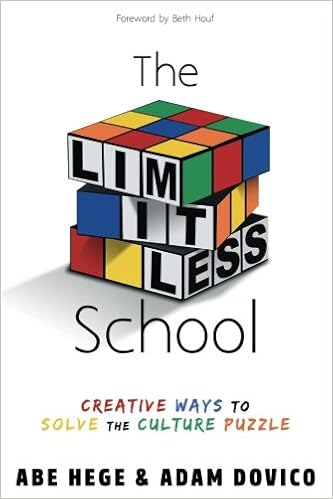
I have really grown to enjoy reading the forewords of these books! Beth Houf, co-author of Lead Like A Pirate, nails it in the first two pages! She says, “Culture isn’t something you do to people; it is the bedrock of any school campus…Culture first, culture next, culture always.” This is one of my favorite parts of the book written by Beth & Shelley Burgess so I was thrilled to see it here.

Typically, I do not spoil the acronyms provided in the book, but this one needs to be shared. (You can preview the first chapters here!)

  • Leader

  • Impressions

  • Marriage

  • Integrity

  • Time

  • Limelight

  • Educate Yourself

  • Success

  • Set Goals

That’s impressive, right? Abe and Adam discuss how each of these topics play a huge role in creating and strengthening a positive school culture. Trusting others, and being trustworthy yourself, are key components, both for students and staff of a school. Integrity is what you’re doing when no one else is watching. Traditions are also discussed within the book. When I started the pilot position at the STEM magnet middle school I serve, I wanted to give students a reason to come to the media center. I wanted a way to display the community effort that our school needed to be successful. Because I’ve always been a fan of puzzles (and I lucked up and found a beautiful puzzle of wild horses on Amazon for insanely cheap), I put a 1,500-piece puzzle on a table in the media center. At first, no one touched it. I put together a few pieces here and there, and a few 8th graders started venturing into the media center in the mornings to put a piece or two in. Before we knew it, the edges were complete. By then, other teachers within the school saw the puzzle at faculty meetings. They said there was no way we’d finish the puzzle with all 1,500 pieces remaining. That students would steal pieces, or pieces would drop and be sucked up by those amazing school vacuum cleaners (They pick up everything! I’d love to bring one home with me one day and see what it can do on our carpets!) I felt kind of defeated because I wanted to see the good in the students and I wanted to believe they would take pride in this puzzle that showcased their school mascot.

It took nearly 4 months. The final piece went into the puzzle and the 8th graders who had worked so hard on it looked completely…lost. They had finished the puzzle, but rather than feeling a sense of accomplishment, I believe they dreaded taking it apart to put back in the box. We devised a plan and that puzzle is now a focal point in our media center – matted by a black science fair board cut to fit the space within a stunning oversized frame that I found at 60% off one day! As for the 1,500 pieces… every single piece was there. Not one went missing over the entire 4 months!

This has become a tradition in our school. We’ve even purchased sorting trays for the pieces and I have kept one large rectangle table specifically to be the “puzzle table”. When each 8th grade finishes their puzzle, they want it on the wall immediately. I’ve already purchased the frame for this one! The 8th grade puzzle is at least 1,000 pieces and I select the image that I believe represents the 8th grade class as a whole. We just finished our second week of school and already three different 8th graders have come to me asking when the puzzle is going to be put out for them to work on! I will unveil it to our 8th graders next week and students can begin the excitement of seeing it come together the following week! I can’t wait to share it with you, as well! (Hint: It’s part of a #DBC50Summer implementation… when I saw this one, I knew I had to make a little twist to the original plan & I am so thrilled to share when it is finished!)

The section of the book that really touched my heart was Educate Yourself. Yes, it’s about lifelong learning, but also about so much more! The rural area in which I live is very much at the heart of the Bible Belt. There’s a church on every corner, and on Sunday afternoon, if you aren’t in your “Sunday best” at “the Walmart” you get the side-eye, judge-y look from others still wearing theirs with pride (some of you know exactly what I’m talking about). I will choose not to get on my soap box right now about these things, but will just suffice to say that I do not believe it is my place to judge others and I do believe it is my duty as a Christian to love my neighbor (others). That’s everyone; not just those that belief the same way I do, those that look the same way I do, those with the same lifestyle I have. Everyone. And that’s exactly what I try to do on a daily basis. (And also, at my church, we wear jeans and t-shirts. It doesn’t make me any less of a Christian. Just saying.)

Last year I conducted a survey asking for students’ honest opinion about their experiences in middle school. I was blown away by their maturity and thoughtfulness in answering the questions honestly and respectfully. A few of my students noted that the LGBTQ community was bullied, that they wished homophobic terms would be reprimanded in the same way as racial slurs, and that they would like more representation in the books available in the media center. Here is one response from a student:

“Schools need to be aware of mental health, and awareness for bullying (homophobia, transphobia, racism, fascism, sexism, etc). Teachers need to stand up for their students when they are getting bullied. For example, if a teacher hears things like “that’s gay”, “fag***” and the n word (coming from someone who is not black) they should say something. People have been fighting for rights for years now, and I want to (and others too) to come to school and feel safe and be accepted for who you are no matter your race, religion, sexuality, or gender.” -8th grader

That’s powerful, y’all. To be sure I advocate for this voice and better the experience of my students, I need to educate myself. I need to seek out books they can read and identify with the characters. I need to allow my students to connect with like-minded peers. Anytime I attend an edcamp and I see a session on equality, equity, culture responsiveness, etc I do all I can to attend that session. It is, without fail, the most open and honest conversations I’ve ever been part of. I need to provide my students the opportunity to engage in those open and honest conversations that I learn and grow from. I need to provide those books with characters they relate to, and those like-minded peers. Each student should have a positive role model that reminds them of themselves.

I LOVE this video explaining privilege! We should all check ours!

That’s where my implementation comes into play, I believe. I want to provide positive diverse role models through book selection and research in the media center. It’s a small step, but it’s a step in the right direction. I’d rather take a multiple small steps forward than one large step too quickly and risk backward movement. I’ve mentioned an open genius hour as a #DBC50Summer implementation. (Read more here in the post about The Wild Card by Wade & Hope King) Through reading Pure Genius by Don Wettrick, I learned that modeling and structuring the first genius hour is important to the success of future genius hours. I could confine the genius hour topics to be about the qualities of a positive role model & selecting a role model with which the student can identify. These positive role models, selected by students, can then be shared via whatever platform/tool the student desires and discussed among those in attendance. Remember, it’s open to any and all, so there may be 50 or 2; I’m honestly not sure. I’m taking a risk here & building the plane as we fly it. Finally, students can determine if we have any books by or about that person, and if we need purchase some. We will find creative ways to fund these new books & offer a display of diverse positive role models when the books arrive, and make them available for circulation.

I knew this book wouldn’t steer me in the wrong direction! Abe and Adam are located only about an hour from me and I’d love to visit their schools! Watching their tweets is so inspiring and I love the energy in their schools that is evident through social media. (Side note: Abe started his journey as principal of an elementary school this year, so it’s been awesome watching him develop the culture in a new school using the same strategies outlined in his book!) You can follow along too by following Abe and Adam at @abehege and @adamdovico, respectively. Also see what others are doing with their limitless schools using the hashtag #LimitlessSchool. Adam’s website is here. Teach Me Teacher podcast interviewed Adam about The Limitless School. You can see that here in part 1 and part 2.

If you want to change the culture of your school, and want practical ways to make it happen and quantitative data to prove it’s working, you need to grab a copy of The Limitless School!

As always, feel free to add to (or start) the discussion on flipgrid! This global collaboration space for all DBC, Inc books was the brain-child of Andrea Paulakovich, who fell in love with the idea of #DBC50Summer early in the process and ran with it! I’m so thankful to be connected to her, and you should get connected, too!

Rereading book 40 tomorrow! This book was released less than 6 months ago and has taken education by storm! I mean, who doesn’t love a good protocol, right? Especially when they’re a bit silly! Can’t wait to share my favorite protocols from The EduProtocol Field Guide by Marlena Hebern and Jon Corippo in the next #DBC50Summer blog post! I think the implementation will be fairly obvious…
#DBC50Summer 38/50: Google Apps for Littles

Where in the world was this book when I was still in an elementary setting? Oh my word! The sheer amount of times I have heard in my career that our littlest learners can’t do something… it’s innumerable! Sad truth is, we aren’t giving them an opportunity to show us that they can do so many of the things our older students are doing. As a teacher, I will be recommending book 38 to every PreK-2nd grade teacher I come in contact with; as a parent, I will be using so many of these ideas for my own 5 year old! I actually just bought an additional copy to gift to her kindergarten teacher (shhhh)!

I’ve been trying to do #DBC50Summer in order of release date, and we are entering a period of Dave Burgess Consulting, Inc where books are released back-to-back-to-back! It’s interesting to note that Teach Like A Pirate was released in 2012 and the second book, Pure Genius wasn’t released until 2014. Beginning in 2015 and continuing through Summer of 2016, DBC was releasing a book a month on average. Then in 2017, DBC, Inc really started to take off, releasing twelve books in just over 8 months and 2 more to round out the calendar year. This year Dave and Shelley have published 22 books between January and the end of July! We were treated to three and four books a month this summer! It seemed like each week another one was coming out!

Because of that, the remaining books in #DBC50Summer were typically released within days of one another and I’ve done all I can to be sure the book numbers are correct. I reached out to DBC when I first began this process. Using the information from DBC, I did some research using author blogs, tweets, and sending direct messages to the authors asking if they remembered the official release date of their book(s). (I’m a fan of triangulating data… I blame my MLS classes, ha!) Definitively, book 39 (more on that in a minute) was released on February 19, 2018. Checking blogs and tweets, Google Apps for Littles by Christine Pinto and Alice Keeler was already out and doing amazing things on the Amazon best new release list, which would make it book 38!

Like all other books from DBC, Inc that have Alice Keeler’s name on the cover, this book is extraordinary! Each of the books about the Google line are in full color and are absolutely stunning! Check out this page from one of the #BookSnaps I tweeted today. Isn’t it gorgeous?

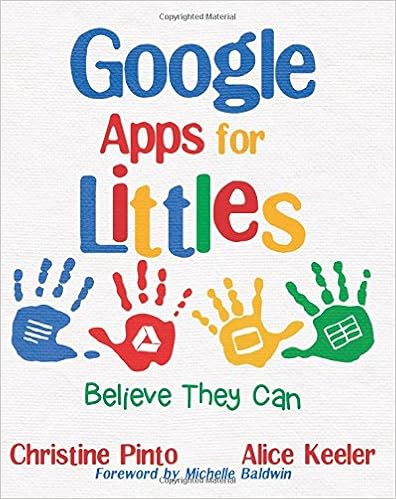
I love that Christine Pinto put pictures of her students and shared their work in this book! Seeing the excitement on their faces and photos of her organization really brought the book to life! The handprints with Google logos on the front of the book are a perfect addition and definitely make the cover memorable!

From the very beginning, I was captivated by this book! Even the foreword (written by Michelle Baldwin) was incredible! I have been guilty of logging into computers for my littlest students and then having them just leave the lab while I would run around and log every student off after they left. I love the authors’ idea of making a challenge for students to log on and off the Chromebook or Google Chrome account, putting a sticker on an incentive chart for each time it is done correctly. I’m telling you what’s the truth… there’s not a whole lot that the Littles (probably just go ahead and read that as middle schoolers, too) wouldn’t do for a sticker. Bonus cred if you get the smelly stickers. I’m just going to go ahead and say that smelly stickers saved my classroom management plan on multiple occasions. I especially love the “Meaningful Tech Integration” section of the Introduction in which Christine and Alice point out, “Replacing those activities [manipulatives, blocks, toys, etc] with computer tasks does not make learning better.” They go on to point out that allowing students, even the Littles, to use technology gives them an opportunity to learn, practice, collaborate, share, and connect.

The authors do an amazing job sharing the logistics of using Chromebooks, iPads (or other tablet), and/or Google Chrome on desktops in the PreK-2nd grade classroom. I love the log-in cards and color coding the keyboard and log-in cards to assist students in finding the letters and numbers to match.

One of the key themes in this book is having our students learn by exploration. Alice and Christine encourage us to allow students to click and explore as they learn about icons.

“Sometimes people struggle with technology because they are afraid to click on things. We do not want our kids to have to ask for permission to click on something or be afraid. Encourage them to explore and ask the kids what the icons do instead of telling them what they do…Let them explore, click, and learn!” ~Pinto & Keeler

As is true with many DBC books, there are links to template after template that allows you to take this back to your classroom tomorrow! I love the pixel art and appreciate the link in the book! My students love to create pixel art in Minecraft, but we only have 8 computers in our Minecraft Lab, so using Google Sheets with conditional formatting is an excellent way to incorporate this art form in class! I can totally see using this as a BreakoutEDU clue in the near future!

Searching for images with word families is definitely an activity I will do multiple times with Sophie, my daughter who just started kindergarten. She would love finding her own images on the internet. And the “explore” feature creating the best layout on the slide is just plain genius! I will definitely be using the color coded slides to assign slides to groups from this point forward! What a simple way to visually assign slides! There are so many things I can implement, even though I don’t teach the Littles anymore! Just as Teaching Math with Google Apps had a math focus, but could be used by any teacher because the information contained was just that good, Google Apps for Littles is focused on our youngest students, but certainly has relatable information for teachers of all grade levels! Don’t be fooled by those cute little handprints on the cover! Even if you’re a high school teacher, you will want get something out of this one!

I am the faculty sponsor for multiple clubs at my school. Makerspace Managers (which will also function as Innovation Engineers, thanks to Pure Genius by Don Wettrick), Game Club, Between the Lines Book Club, and now I will have students coming to the media center for an open invitation genius hour opportunity. I’ve been trying to figure out a way to manage that time without grading and formalizing the process. I want the students to want to be there and not feel as if it’s another assignment being dumped on them.  The Template Tab information from this book is exactly what i was looking for! Using this template, each student will have their own tab in one Google spreadsheet and they can reflect on their progress, communicate with me about wants and needs, and have a running journal of their genius hour journey to use if they choose to blog their story on the school’s new student-led blog (which is the implementation plan for Shift This by Joy Kirr and Ditch that Homework by Matt Miller and Alice Keeler.) I love when multiple implementation plans come together because it is making #DBC50Summer more cohesive and intentional. It’s also helping me think through the actual implementation and what will and may not work.

I also loved Kasey Bell‘s Magnetic Poetry Template! You can find more about magnetic poetry on Kasey’s blog at shakeuplearning.com/magneticpoetry (you’ll hear more about her very soon)! I look forward to sharing that with my middle school students next week, just as a fun activity. Then they can screenshot it using Alice’s extension and add it to a school-wide collaborative Google Slides. Now that revision history has been improved, I’m not as worried about a student deleting slides or adding anything inappropriate.

There are so many additional ideas for encouraging our Littles and providing them the same opportunities as our older students that can be found on Twitter! You can find these using the hashtag #GAfE4Littles! Christine has a beautiful website that can be found here. I would definitely recommend checking out the #InnovatingPlay and #SlowFlipChat sections of her site! (May also want to create a column in your Tweetdeck for those as well!) Remember the rabbit hole that is Alice’s website? It can be found here. The Google Teacher Tribe podcast (Kasey Bell and Matt Miller) interviewed Christine! You can listen to that here! Vicki (@coolcatteacher) Davis also hosted Christine on her 10-Minute Teacher podcast here. I would also highly recommend subscribing to both Christine’s and Alice’s YouTube channels!

If you’ve been following this journey for any length of time, you likely know what comes next. The flipgrid is available, thanks to the brilliant idea of my friend, Andrea Paulakovich! She kindly asked me if I’d like to co-pilot this global collaborative space available for all DBC books; of course I said yes! Please feel free to share your thoughts there and bring some friends along!

I am so excited to get to read book 39! It’s by two principals from my home state of North Carolina! In fact, they are located about an hour from my school! (Quick story) When I met Dave Burgess in April, we had a discussion about this book. In fact, it was through this conversation that I knew he (and his company) was legit. I mean, I had my doubts… I wondered if it was all a show. (I can be fairly cynical – we’ve covered this in another blog. I’m working on it.) You see, he brings a selection of books to his speaking engagements that he sells at a discounted price and will sign and personalize Teach Like A Pirate and/or P is for Pirate for you. What got me was that he could tell anyone who approached his table about each of the books he had published (not only the ones that he brought with him). He knew all 65 authors by name, and knew where they were from. The company is growing exponentially, but somehow he and Shelley have still managed to make it feel like a family. Book 39 caught my eye because of its beautiful cover; he let me know that the authors were from North Carolina and shared a story about the book with me. I knew then that I had to get it! So one of the five books I bought that day was The Limitless School by Abe Hege and Adam Dovico. I am pumped to finally be able to read book 39 after owning it for nearly 5 months! Hoping to blog about it tomorrow! Only twelve books left and 15 days until Fall begins! I can totally do this!

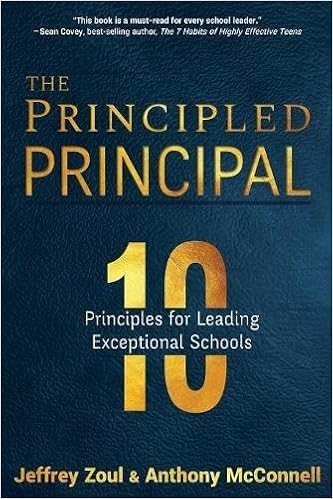
#DBC50Summer 37/50: The Principled Principal

Honest is always the best policy, right? That’s what I’ve heard anyway. So Jeff, Anthony… don’t take this personally…

I had absolutely zero interest in reading this book.

There… I said it.

It didn’t “fit” with my educational goals. It wasn’t “in my wheelhouse” so to speak. I have never wanted to be an administrator. There’s not a bone in my body that ever wants the pressure and stress that is put on administrators of public schools. (I say public because that’s all I know and I’m not going to assume to know anything about other schools.) Naturally it would make sense that a book called The Principled Principal would be the last educational book I’d pick up. This is a perfect example of why I wanted to do my personal challenge of #DBC50Summer in order of release date. Otherwise… let’s be real (see what I did there, Tara?)… I would have missed out on this gem because I would have never read it. In fact, the only reason I actually read it rather than “fibbing” was because I wanted to the fidelity of #DBC50Summer to remain intact. I want to be able to say that I have actually READ each of these Dave Burgess Consulting, Inc books. So I cracked open The Principled Principal (book 37) by Jeff Zoul and Anthony McConnell and was blown away by what I read.

I value & respect my administrators very much; I have been blessed to work for exceptional principals and assistant principals. My first principal interviewed me THREE times before offering me the job. Made sense though – I was only 20 years old, fresh out of college with zero experience, and was not from the area. I wouldn’t have hired me. She was every breath of that school. I cannot say enough great things about her. When she retired, it didn’t matter who came in as principal because they didn’t stand a chance filling those shoes. Buddy the Elf could have become principal and served us hamburgers with syrup with all his contagious Christmas spirit and it still would have been a tough sell. I left that school midyear to begin my career as media coordinator. (You know that when a ‘singleton’ position opens up, you jump on it.) The principal that hired me for that job also took a huge risk with me. I had not yet finished my Master of Library Science and had (again) zero experience in the media center (nor with any grade level other than 5th grade – and 1st grade as my student teaching). She was moved to another school just 6 months after I started my job there. Then I began a phenomenal relationship with the new principal and we both were devastated when I was moved to middle school to pilot a new position for our district. She was happy for me, and I was excited for the challenge, but leaving her and our working relationship was heartbreaking. The principal I work for now is a forward thinker who is constantly pushing us to be our best for students. Best part (for me anyway)… she was an instructional coach. So she knows what my role is like and supports me at every opportunity & challenges me to see all points of view. I have worked for nine assistant principals in 13 years!

Being friends with many of these administrators, I see the toll that running a school can take. I see the exhaustion and sacrifice that is made by administrators on a daily basis. I can confidently stand (errr… sit) here today and tell you that I have absolutely ZERO intention to ever become a building level principal. Others are gifted with that calling, so have at it. I respect you and look forward to working with you to help students and teachers in the building succeed. I will be your confidant, your sounding board (we all need one), and you never have to worry about me wanting to take your job (HAHAHA)!

This book is powerful. I’m in a hurry to allow my principal to read it; not because she needs the principles for development, but because every page I read reminded me of her. I want her to see that what she’s doing is phenomenal and forward thinking. That she fits in perfectly with the 30 principals that share their story within these pages. I loved the 3-2-1 format at the end of each chapter. It reminded me of Teach 4, Lead 4, Learn 4 at the end of each chapter in Start. Right. Now. (co-authored by Todd Whitaker, Jeff Zoul, and Jimmy Casas). In 3-2-1, the authors share 3 stories from phenomenal principals (like North Carolina’s own Derek McCoy and Sean Gaillard – both friends of mine!), 2 resources to check out that further your learning from the chapter, and 1 culture crusher that relates to the principle covered in the chapter. I’m not going to spoil the fun of the 10 Principles – get your own copy to find out what they are!

Several (and I do mean a TON of) quotes stood out to me as I read.

The idea of “Have-To’s vs Must-Do’s”

“Prioritize innovation as a non-negotiable in our schools.”

“If we cannot truly understand where people are coming from and what is important to them, we cannot lead them.”

“You cannot control them, but you can control yourself.”

“You are the most important person you lead. We cannot successfully lead others until we successfully lead ourselves.”

“Students who are prepared for…learning expectations through daily…learning experiences designed by…educators who do not fret about standards can knock any assessment out of the park.” (Preach, Hallelujah, Yessir, and Amen)

There are so many other quotes I could add, but let’s look at topics.

I love the section where Jeff and Anthony talk about your school library being one of the places going out of date the most. Seems a bit ironic being that I work in a media center, doesn’t it? However, it’s totally true! Our media centers must either evolve or go the way of the dinosaur. I, for one, choose to evolve. The space in our school is student-owned, bright and cheerful, a space for collaboration, constantly filled with classes, and includes a tabletop game section, 8th grade puzzle (which has already become a tradition over the 3 years I have served there), minecraft lab (which will double as esports league computers coming soon), makerspace, virtual reality lab, flexible seating and tables on wheels, and I’ve recently transformed my office into a small group meeting space. Oh… and it has books. Lots of them. Notice that isn’t all it has though. It’s not a book warehouse, but a space for thinking, creating, collaborating, and brainstorming.

Jeff and Anthony also encourage us to brainstorm five words that reflect my core values. This reminded me of my P is for Pirate by Dave & Shelley Burgess implementation in which I chose 5 words to describe my classroom (media center).

My 5 core value words are empathy, responsibility, growth mindset, consistency, and drive.

Neither of those are my implementation for The Principled Principal. My implementation comes from the disaster of a day (read that as week, please) that I’ve had. It’s chromebook season at the STEM magnet middle school that I serve. Do you know what that means? I am distributing 400(ish) chromebooks in a week, revisiting expectations with every child, discarding old/broken chromebooks and replacing with new-to-them chromebooks, which means the spreadsheet needs to change. It’s 123 new chromebooks for 6th grade that need to be “bagged and tagged”, teaching those students how to use Google Drive, create a WikiProject in our LMS, and understand policies behind acceptable use. It’s matching appropriate chromebook models with new students and brief troubleshooting when students can’t log on to our server. Y’all… this is a stressful time. I don’t typically ask for help, nor do I accept help when it’s offered. It usually takes more time to explain my convoluted process than to just do it myself. I’m also a bit of a perfectionist, so I go behind the other person anyway and double-check. (I know, I know… I need to let it go. But I just can’t.) If I’m going to issue a chromebook to a student and something happen where we have to charge the family for something, I want to be able to 110% vouch for the condition of the chromebook when it was placed in the student’s hands.

You know the Snickers commercial tagline? “You’re not you when you’re hungry.” Well, I’m not me when it’s Chromebook season. I’m crabby, quick to argue, slow to listen, and generally just want to be left alone. Give me Pandora, my label-maker, my spreadsheet, and a scanner and let me do my thing. I have taken frustration out on more than one person this week. I have certainly not been a contributor to any resemblance of positive culture in the past 10 days. Today was the breaking point. As soon as the first 6th grade class came in for WikiProject training chatty and not listening to instructions, I lost my cool. It was ugly. It was only 9:15 this morning and I had already reached my boiling point.

Now I know better. I know to project directions on the board. I know to set expectations from the very beginning. I know that the quieter I talk the quieter they will get. But nope… I yelled the directions (very quickly, might I add). I proceeded to show them that I was in charge of this space, so there (humph). And I did this class after class after class today.

What in the world was I thinking? That’s not the way we operate in our media center. I don’t talk to students like that. I focus on building great relationships. By the time the 6th period class rolled around (I’m ashamed to say that it took me until 1:45) to get myself back together. As they entered, I was much more organized and my voice was calm. I praised students and we discussed common mistakes made throughout the day. I started off by letting them know I had been having a really rough day, being completely vulnerable in front of my students. I let them know up front that none of that was their fault, and that I was really working to get myself back together and find “happy Mrs. Ray” and invite her back to school.

Sixth period went so smooth. I enjoyed it, and I feel like the students enjoyed it. The feedback they were giving me with their attentiveness and enthusiasm matched my gut instincts. Now how much different would the rest of my day been if I’d just been vulnerable and let them know up front that I was stressed out from Chromebook roll-out. What if I asked for help when I felt overwhelmed? What if I allowed others to do something as minuscule as removing the new batteries from their plastic wrap? (My daughters ended up doing it when they got off the bus, and they loved it. Weird!)

My implementation for this book comes from a mix of two principles. The People Principle and the Harmony Principle. I need to be the one with a calming effect, not the one who stirs the pot of negativity by adding my complaints. I need to remember that as an instructional coach, others feed off of my attitude. I’m not saying that I will fake it, because I think they need to see me struggle, too. There’s a camaraderie that is built through these struggles, but I also need to work on my actions meeting my words in my high-stress times at work.

I was able to pull so much from this book that I was so hesitant to read. I am so thankful to have read it and certainly feel that if you are a school leader of any kind, not just “principal” you should grab a copy of this book for yourself! These principles are principles of exceptional leaders, not just exceptional principals. I really enjoyed The Principled Principal and look forward to sharing it with others.  You should also follow along with the conversation on twitter using the hashtag #10Principles, as well as check out the website here! There are book study resources on the website, as well as my favorite video seen below. (So much truth!) You can also check out the individual author websites/blogs for Anthony McConnell and Jeff Zoul.

For a preview of the book (whaaaat?!?! Right?! Dave Burgess Consulting, Inc has an updated website which allows you to preview every.single.DBC.book! For REAL! – I did it again, Tara!), click here & scroll down to the very bottom of the page. But beware, you’re going to want to buy your own copy because starting it is like opening a can of Pringles.

Finally… here are the very few tweets I managed to get out there. I’m trying to stay off social media as much as possible so I can get these last few books read and not be distracted. You will likely see less tweeting and #BookSnaps from here on out, simply because I’m running out of time. I have a deadline to meet (September 22 at 9:54 pm EST, but who’s counting). I refuse to let it go by without finishing #DBC50Summer!

Flipgrid is available here! Thanks Andrea for an incredible idea and so blessed to copilot with you!

Next up in #DBC50Summer is the final one (for now) from our favorite Google Guru (yes, I call you that all the time, Alice), Alice Keeler! She teamed up with the amazing Christine Pinto to share the message that even our youngest learners can use technology to showcase their learning! I love this, and so wish I’d had it when I was working at the elementary level! Check out Book 38 from the DBC, Inc powerhouse – Google Apps for Littles.