#DBC50Summer 30/50: Spark Learning

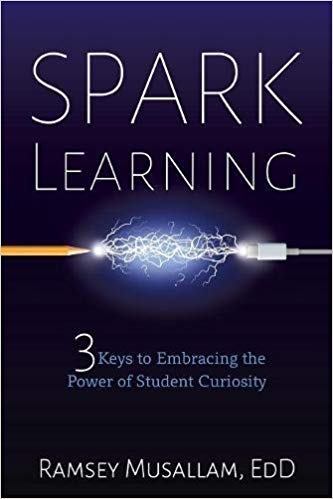
When I first started thinking of blogging my thoughts about all of the Dave Burgess Consulting, Inc books, I checked Dave’s website to see a comprehensive list of the books he and Shelley have published over the years. Many of the books I recognized from Twitter or Amazon, but there were several that I didn’t recognize as DBC books. Two years ago I vanished from Twitter only resurfacing during conferences, edcamps, or workshops. It was just a few months ago that I really reinvested in my #PLN and plugged back in to the power of Twitter. During this hiatus, DBC really began to pick up steam and released several incredible books. Among them was a book that was written as an extension of a TED talk from Ramsey Musallam, EdD. The thirtieth book released by DBC, Inc is Spark Learning!
sparklearning

Before I even started reading, I tuned into the TED talk from Ramsey. You should stop and watch that real quick, okay? I’ll even save you the Google search, just click here.

So… what did you think? Pretty awesome, right? I can certainly appreciate his daughter’s curiosity as my own 5 year old asks “why” about everything! As a mom, I’ve got to be honest, it drives me crazy! I’ve even uttered because I said so. However, as an educator, my heart rejoices and I hope she never loses that intense desire for knowledge. So how do we help to encourage curiosity and inquiry in the classroom?

Ramsey shares the information from his TED talk and so much more in his book, Spark Learning. Much like his TED talk, he serves a powerful punch in a short period of time. It only took me about 90 minutes to read this book and I pulled several takeaways in that quick reading. In the book, Ramsey shares his 3 keys to embracing the power of student curiosity again.

Rule 1: Curiosity Comes First

In this section, Ramsey shares the research behind making curiosity the focal point of your lesson, and not the instruction. He shares three curiosity “sparks” that can pull your learners into your lesson. (Sounds a lot like the Captain‘s “hooks” to me!) These “sparks” are Missing Information, Anticipated Solution, and a Surprising Result. He shares specific examples of each of these “sparks” in various content areas. One of my favorite spaces in this book is where he intentionally gives you space to jot down ideas that have been…wait for it…”sparked” by what you’ve read! This was the perfect space to write my implementation plan for this book! Yep, I already had it figured out in the first rule!

I love that Ramsey is constantly looking for ways to use what he sees “in the real world” in his classroom! I, too, am always seeing the world through “teacher eyes” and drive my non-educator friends crazy when I mention how that would work perfectly in this or that class. In fact, when I was in Chicago this summer for BadgeSummit (check it out on Twitter here – it was great stuff), my coworkers and I went to the Field Museum. The entire time we were there, I was taking pictures of exhibits… why? Because it connected with our science curriculum and that is another resource my science teachers could show students!

Rule 2: Embrace the Mess

I appreciate Ramsey’s vulnerability in this chapter as he describes the same thoughts so many of us have when planning our lessons and the guilt that creeps up when we work those late hours to perfect a lesson only to leave knowing that it’s still not quite right. Many of his thoughts I have definitely had as well. I find it odd that my favorite quote from this book isn’t even a quote from the author. Don’t get me wrong, I enjoyed reading this book and took a lot from it. Ramsey is a wordsmith; he pulls together phrases in ways that make you stop and reread the sentence to be sure you read it correctly. But the quote that stuck with me is the same quote that stuck with Ramsey when he first heard it. In fact, he even states that he had to pull over on the side of the road to take notes upon hearing this!

It is through intense structure that I find the safety to be creative. ~Jon Stewart

Yes, y’all… Jon Stewart…the comedian from The Daily Show. Those profound words belong to him.

The correlation between The Hero’s Journey and the 5Es learning cycle blew my mind! I love the example shown and will definitely use this to create a lesson that encourages curiosity on the pages provided. In the space to jot down notes in this section, I wrote about the arduous task of waiting… I have always struggled with wait time. Whether that is the time between posing a question to the class and waiting to call on a student, or the time given to write a response, or the time between taking the standardized tests at the end of the year and getting the scores back. I’m not good at waiting. This section reminded me that waiting is integral to learning. I love how Ramsey relates the mentors in movies to a teacher in a classroom. The movies wouldn’t be as great if the mentor showed up in the first scene! Students need to struggle a bit before the mentor steps in to impart their wisdom to the “young grasshoppers”.

Rule 3: Practice Reflection

I love the reflection techniques that Ramsey shares here, both for students and teachers! It’s so vital that our reflections be consistent, honest, and mutual as Ramsey states in the book. Being consistent is the hardest part for me, but I’m planning to do better in this year through blogging.

I have to say that this is one of the first books that did not 100% align with my own educational philosophy. While you may have a “oh no she didn’t” look on your face right now, give me a minute to explain. I’m actually thrilled to finally have this moment! This is perfect for my own reflection and I’m beyond excited that I’ve been able to take the time this summer to begin to really nail down what my educational philosophy really even is! Think about it… it wasn’t that long ago that I stopped and determined my own #EDUpassions through bracketology. Now I’m at a place where I feel confident enough in my own opinions to question something in the book. That’s a HUGE place to be, y’all!

Ramsey shares a way of reflecting called Double Lesson Planning. Here he recommends creating two columns, one with this year’s plans and one with next year’s plans. Immediately after students leave, he copy-and-pastes this year’s plan into the next column highlighting changes he’d like to make for the next year. In my position, I haven’t reused any lessons in the past 5 years. In the media center, I have the opportunity to teach with more flexibility so my educational philosophy encourages me to find new ways to teach every year (without duplicating lessons). Also, I don’t have a specific objective to meet in each grade level, but have school goals that I try to reach. Last year we focused on digital citizenship and safety. This year my focus will be on research and inquiry. Therefore, this practice won’t work for me. When I was in the classroom, this practice would have suited me well, but now it doesn’t align with my teaching practices, which are a direct reflection of my own educational philosophy.

I love the 10 Bonus Strategies that Ramsey lists at the end of his book! You’ve got to check those out! I can see using and/or sharing a version of each one this year!

Implementing Spark Learning

This may have been the quickest that I ever decided on an implementation for one of the DBC books so far! Immediately upon reading the first section, I wanted to create a way to spark curiosity in my students and engage them in learning outside of the classroom setting. Last year I had a bulletin board in an old trophy display that read “Today’s News is Tomorrow’s History” and had QR codes to the current headlines of local, state, national, and international news. In class we discussed bias in the news and verified that each of the news outlets I presented were among the least biased outlets available. Because the QR codes were linked to the home page of each news outlet, I didn’t need to update it at all because the QR codes were linked to pages that updated daily. I love this board and although I don’t want to take it down, I realize that students may likely walk past it and not bother to check the news because this was “last year’s board”. I also want my students to see that I’ve put in the effort to think of something else they can interact with this year. Our school is working to create a culture of readers as a piece of fulfilling our vision of creating lifelong learners. Part of that culture is seeing that each of our teachers are readers as well. With this in mind (what Dave calls Creative Alchemy), I’m going to create a board that sparks curiosity through showing the favorite books of each staff member and asking students to predict via Google Form (linked from a QR code on the board) who they believe chose that book as their favorite. You’ve likely seen versions of this on Pinterest, but I hadn’t even considered using it until reading about the “sparks” in the first section of this book. I’m excited to have teachers share their favorite book and create this board this week! I will post pictures and share a blog post upon the revealing of the answers to students! I’m not a creative bulletin board kind of gal, so I’m excited that this book has sparked (yup, I went there) an idea of a bulletin board!

I greatly enjoyed reading Spark Learning by Ramsey Musallam, EdD! You can check out parts of Ramsey’s website for free and the rest requires a monthly membership (bummer). You can get more of Ramsey on the Internet TV Show called Infinite Thinking Machine produced by CUE! He is a co-host on the show! I’m excited to watch a few of these myself. As always, the flipgrid is a space to share your own reflections and ideas from each of the DBC books! Andrea Paulakovich thought this piece of awesome up when #DBC50Summer first started in June. Please feel free to share in this space for global collaboration (& go follow Andrea – she’s incredible).

Well, folks… that’s it for our third set of 10 books! It’s time to continue with the Summer Recaps by sharing the last 10 books read, so look for Summer Recap 3 coming up next!

#DBC50Summer 27/50: Unmapped Potential

When I was a kid, I remember using one of those big state maps to get from place to place. You know the ones; they’re a pain to get folded back the right way. I remember being asked to create a path to get us from Point A to Point B. At the time, that was perceived as a skill that I needed to know once I got my license, just in case I got lost. I’m sure the thought never crossed my parents’ minds that we’d not only have a GPS available, but that I’d have multiple GPS options from which to choose.

I was on my way to South Carolina to hear Dave Burgess speak at a keynote the next day (for the second time; yes it’s that good) and hit some major traffic in Charlotte. Of course it was afternoon rush hour and there was about 25 miles of construction zone ahead of me. I had spent my day moving outdated technology out of storage to be picked up by our technology department, and I just wanted to get to my hotel and have a hot shower & relax. Naturally, when I came up on a sea of red brake lights, I was irritated. So I consulted my GPSs, yes – multiple. Initially, I was using the GPS in my car. I consulted Waze to see what the social network was saying and it appeared I’d be in traffic for quite a while. Waze asked if I wanted an alternate route. Why yes, Waze, yes I do… However, every alternate route I took led to more congestion. I could either get mad at the traffic or enjoy the ride. I wish I could tell you that I was above being mad at traffic, that I am mature enough to know that I can’t control it so I should just relax. Not happening. I’m big enough to admit it;  I got mad at the traffic. It was infuriating. I just wanted to get to the hotel! That’s all I was focused on!

Had I read Book 27 in the Dave Burgess Consulting, Inc line up, I might have just relaxed and enjoyed the opportunity to listen to the music I wanted to listen to (I have two daughters who enjoy owning the music selection). I may have still been angry and ready for my hot shower, but at least I would’ve appreciated the irony in my map taking me into even more congestion. Book 27 is all about modifying the map we’ve created in our heads to expose our unlimited potential. It’s called Unmapped Potential and it’s written by Julie Hasson & Missy Lennard. These phenomenal principals can be found on Twitter at @PPrincipals.

unmappeded

This book is so much more than a professional development book. It required me to do some real soul-searching and discover what my prejudices were… against myself and those I serve. A prejudice is a preconception. For the purpose of this blog, it is defined as a preconceived opinion that is not based on reason or actual experience. There are several truths that I had to grapple with while reading this book. I will share a few with you, and then I highly suggest you go purchase your own copy of the book (I’d get a physical copy because you’re going to want to complete the map-changing actions and questions at the end of each chapter).

I’ve been told by people I highly respect that I need to value myself more, that part of my problem with other’s seeing something special in me is that I feel unworthy of their attention for various reasons. And those people would be right. I struggle with self-worth, as many of us do. I constantly compare myself to others, which typically ends with me feeling inferior. Julie & Missy speak to that very thing in the book (see Tweet below). Someone else will always be smarter, more accomplished, prettier, have more money (obviously… I teach), funnier, and more desirable to be around than me. And whomever that person is will likely feel the same way about someone else. Self-confidence is hard because it’s a fine line to walk. Too much and it comes off as arrogance and too little comes off as self-pity. I continue to work on my self-worth, but it’s a struggle every. single. day. I still need some form of reassurance most days, but just a quick note or a small affirmation usually makes all the difference.

I am not flexible. Julie & Missy say that “effective teachers are irrefutably flexible”. Oops! I’ve always struggled with flexibility in my schedule. Those spur of the moment assemblies, changes in schedule because of TAs needing to provide coverage, a sick teacher which prevents me from having the planning I needed to make that phone call or grade that stack of assessments… that’s the kind of thing that put me over the edge. The principal who hired me had a little heart-to-heart with me at one point when she witnessed one of my “freak-out” moments over a schedule change. It must’ve made a strong impact because I still remember her exact words… “Alicia, if you can’t be more flexible than this, you went into the wrong profession.” Wow. In my teacher youth I was appalled that she would say something like that to me. Now, I appreciate her honesty. She was 100% correct! It’s something I’m working on, and I’m actually getting much better at handling sudden changes in my plans. I love how Julie & Missy say, “Filling your days with what is predictable leaves little room for what else is possible.”

My mom used to always tell me that it wasn’t what happened to me in life that defined me, but how I reacted to it. I have heard versions of this same statement over and over in my life, usually when I needed to hear it the most and wanted to hear it the least. The truth in that statement is so evident though. The version from Julie & Missy is shared in a tweet below. There is so much that I cannot control. My power lies in the things I can control and how I react to the things that I cannot control. I choose to be more easy-going and not waste my energy on those things over which I have no control. I will constantly be asking myself this year, “What are you going to do about it?” If my answer is nothing or there’s nothing I can do, then I refuse to waste my energy on it.

Another truth that stood out to me was a bit more personal. When Julie & Missy talk about labels and how we generalize students with a label, I couldn’t help but tear up. I struggle with labels. I will attempt to share why labels are such a difficult topic for me with two quick stories about my daughters:

Sophie, the youngest, will start Kindergarten in just a few weeks. We are so excited for this new adventure for her, but also we’re terrified for her, beyond the normal anxiety that comes with sending your child to kindergarten. When Sophie was about 2 1/2, I started to wonder if she was exhibiting signs of autism. After taking a few parent surveys about autistic behaviors and indicators and discussing her behaviors with a dear friend of mine that was in her residency for psychiatry, I decided to bring it up at her 3 year well-child exam with her doctor. After a lengthy discussion and his observations of her during that appointment (she was having a rough day), he referred her to a behavioral specialist. After several appointments, the psychiatrist described for my husband and me the differences in Developmental Scale Models (DSMs) and that with Sophie being so young, he’d like to give it a couple more years to see how she progressed. We were to continue with play therapy and speech therapy. He wasn’t comfortable diagnosing a 3 1/2 year old with autism (so thankful for this). I asked him what he would write if he were to diagnose her right then with all he’d seen. He told us that under the new DSM, she would be diagnosed as high-functioning autism (formerly known as Asperger Syndrome). My husband and I thanked him for his time and left. We adamantly did not want a label on Sophie. We don’t want others to have a preconceived opinion about our spunky, quirky, beautiful little girl. Through lots of work at home, Sophie is doing much better with her speech and is working to identify and control her emotions. If you met her briefly, you’d likely not see symptoms. Spending day after day with her, you’d definitely understand. We want her teachers to love her and appreciate her for her, not give her a pass because of a label, or write her off because of a label. Julie & Missy discuss this very thing in Unmapped Potential. Sophie has an infinite amount of potential and we want her to have every opportunity to share that potential with the world, without a label.

Bailey, our 9 year old, just finished third grade. She has an insanely high composite CogAT score and is an “out of the box” thinker. She strives for perfection, but is easily frustrated when she doesn’t understand a concept. She puts more pressure on herself than any child I’ve ever seen. Trust me, she doesn’t get any pressure from us. She doesn’t need it. Her first experience with the state’s standardized test (EOGs) came at the end of the school year. She panicked. She passed both the math and the reading with no problem, but did not score a high enough level to be considered for the AIG program (another label). It broke her heart. She cried and cried because she thought she’d let us and her teachers down. Another broken spirit because of a label that we place on children.

As Bobby Boucher’s Mama would say in The Waterboy… labels are the devil!

I appreciate everything this book had to offer. I will continue to grapple with my own mental map. It’s not an overnight process and will be in constant revision as I struggle to see myself as worthy of praise, finding the right amount of self-confidence, and breaking through barriers placed by previous (& current) experiences in my life. My implementation for this one may seem a little peculiar, but I’m going to go with it. In The Writing on the Classroom Wall, I committed to posting at least one big idea for students to see what I believe about education. I have a wall in the media center that is bare and desperately needs to be transformed into a focal point. I will share this journey (#DBC50Summer) with my students and share, in particular, this book when we are making goals for each individual student in regards to how many books each student will read in each quarter of school. I will share the story of mental maps and inquire about what barriers are placed in front of them in regard to their reading goal. Then, I will encourage them to break through those barriers. My reminder of these goals (because I believe that visuals & connections are the key to memory)… I will purchase a large United States road map – one of those that I used as a kid to plot my path from Point A to Point B – frame it and hang it on that blank wall as our new focal point. A visual reminder for every single student that we are constantly fighting negative self-talk and pessimism and we can fight back with positivity and optimism.

Check out Julie Hasson & Missy Lennard’s website, Purposeful Principals. There you can find a book study PDF to enhance your time with Unmapped Potential.  You can also follow along with the learning using the hashtag #UnmappedEd on Twitter. I highly recommend checking out their videos on YouTube here! Pay special attention to the Unmapped Potential Readers Q&A. Also check out the podcast with The Wired Educator with Julie Hasson.

As always, please feel free to share your reflections on the flipgrid. If a password is requested, it’s DBCSummer. A huge thank you to Andrea Paulakovich, the genius behind the fabulous idea of using the platform to provide a space for global collaboration on every DBC, Inc book that’s been published!

Book 28 is another book I’ve had on my shelf for several months and just keep missing out on reading. I’m thrilled to finally be able to read Shattering the Perfect Teacher Myth by Aaron Hogan! Check back soon for the next blog post!

Edited April 5, 2019 to add link to implementation! See how I implemented Unmapped Potential here!

#DBC50Summer 21/50: Escaping the School Leader’s Dunk Tank

I have never liked swimming that much. I like for my feet to touch the bottom of any water I’m in, and I want to be able to see my feet through said water. The summer between my 5th and 6th grade years, I went to a summer day camp hosted at a local high school.  They took us to the movies, bowling, the park, and, you guessed it…swimming. In order to be able to swim in the deep end of the pool (with all of my friends), we had to pass a swimming test… in front of everyone. To pass, we had to jump off the diving board (the lower one, but still scary to 10 year old me), then successfully swim the length of the pool… all the way back to the shallow end, and wait for our pass or fail.

Do you have ANY idea how much was riding on that swim? I don’t remember doing anything but treading water before that day. But there was no way I was going to be in the shallow end with the little kids all summer… So I jumped off that diving board (oh em gee), swam the length of the pool (I think you can call the thing I did swimming… somehow I made it from one end to the other – I had watched the Olympics so I knew how the mechanics of it worked), and waited…

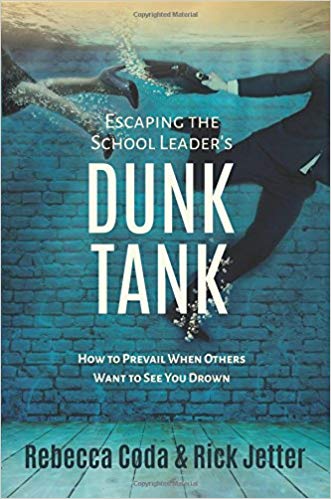
Book 21 in the Dave Burgess Consulting, Inc line up is Escaping the School Leader’s Dunk Tank by Rebecca Coda & Rick Jetter.  You’re going to want this one… trust me.

sldunktank

It doesn’t get much more real than this book right here. There is a “dark side” of education – yep… y’all know about it! We just don’t talk about it. Like me, you have likely been thrown in the dunk tank a time or two. I’ve been fortunate in that I’ve never been held under water, but I’ve definitely experienced my turn in the tank. In this book, Rebecca & Rick pull the curtain back on the more political, vengeful, deceitful side of education. They share stories that will rock your world if you’ve never seen anything like it first hand. They encourage us to walk through our educational journey with “pro-active paranoia,” which may be the best advice I’ve ever heard. If you’re out there disrupting education, pushing the boundaries, doing what’s best for kids no matter what (like we ALL should be doing), there will be haters. Those haters will want to see you fail. Period.

So how do you hold your head above water when it seems like you have no control over the situation? How do you not only survive the dunk tank… but thrive in the dunk tank?

For me… three key points have really stuck with me. One is a quote that will earn it’s place on the media center wall.

Another key point is ensuring that I do not become an adversary for someone else – intentionally or unintentionally. If we’re being totally honest here, I am a pretty competitive person. I like to be first, and I like to be the best. I can’t imagine myself being vindictive for any reason, but reading this book makes me even more aware of how my own facial expressions and body language can portray an adversarial vibe to others. Because I like to be first and best, I have to constantly remind myself that others’ success is not my failure. That helps to keep me grounded. It’s easier to manage my competitive nature when I know the “competition” is also in it for the kids.

Finally, the biggest takeaway from this book is the Gathering Allies chapter. Our allies must consist of the “right” people.  These allies must be nice people!  We need to surround ourselves with people that we want to emulate.

My vertical relationships (with my administration and classroom teachers), my horizontal relationships (my fellow digital learning & media innovation facilitators), community relationships (parents, stakeholders, business partners, etc), and personal relationships (my friends that I confide in) are so important to help me steer clear of the dunk tank. If I should find myself back in the dunk tank, I hope that I have done all I can to show these groups of people that I am “worth fighting for”, as Rebecca and Rick put it. With that in mind, the group I want to focus on is my external professional relationships. In today’s world, I call that my Professional Learning Network (#PLN). My PLN impresses me daily with their positivity, kindness, genuine desire to impact students, and their insanely creative ideas! The communities for many of the DBC, Inc books are so strong and I try not to miss a single chat with them! I have also stumbled upon several incredible groups of people that have quickly become a huge part of my inspirational network. I hope that I provide them some inspiration as well, but I feel quite sure that the scales are tipped in this case. Be sure to check out the following groups (there is overlap):

  • #122edchat
  • #waledchat
  • #champforkids
  • #celebratED
  • #TrendthePositive
  • #CelebrateMonday
  • #BeKindEDU
  • #tlap
  • #LeadLAP
  • #JoyfulLeaders

There will always be days that are rough. There will always be corruption (yes, even in education). We will never be able to make everyone happy.  This book gives sound, practical advice for how to manage these adversarial conditions. Rebecca and Rick also give indications of when you’re in a dunk tank and don’t realize it yet, and when you just need to retreat and flee the situation completely, assuring us that this isn’t a failure on our part.

I’m not going to lie; this book scared me a bit. It revealed the side of education that no one wants to talk about. If we don’t talk about it though, we aren’t prepared to deal with it.

It’s a lot like that first swim across the length of the pool after jumping off the diving board in front of my friends at summer camp. However, because I saw the mechanics of how it works, I was able to perform and pass the swimming test. Hopefully with the tactics I have learned from Escaping the School Leader’s Dunk Tank, I will be successful when these situations arise, as well. I, for one, am thankful that Rebecca and Rick took the edgy route and weren’t afraid to expose real truths of challenges in education. I feel more prepared to deal with adversaries in the future.

My implementation for this book is to remain involved in Twitter communities throughout the school year. I generally fail at connecting once school is back in session, although that’s when I need the connection with allies the most! I usually share what the students and teachers are doing, but lack motivation to join chats and become truly connected. This year, I intend to attend and fully participate at least three chats per month. These networks give invaluable information that I can then use to change the discussion at my school, if needed.

There are multiple resources available from Rebecca and Rick! There are posters available here, podcasts (Better Leaders, Better Schools and Transformative Principal), and the Leadership Dunk Tank website here. When you sign up for their newsletter, you will receive a free Dunk Tank Reflection Guide eBook! The hashtag used to discuss these ideas is #sldunktank and both Rebecca and Rick are very active on Twitter! The flipgrid is available here and the password, as always, is DBCSummer. In this flipgrid, share your tribe! Tell others who inspires you; who is part of your external professional allies network? Shoutout to Andrea Paulakovich for this incredible idea! Don’t forget to grab your copy of Escape the School Leader’s Dunk Tank here!

Ready for Book 22? It is none other than Start.Right.Now. by Jimmy Casas, Todd Whitaker, and Jeff Zoul. This will be my first read of this book and I cannot wait to get to it!