#DBC50Summer 22/50: Start. Right. Now.

This book stepped on my toes. So much! If you’re like me, you may want to grab some steel-toed boots before cracking the cover on book 22 in the Dave Burgess Consulting, Inc line up! Just through my first reading of this book (there will most definitely be a second read in my not-so-distant future), I have grown tremendously and reflected on times that I was NOT the excellent educator that the authors refer to throughout the book. That’s a gut-wrenching moment when you read something powerful and think, “I don’t do that very well” or “I’m guilty of that” when reading what educators of the status quo do.

In fact, the reflections during the reading of this book were so intense that I actually blogged during the reading of the book. Until this point in #DBC50Summer, I have never done that. I’ve read the book in its entirety before writing the first word in the blog. I couldn’t wait during this book. I had to get my thoughts out before being able to focus my energy on the next section.

startrightnow

The tremendous trio that is Todd Whitaker, Jeff Zoul, and Jimmy Casas wrote Start. Right. Now. which is the 22nd book for DBC, Inc! This book is true to form in that it doesn’t disappoint.  Even the first chapter inspired some serious highlighting!

Getting into the “meat” so to speak are four tenets of excellent leaders.  Each of these produced it’s own special gut-check and I intend to identify strengths and weaknesses in each of these areas.

Know the Way

Within this section Todd, Jeff, and Jimmy articulate very clearly that excellent leaders [teachers] (they argue that it’s interchangeable and I whole-heartedly agree) know their stuff.  They know their content, they know their learners, and they know how to connect the content and the learners. I can, without hesitation, say that life-long learning is a strength for me. I know my content (media & technology) and I know my learners (both students & teachers). A powerful quote from this section is, “If you have a host of important priorities, you have no important priorities.” When we introduce something “new”, we must stop and decide of which “old” initiatives we’re willing to let go. We need to analyze what we will start, stop, and continue doing. When we say “yes” to something, we are ultimately saying “no” to something else. I am guilty of saying “yes” to too much, while not letting go of something else. I am also guilty of asking others to do too much, as well. Part of my implementation from The Zen Teacher is to say “no” to allow myself a planning period each day. From the outside, it looks selfish to do this, but in all actuality, it’s done from a place of devotion to students. I cannot do anything at 100% when I stretch myself too thin. Purposefully carving out that time in my schedule to prepare will only deepen the learning for my students in the long run.

My implementation for this section of the book is to not only uphold my implementation from The Zen Teacher, but also to become more knowledgeable in the middle school curricula. I know the standards in media and technology, but learning the standards for content areas has been a struggle for me. When I intentionally sit down to learn it, I will be able to better serve the staff and students.

Show the Way

The quotes in this section are insanely incredible! This section really got me pumped about the future and showing, rather than telling, the vision for our students and our school. Check out these powerhouse quotes from Todd, Jeff, and Jimmy!

“Top-notch educators do not wait for change to happen to them. They proactively anticipate impending changes and make these changes work for them, rather than wasting energy working against change.”

“We implore you to shoot for amazing rather than average.”

“Visionary leaders who succeed in inspiring others to participate…do so, in part, because of their genuine belief in and passion for the vision…their energy, enthusiasm, and genuineness attracts others to their vision.”

I love the reference back to George Couros’s The Innovator’s Mindset and the debunking of “innovation” as a buzzword.  The gut-check in this section is whether I am SHOWing my vision, rather than simply TELLing about it.  Right now, through these blog posts, I am telling all about what I plan to do when I return to school next month.  However, unless I actually DO the things I’m saying I will do, these blogs are nothing but a phony. Nothing but time truly wasted through the summer. Yes, they will have helped spread the word about DBC, Inc.  That was never the ultimate goal, though. The goal was to learn as much as possible in order to better the experiences of the students and staff at my school.  However, the knowledge I’ve taken in while on this journey is pointless if I don’t make visible changes for the staff and students I work with by SHOWing rather than TELLing. My implementation for this section is to purposefully integrate the things I’ve learned from the reading of each book through holding myself accountable for blogging about the impact of each book. (Did I just say that?!?!) That doesn’t mean I will literally write another blog for each and every book, but I will blog about projects and moments that showcase that the knowledge gained in various books was actually used.

Go the Way

This section was a little easier to digest for me because my toes are pretty much intact. (I guess they needed time to heal from the first two sections, whew!) I typically practice what I preach. I do my very best to be sure each person I encounter is met with positivity and a smile. Don’t get me wrong. I have bad days, just like everyone else. It’s rare to see me aggravated, but I do get frustrated, annoyed, agitated, just like everyone else. There are times that I’m angry with someone and I’ll end my frustrated comments with “but I love you, and that’s what’s important right now.” It helps me remember that I love them too, just by saying it out loud. When I was a kid, my grandmother (Nanny) owned her own tax preparation business. She would have me use the typewriter (yes, typewriter) to put address of the IRS and NC Department of Revenue on 25 envelopes per day. As I got older, she allowed me to begin answering the phone. As I answered, she wanted me to smile. She would tell me that the people on the other end could tell if you were smiling or not. I believe that to be true today. I believe that when you talk on the phone, write an email, engage in social media, you should be smiling. The smile comes through in your writing and your tone.

My implementation for this section is to not be afraid to hold those crucial conversations. As an instructional coach, this is the hardest part of my job. Upon reflection, I know that it shouldn’t be. I’m not being ugly or condescending toward anyone, but am constantly trying to keep the students best interest in mind. A boring classroom is never what’s in the best interest for students. Therefore, crucial conversations, truthful, transparent, open conversations to better both parties as educators, shouldn’t be something I fear. Rather, it should be viewed as an opportunity for growth and to be a catalyst for change for everyone involved.

Grow Each Day

I participate in Twitter chats, I attend edcamps, I actively seek out ways to grow my practice. I’ve got this one in the bag… or not! Feedback… critical feedback is so hard for me to accept. Always has been so difficult for me to hear that something I’ve done wasn’t “good enough”. Of course, it’s not being presented to me as “not good enough”. I’m being told that it’s “an area of growth”, or that I could “change x, y, and z to make it better”. The whole time, all I’m hearing is that it wasn’t “good enough”. I have learned that before I attend an observation post-conference, I need to get in a certain mindset.

I need to go into these conferences with humility, grace, open-minded, and with the expectation that I will learn something new. After reading this section of Start. Right, Now. I realized an important truth. Why in the world am I not going through my day-to-day life like that?

I’m my own worst critic. I automatically assume the worst in most cases. When I hear that something truly wasn’t my best, it hurts. However, after taking the time to digest the feedback and observe my experience through someone else’s eyes, I almost always end up agreeing that they were right; it wasn’t my best, and therefore it wasn’t “good enough”. Asking for feedback is not a problem, it’s the accepting feedback that I need to work on improving.

My implementation for this section of the book is to purposefully ask for, and accept feedback from the best of the best. Surrounding myself with excellent educators will make me better. There’s no way that it can’t make me better. Getting feedback from them and internalizing it will make me better for my students and staff. That’s a win-win. I just have to put my pride to the side. (Yes… I rhymed… on purpose.)

Final Thoughts

Start. Right. Now. pushed me in ways that I wasn’t expecting. Todd, Jeff, and Jimmy showed me what excellence looks like, and make me want to pursue that excellence relentlessly. I want to be excellent. Because of that, I will be rereading this one soon after completing the #DBC50Summer challenge. My favorite part of the entire book is the Teach 4, Lead 4, Learn 4 at the end of each section. In these sections, the authors give us 4 teacher leaders to follow, 4 educational leaders to follow, and 4 ways to continue the learning. In this same spirit, I offer my own Teach 4, Lead 4.

Teach 4

  1. Phil Strunk (@MrPStrunk): This middle school history teacher constantly shares his passion on Twitter, making me want to be better every day. He is the founder of #waledchat and an inspiration to all who follow him.
  2. Michael Matera (@mrmatera): As a middle school social studies teacher, Michael gamifies his course, which allows his students to be the ones in charge of their learning. He is the author of Explore Like A Pirate, Book 10 in the DBC, Inc line.
  3. Shaunda York (@shaundateaches): This elementary school teacher’s success is a bit personal to me. She completed her student teaching in my classroom many moons ago. I knew, even then, that she had it… she had the passion and enthusiasm to make her a favorite among students, parents, and administrators. Shaunda is an exceptional teacher who is views changes as opportunities! Follow her!
  4. Susan Jachymiak (@msjachymiak) have so enjoyed following Susan’s journey on Twitter as she created #newteacherjourney and landed her first classroom teaching job. I look forward to seeing so much awesome stuff come from her this year! Go ahead and follow her because great things are coming from this one!

Lead 4

  1. Lucas Gillispie (@lucasgillispie): Spot #1 on this list must go to my district director of digital learning and media. Without his support and encouragement, I would’ve left education a while ago. Lucas not only shares the latest trends in education, in many cases, he creates the latest trends. The creator of the WoWinSchools project and a leader in gamified learning, he is one you’ll want to follow (if you aren’t already).
  2. Allyson Apsey (@allysonapsey): This amazing principal is one I would follow across a desert. She is authentic and encourages growth at every possible turn. She is the author of The Path to Serendipity (you’ll hear more about it later in the #DBC50Summer). Her passion and energy are contagious. Kindness and thoughtfulness is put into every word she tweets. I adore this lady!
  3. Sean Gaillard (@smgaillard): Sean is a middle school principal with a heart for education. He is constantly connecting others and inspiring educators to find their personal best, then deliver it daily. His encouragement is unending and, as the creator of #CelebrateMonday & #TrendthePositive, it’s easy to see why people gravitate to his positivity! Oh, and he’s also the author of book 49 in the DBC, Inc line – The Pepper Effect!
  4. Cristina Dajero (@cristinadajero) & Kelly Hoggard (@khoggardGRT): Yes, I cheated a bit here.  But if you follow these two, you’ll see that they are joined at the hip anyhow, so it only makes sense to add them together. These educators are leaders in every sense and I am constantly uplifted by them. Kelly is the creator of #ChampforKids and Cristina is the creator of #LoveLiteracyLearning.

Be sure to join us on flipgrid and share how you Know the Way, Show the Way, Go the Way, and Grow Each Day! The password is always DBCSummer. My dear friend Andrea Paulakovich (Go follow her now!) shared this amazing idea while we were beginning our individual #DBC50Summer journeys. It serves as a space for global sharing related to each DBC, Inc book! Epic stuff! Also, check out the following resources for Start. Right. Now.

Dave Burgess’s Blog on Start. Right. Now.

Todd Whitaker’s Website

Jeff Zoul’s Website

Jimmy Casas’s Website

Educators Lead Podcast with Jeff Zoul

I am SOOOO excited about Book 23! I’ve been looking forward to this since starting the #DBC50Summer journey! It’s finally time! Teach Like A Pirate was transformative for me, making me want to be a better educator, creating experiences for students! It has been Lead Like A Pirate that encourages me daily as an instructional coach! I am pumped to finally get to share my reflections on this book by Shelley Burgess and Beth Houf on my blog!  Stay tuned!
#DBC50Summer 21/50: Escaping the School Leader’s Dunk Tank

I have never liked swimming that much. I like for my feet to touch the bottom of any water I’m in, and I want to be able to see my feet through said water. The summer between my 5th and 6th grade years, I went to a summer day camp hosted at a local high school.  They took us to the movies, bowling, the park, and, you guessed it…swimming. In order to be able to swim in the deep end of the pool (with all of my friends), we had to pass a swimming test… in front of everyone. To pass, we had to jump off the diving board (the lower one, but still scary to 10 year old me), then successfully swim the length of the pool… all the way back to the shallow end, and wait for our pass or fail.

Do you have ANY idea how much was riding on that swim? I don’t remember doing anything but treading water before that day. But there was no way I was going to be in the shallow end with the little kids all summer… So I jumped off that diving board (oh em gee), swam the length of the pool (I think you can call the thing I did swimming… somehow I made it from one end to the other – I had watched the Olympics so I knew how the mechanics of it worked), and waited…

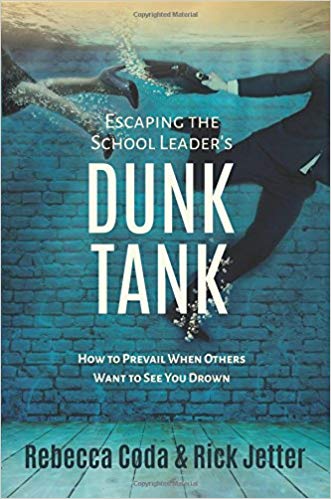
Book 21 in the Dave Burgess Consulting, Inc line up is Escaping the School Leader’s Dunk Tank by Rebecca Coda & Rick Jetter.  You’re going to want this one… trust me.

sldunktank

It doesn’t get much more real than this book right here. There is a “dark side” of education – yep… y’all know about it! We just don’t talk about it. Like me, you have likely been thrown in the dunk tank a time or two. I’ve been fortunate in that I’ve never been held under water, but I’ve definitely experienced my turn in the tank. In this book, Rebecca & Rick pull the curtain back on the more political, vengeful, deceitful side of education. They share stories that will rock your world if you’ve never seen anything like it first hand. They encourage us to walk through our educational journey with “pro-active paranoia,” which may be the best advice I’ve ever heard. If you’re out there disrupting education, pushing the boundaries, doing what’s best for kids no matter what (like we ALL should be doing), there will be haters. Those haters will want to see you fail. Period.

So how do you hold your head above water when it seems like you have no control over the situation? How do you not only survive the dunk tank… but thrive in the dunk tank?

For me… three key points have really stuck with me. One is a quote that will earn it’s place on the media center wall.

Another key point is ensuring that I do not become an adversary for someone else – intentionally or unintentionally. If we’re being totally honest here, I am a pretty competitive person. I like to be first, and I like to be the best. I can’t imagine myself being vindictive for any reason, but reading this book makes me even more aware of how my own facial expressions and body language can portray an adversarial vibe to others. Because I like to be first and best, I have to constantly remind myself that others’ success is not my failure. That helps to keep me grounded. It’s easier to manage my competitive nature when I know the “competition” is also in it for the kids.

Finally, the biggest takeaway from this book is the Gathering Allies chapter. Our allies must consist of the “right” people.  These allies must be nice people!  We need to surround ourselves with people that we want to emulate.

My vertical relationships (with my administration and classroom teachers), my horizontal relationships (my fellow digital learning & media innovation facilitators), community relationships (parents, stakeholders, business partners, etc), and personal relationships (my friends that I confide in) are so important to help me steer clear of the dunk tank. If I should find myself back in the dunk tank, I hope that I have done all I can to show these groups of people that I am “worth fighting for”, as Rebecca and Rick put it. With that in mind, the group I want to focus on is my external professional relationships. In today’s world, I call that my Professional Learning Network (#PLN). My PLN impresses me daily with their positivity, kindness, genuine desire to impact students, and their insanely creative ideas! The communities for many of the DBC, Inc books are so strong and I try not to miss a single chat with them! I have also stumbled upon several incredible groups of people that have quickly become a huge part of my inspirational network. I hope that I provide them some inspiration as well, but I feel quite sure that the scales are tipped in this case. Be sure to check out the following groups (there is overlap):

  • #122edchat
  • #waledchat
  • #champforkids
  • #celebratED
  • #TrendthePositive
  • #CelebrateMonday
  • #BeKindEDU
  • #tlap
  • #LeadLAP
  • #JoyfulLeaders

There will always be days that are rough. There will always be corruption (yes, even in education). We will never be able to make everyone happy.  This book gives sound, practical advice for how to manage these adversarial conditions. Rebecca and Rick also give indications of when you’re in a dunk tank and don’t realize it yet, and when you just need to retreat and flee the situation completely, assuring us that this isn’t a failure on our part.

I’m not going to lie; this book scared me a bit. It revealed the side of education that no one wants to talk about. If we don’t talk about it though, we aren’t prepared to deal with it.

It’s a lot like that first swim across the length of the pool after jumping off the diving board in front of my friends at summer camp. However, because I saw the mechanics of how it works, I was able to perform and pass the swimming test. Hopefully with the tactics I have learned from Escaping the School Leader’s Dunk Tank, I will be successful when these situations arise, as well. I, for one, am thankful that Rebecca and Rick took the edgy route and weren’t afraid to expose real truths of challenges in education. I feel more prepared to deal with adversaries in the future.

My implementation for this book is to remain involved in Twitter communities throughout the school year. I generally fail at connecting once school is back in session, although that’s when I need the connection with allies the most! I usually share what the students and teachers are doing, but lack motivation to join chats and become truly connected. This year, I intend to attend and fully participate at least three chats per month. These networks give invaluable information that I can then use to change the discussion at my school, if needed.

There are multiple resources available from Rebecca and Rick! There are posters available here, podcasts (Better Leaders, Better Schools and Transformative Principal), and the Leadership Dunk Tank website here. When you sign up for their newsletter, you will receive a free Dunk Tank Reflection Guide eBook! The hashtag used to discuss these ideas is #sldunktank and both Rebecca and Rick are very active on Twitter! The flipgrid is available here and the password, as always, is DBCSummer. In this flipgrid, share your tribe! Tell others who inspires you; who is part of your external professional allies network? Shoutout to Andrea Paulakovich for this incredible idea! Don’t forget to grab your copy of Escape the School Leader’s Dunk Tank here!

Ready for Book 22? It is none other than Start.Right.Now. by Jimmy Casas, Todd Whitaker, and Jeff Zoul. This will be my first read of this book and I cannot wait to get to it!

#DBC50Summer Book 11-20 Recap

Screen Shot 2018-07-07 at 3.54.07 AM

In the first recap, #DBC50Summer Book 1-10 Recap, I was hoping I would reach book 20.  Honestly, I look back on the past three weeks and I have no idea how I ended up actually being able to read the first 20 books released from Dave Burgess Consulting, Inc. The first recap post was made about 5 days post-op from a minor surgery, and I’ve been running all over the state since then. I was fortunate to speak to a few hundred educators throughout the state about NCWiseOwl (a free database of amazing nonfiction resources for North Carolina public school educators), then got to meet 24 more incredible educators from North Carolina at the North Carolina Center for the Advancement of Teaching (NCCAT). There we discussed how to reach Generation Z through active and digital learning. We covered topics from augmented and virtual reality to gaming in education to social media to the maker movement to coding and so much more. It was insanely awesome to spend three days with these amazing educators! Finally, I was elected to the North Carolina Technology in Education Society (NCTIES) Board of Directors as the North Region Representative last Spring and we had our first board meeting to plan for the 2019 conference, held in March. Seeing the curtain pulled back just made it more evident how hard that team works to put on a spectacular conference every year and promote digital learning as great pedagogy and not just shiny new tools! It’s an honor to be part of that group!

With all of that going on, I have no clue how I got to book 20! I have had so many direct messages and tweets on Twitter asking how I’m physically able to get these books read so quickly, reflect, and blog about them. My sincere answer is I have no idea. I am so motivated and inspired by the words in these books that I just can’t stop. As soon as I finish one book, I’ve got a million ideas buzzing around my head and have to get my thoughts written down as quickly as possible. As soon as I get the writing done, I’m eager to move on to the next book. As I write this blog, I’m actually staring at Book 21 (which I started today) and would really rather be reading than blogging, ha! The books within the next set of 10 are incredible & I can’t wait to get started on them!  However, before we can look at where we’re going, we need to take a quick review of where we’ve been in Books 11-20!

#DBC50Summer started as Creative Alchemy, a term Dave Burgess uses within Teach Like A Pirate to describe that A-HA moment when you have multiple problems that need addressing and solve them using a creative…

Wait a minute, I have to tell you what just happened, literally JUST happened, before I can go any further. So I was looking up some kind of definition for Creative Alchemy preferring to use Dave’s definition rather than some jumbled up mess of my own. Upon searching for Creative Alchemy Dave Burgess, I was led to a blog written by the Captain himself in March 2012, which dates it before Teach Like A Pirate was published & the advent of Dave Burgess Consulting, Inc. In fact, the email address is from the days of “Outrageous Teaching.” Anyhow… I was reading this blog and in it, Dave says,

“I am always trying to convince teachers that the best books to read about teaching are rarely in the education section.  I always have 3 or 4 books on my nightstand, a book in my car, one in my school bag, and several more on my phone. I consider it one of the most important parts of my job to constantly expose myself to the high quality thinking of other people. It challenges me, it keeps me current, and it provides me the raw resources that I need for creative alchemy.” ~Dave Burgess, Creative Alchemy, March 2012

Let’s take a moment to appreciate the irony of that entire quote… “the best books to read about teaching are rarely in the education section”… well, they are NOW thanks to DBC! How incredible to read this knowing that 6 years and a few months later, they would have released their 50th book, many of which have become insanely successful communities of educators supporting, challenging, and growing one another across the nation (and the world).

“always have…books on my nightstand…my car…school bag…more on my phone”… and now, according to #KidsDeserveIt episode 100 their inbox is flooded every week with manuscripts. Sounds to me like they’re reading books EVERYWHERE now!

Finally, the last section speaks to me at such a deep level in light of the #DBC50Summer… “constantly expose myself to the high quality thinking of other people. It challenges me, it keeps me current, and it provides me the raw resources that I need for creative alchemy.”  The amount of truth in these two sentences cannot be overstated.  Reading these 20 books, even if I stopped right now (which I’m most definitely not going to do), I have grown more as a professional, and as a person, than ever before.  Here I am, twelve years into my career, and I am FINALLY starting to shape my educational philosophy.  I am finally starting to figure out who I am as an educator, and these past ten books have really pushed me to reflect on what I believe about learning and education as a whole.

I’m honestly in a bit of shock that Dave wrote that paragraph in his blog (and a similar one in Teach Like A Pirate) over 6 years ago, and it’s just sitting out there, like it was waiting to inspire someone like me all over again. Just… wow.

Moving along, creative alchemy is what brought me here. I wanted to begin blogging more consistently, growing my PLN on Twitter, and I had all these Dave Burgess Consulting, Inc books sitting on my bookshelf and had only read a handful of them due to time constraints.  It all clicked as I sat staring at the shelves that #DBC50Summer was the solution to each of my problems. I am so excited to be nearing the halfway point, but there’s so much awesome still to come!  Let’s review Books 11-20.

11 – Your School Rocks by Ryan McLane and Eric Lowe – This book challenges us to tell our school’s story through social media.  Taking us on the journey of two principals sharing their school’s story, we see the relevance behind meeting the public where they are… and in this day and time, that’s social media platforms.

12 – How Much Water Do We Have? by Pete Nunweiler and his wife, Kris – This obscure book in the DBC lineup really isn’t an education book at all.  However, the connections with education are certainly evident in the principles of conquering challenge and thriving during change.

13 – Play Like A Pirate by Quinn Rollins – This is the book that really made me start thinking about what kind of educator I am.  What are my passions? (Thankfully I finally discovered them here) Quinn brings his passions into the classroom and uses comics, toys, and games to make learning fun again!

14 – 140 Twitter Tips for Educators by Brad Currie, Billy Krakower, and Scott Rocco – I’ve recommended this book to so many educators in the past two weeks! This is the perfect book for any educator who is unsure about how Twitter can benefit them and their students!  Check it out, for sure!

15 – The Classroom Chef by John Stevens and Matt Vaudrey – This book was like digging back into Teach Like A Pirate again!  The creative ideas for making math (and any subject really) engaging and exciting for students, as well as the idea that we should be preparing lessons rather than lesson planning, stick out to me from this book!

16 – Launch by John Spencer and AJ Juliani – A powerful book detailing an incredible design thinking process using the acronym LAUNCH.  The process is written in kid-friendly language, and includes the vital piece of launching the product to the intended audience.  Loved this one!

17 – Kids Deserve It by Adam Welcome and Todd Nesloney – Educators should strive to be our best every. single. day. We must not let up on growing ourselves and pushing those around us, because Kids Deserve It.

18 – The Writing on the Classroom Wall by Steve Wyborney – This is another lesser known (at least it was to me, but maybe I’ve been under a rock) DBC book.  I was unaware that it was DBC until I began my #DBC50Summer research.  Steve has a unique way with words and speaks metaphorically.  His quotes throughout the book are thought-provoking and he really makes you question what you think about teaching and learning. This book stretched me, and I know it will do the same for you!  I highly recommend grabbing this one!

19 – 50 Things to Go Further with Google Classroom by Alice Keeler and Dr. Libbi Miller – This book is an amazing guidebook to how to create a student-centered classroom using a digital tool, Google Classroom.  The tips and tricks within this book are amazing, as if we’d expect any less from this dynamic duo! Definitely look into this book if you want to utilize Google Classroom to its fullest extent!

20 – Instant Relevance by Denis Sheeran – This super short book packs a lot of punch in its only 102 pages.  A quick read that leaves you with lots to ponder. Denis is hilarious and you’ll laugh from start to finish, learning how to make learning relevant to your students through making connections with them.

So there you have it!  The second #DBC50Summer Book Recap, and a little tangent brought to you by a super old blog post from the Captain that I wasn’t expecting to impact me like it did.  Speaking of the Captain, he created two videos upon the release of these books (one for books 11-15 and one for books 16-20) that you can check out here.

Books 11-15

Books 16-20

Are you ready to reach the halfway point and beyond?  The next ten books are stellar (according to their Twitter fame & Amazon reviews)!!!  Many of them have been on my MUST READ list for a while and I’m so excited to finally get to crack the spine on them!  One of the most influential books of my career is also coming up in this set of ten!  Any guesses as to which that might be?  Oooooh I can’t wait!  Book 21 blog is coming soon!  Stay Tuned for the reveal of the next ten books in the order they were released!

*Interested in joining in on the #DBC50Summer fun? Don’t feel as though you have to read them all and you don’t even have to read in order! Choose a few that you’ve been wanting to dive into! Share your reflections with the world; maybe it’s #BookSnaps, maybe it’s #Sketchnotes, maybe it’s #blogging or #vlogging… the idea is basically just to share your learning from DBC books in any format, so others can learn with you! Here’s the thing though… we can all read these books. That’s fabulous, really! But what are you going to DO with the information you gain from reading it? How will it impact your teaching practice and/or your students? That’s the biggest piece of #DBC50Summer for me… creating the ONE (or two, or three) thing I want to implement in the 2018-2019 school year. You can see the updated spreadsheet with titles/authors, Flipgrid links, blog post links, and implementation plans here! If you aren’t sure where to start, check out each blog post above and click on the Flipgrid information! You can start there! (Shoutout to Andrea Paulakovich – genius extraordinaire!) Just tag #DBC50Summer in your tweets and join in on the fun!  Several are hopping on board & I’d love to have you join in, too! Reach out to me on Twitter if you have any questions! I’d love to connect with you! Thanks for sticking with me!

Alicia Ray

@iluveducating