#DBC50Summer 25/50: Teaching Math with Google Apps

I love the fact that book 24 and book 25 in the Dave Burgess Consulting, Inc line up came out back-to-back! These two books flow well together as they both discuss that the most important thing in math isn’t the answer itself, but is found in the process of finding the answer. When students ask, “when am I ever going to use this” the answer is now clear, no matter what concept being covered…the critical thinking skills developed in math will be used every. single. day.

Book 25 is the third book published by DBC for Alice Keeler. (The first two released were 50 Things and 50 Things Further, both co-authored with Dr. Libbi Miller.) Alice co-authored book 25 with the late Diana Herrington. Sadly, Diana passed away unexpectedly on May 17, 2017, just a few weeks after the release of their book. Diana’s love of teaching math and her passion for making math fun for students lives on in her words in the book. Teaching Math with Google Apps is book 25, and marks the halfway point in #DBC50Summer!

googlemath

Choosing from any of the Alice Keeler Google Apps books will result in a beautiful read. These pages are printed completely in color and organized in such a way that the content is easy to navigate and understand. Teaching Math with Google Apps can be used as a cover to cover professional development read, or as a quick reference guide (I’ll be using it as both)! In this book in particular, the sections of reading are color-coded in the top corners. I personally enjoy a good color-coding system, so this immediately spoke to my heart. I also love that Alice & Diana brought in some familiar faces to contribute! We get to hear from Shelley Burgess (co-author of P is for Pirate and co-author of Lead Like A Pirate), John Stevens (Table Talk Math and co-author of The Classroom Chef), and Denis Sheeran (Instant Relevance).

There are so many amazing tips, tools, activities, examples, and templates included in this book! The complete list of links is available when you purchase the book. That list of links alone is worth every penny! There are examples and templates for elementary through high school math classes, so there’s something for everyone here!

Some of my favorite activities within the book are Pixel Art using Google Sheets (I know, right? Genius stuff! It’s like a digital color by number), utilizing all that Google Forms has to offer through the implementation of self-graded quizzes that offer students immediate feedback, and using the Explore feature in Google Apps to make math relevant to students through maps, shopping, and can even be used to complete a scavenger hunt to find math “in the wild”.

Alice and Diana suggest using Discovery activities to learn collaboratively. Another idea they have is to put the beginning of the lesson in the middle. So think about this… typically students come into math class (or any class) and we quickly review (those who got it yesterday are now tuned out while those who didn’t get it yesterday are already frustrated), probably go over homework (waste of time – both the giving it and the going over it), and then start your lesson for the day 10-15 minutes later having wasted valuable class time. Diana challenges us to switch that up? What if we put our beginning in the middle? What if we didn’t go over homework (or give it for that matter) and we start with an extension from the day before? And… wait for it… they do this collaboratively so those that excelled yesterday have the opportunity to refine their knowledge by peer tutoring those who struggled yesterday. Their peers, those that struggled, get to hear the information from a different perspective and will likely have more understanding. Meanwhile, the teacher is monitoring and asking questions. After completing the extension activity and discussing it as a class, you transition into the day’s mini-lesson and allow students to discover the math using activities in Google Apps rather than telling them (Alice & Diana give the example that we typically TELL students the Pythagorean Theorem… why not ask the students what it is? They have Google! Google will tell them!) This shift in teaching and learning even sounds as though it would flow better. Makes much more sense to me anyhow. Great thinking, Diana!

Some of my favorite quotes from this one are listed below. (Y’all, Alice Keeler has a way with quotes, by the way. After meeting her in June, I can hear her saying some of these in my head now. I can hear the conviction behind some of these quotes and even if you aren’t really sure if you agree, you’ll find yourself nodding along, because the passion in her voice makes it so that it’s the gospel truth.)

“No matter the medium, design for student engagement.”

“Teach like YouTube and Google exist.” (one of my favorite favorites) Going hand-in-hand with that one, Alice says, “I have a rule: Do not tell students things they can look up.” [see Pythagorean Theorem statement above]

“Glitter, scissors, and glue should not be abandoned. Sometimes technology is not the best tool. While work can be created on paper…the work can still be submitted digitally…insert an image”

“The conversation becomes a risk-free learning zone – and that’s where the magic happens!”

“It is important for students to approach a problem with strategies rather than procedural steps. Strategies help them make connections when confronted with new situations.”

My implementation for this book is two-fold.  There is an activity (and template, woo hoo, get the book and you have access to the template, too) in the book where students take a selfie and upload into a collaborative Google Slides presentation and share a couple of things about themselves. I want to do this during my first media class with my 6th grade students. It introduces students to Google Classroom, Google Slides, and allows me to get to know the students’ names and faces as well. Secondly, at some point in time this year (and knowing how much Alice loves her spreadsheets, she would recommend sooner rather than later), I want to complete the Google Sheets activity included in the book where students will discover how to input data and manipulate Google Sheets. Using Google Sheets more will only help my students in the long run, so giving them a strong foundation with this template on the basics is a great place to start. I’m excited to see where this takes my students, and the staff! This book is specifically geared toward math teachers, but there’s so many activities here that can be adapted across the curriculum that I would truly recommend this book to anyone! The back of the book even has some Google tutorials for those moments when you’re reading and think, I have no idea what they mean by revision history. Detailed information with a beautiful screenshot is included here as well!

As usual with books co-authored by Alice Keeler, there is a vast world of information on her website. Go to alicekeeler.com and knock yourself out! Check out the hashtag #GoogleMath on Twitter for more. You can also subscribe to the Google Math Newsletter here! Don’t forget that if you want that link with ALL the resources, templates, examples, and other amazingness included in the book, you need to purchase a copy for yourself! You can do that here! Finally, you can always contribute to the flipgrid using the password DBCSummer (if it asks for one). Andrea Paulakovich had the brilliant idea to create a space for global collaboration around each DBC book, and I love it! Please share your thoughts there! We always include a prompt, but that prompt isn’t required. If you have something better in mind, share that! We just want to learn together in that digital space!

***One of Diana’s visions was to create a scholarship fund to encourage students to go into STEM fields. There is a gofundme page here or you can donate directly Fresno State in memory of Diana Herrington. These donations go toward an endowment at California State University Fresno for students who want to teach math! Diana’s passion for math lives on! Any donation is appreciated!***

Well, we’ve reached the halfway point! Next up is a book by one of the sweetest ladies I’ve ever “met” (well, met virtually…on Twitter, but I will meet her face-to-face one day, I hope)! If you want to know how to make small changes for a HUGE impact, check out book 26 in #DBC50Summer: Shift This by Joy Kirr!
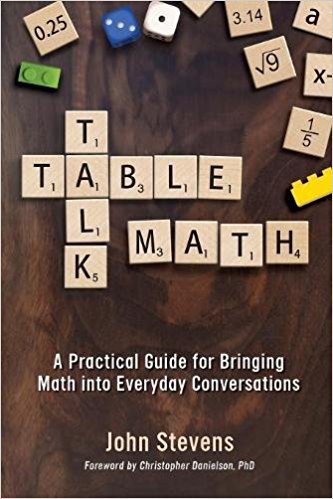
 

#DBC50Summer 24/50: Table Talk Math

You may remember from previous postings that before I became an digital learning coach/media coordinator, I was a fifth grade math teacher. I was initially hired to teach fifth grade students, and I taught math three times a day to three different classes. I loved it. Unfortunately, looking back I now realize that I was also a horrible math teacher. Other than the working problems on the overhead for the vast majority of our class time, I had another deficit. I was always good at math. Scary good. Because I never really struggled with math, I didn’t understand when people said they “weren’t good at math”, or when math didn’t come naturally to them. I thought doing 15 problems in the workbook would solve the issue. I didn’t realize it was a lack of mathematical reasoning and problem solving that was getting in the way for my struggling learners. I wish so badly that I had known about the resources in book 24 to help students see that math is fun and 100% applicable to their lives!

<proudly standing on soap box>

My least favorite utterance: “Oh, I’m glad you teach all of the math because I can’t do fifth grade math.” Really? Why would you even utter those words? As a grown (wo)man, you’re admitting that fifth graders can do more advanced math than you are capable of doing… yeah, that’s not impressive to share. Lose that sentence from your lexicon, please. While we’re at it… the whole “I’m not good at math”… let’s lose that one, too!

<stepping off soap box, #sorrynotsorry>

tabletalkmath

Book 24 is Table Talk Math by John Stevens (yes, THE John Stevens that co-authored The Classroom Chef with Matt Vaudrey) and it is an incredible read! I love that it is a quick, easy read, full of wonderful information and stories about John and his family! I find that this is another book that strikes me more as a parent than as a teacher.

There are several key points I’m taking away from this book. One is holding conversations with your child. I am so guilty about giving my daughters answers rather than asking them questions. I get so tired of hearing “why, mommy” when I’m at home. My sweet girls get the worst of me. I’m sure several of you that are teachers AND parents can identify with that, too (and if not, please tell me you can because it’ll make me feel like slightly less of a failure… thanks). By the time I get home in the evening (yes, evening), I’m exhausted and dreading helping with homework (thankfully my daughters’ school has an amazing principal who doesn’t allow homework beyond reading and a couple math problems), getting showers taken, supper, and bedtime. I’ve been with students all day (and I love them, don’t get me wrong, buuuut), all I want is some alone time or time to converse with an adult, and the girls want my undivided attention. This, in turn, makes me a bit snippy toward them – my patience is lacking by 5:30-6:00 in the evening. I’ve got to do better; I’ve got to BE better for them. They deserve the same time and devotion, no… they deserve MORE time and devotion than my students get from me. I am their mother! I love how John shares the stories about his children, and how he changes from “Mad Dad” to “Math Dad”. I want to transform from “Mrs. Ray” to “Mom” with more finesse each day, allowing them to have the best of me. These relaxed discussions about math are a great way to move forward with this.

Another key point is that kids should struggle and have to explain their reasoning once they reach a decision. Our kids (personal or professional) should have to think! John constantly reiterates that the answer is not as important as the process to get the answer. If we have the kids explain their reasoning behind their answer, it shows the mathematical processes happening “behind the scenes”. Oh, and timed-tests… no bueno. Research proves it’s ineffective. Stop doing it.

Finally, the piece of knowledge I’m taking away and implementing are the tons of resources John shares within the book! I’ve got to be honest and say that I’m actually cheating just a tad on this one because I’ve already shared the resources with our math teachers, as of just a few minutes before writing this post. But you know what? There are 50 books and I’m pretty sure you’ll allow me to already have one implementation complete as we move into the 2018-2019 school year, right? Please?! (And if you’re a stickler for it being implemented “in the school year”… I started back to work today as an 11-month employee and sent the email with several of the resources in the book after reading and before blogging, so technically, it’s being implemented in this school year. Boom! Also, I have a back-up plan.)

Some of my favorite resources from this book are below:

John Steven’s Would You Rather Math is a phenomenal example of authentic choices students make, both as students and adults. These choices require (gasp) math!

Andrew Stadel‘s Estimation180 website gives multiple examples for estimating, showing a benchmark then allowing students to determine an upper limit (maximum) and a lower limit (minimum) before estimating. The exact amount is listed on the website for the students (read: adults like me) who can’t handle not knowing the precise answer.

Fawn Nguyen‘s Visual Patterns website is amazing! Giving us examples of patterns and having students find the next, or “nth” term in the pattern shows sound mathematical reasoning. I love that some of the patterns can actually yield various answers.

Another site that can showcase various answers is Mary Bourassa‘s Which One Doesn’t Belong! As long as the student can give reasoning, accept the answers!  This site is a great conversation starter! I love the idea of debating answers, and that this site can be used with all grade levels!

Finally, the Fraction Talks website, created by Nat Banting, is one that I will be using with my personal children regularly! I love the use of flags as fractional representation! Building a strong understanding of fractions will help as my girls, and students, get older and begin having to see fractions abstractly.

At my school, I am in charge of putting announcements on the TVs each day. Another implementation for this book is to use these websites as part of the TV announcements! Selecting one problem each Monday and Wednesday (or Tuesday and Thursday), students can discuss math at lunch with their peers (we have a TV in the cafeteria that runs announcements all day, as well as one in the school lobby before and after school). I’m looking forward to hearing these discussions and providing math teachers an opportunity to capitalize on these conversations without sacrificing class time.

I highly recommend purchasing this book, especially if you’re a math teacher! The resources are tremendous and as a former math teacher I found myself nodding along many times. If nothing else, the footnotes provided by John Stevens are hilarious! I love his personality! Feel free to visit his website at tabletalkmath.com and join in on the conversation on Twitter at #tabletalkmath. Finally, one of my very favorite blog posts written by John is the explanation of the cover of Table Talk Math. You can find it here titled “7 Reasons to Judge Table Talk Math By Its Cover”. Clever, right?

As always, join in the flipgrid conversation using the password DBCSummer! Many thanks to Andrea Paulakovich who had this genius idea that flipgrid could be used to conduct a global book reflection on all DBC, Inc books! The space is there if you’d like to use it, and likely isn’t going away, so start sharing!

I am so excited to reach Book 25! Released immediately after Table Talk Math, Alice Keeler and the late Diana Herrington knocked it out of the park with Teaching Math with Google Apps! And oh yes, it is that good! If you are a math teacher, and you are a Google school, and you don’t own this book – you should fix that now. Right now. Check back for the blog soon!

#DBC50Summer 23/50: Lead Like A Pirate

Settle in… this one will take a while. Seriously, go grab some coffee, a snack… perhaps you’d like a blanket? (Blankets are plentiful in my house; I’m always wrapped up in one, even on summer days!) In fact, go ahead and throw on your pajamas, tuck the kids in bed… do all the things before starting. I’ll wait…

All done? Cozy? Ready? Let’s go!

In 2011, I realized that I did not want to be a classroom teacher forever. (Hey, we’ve talked about this being judgment free here… don’t judge me!) Don’t get me wrong, I love the students; I love everything about learning with the students. I hope that if you’ve been on this journey with me for very long, that truth has been evident. However, I wanted a greater impact. I also knew that I had absolutely ZERO interest in being an administrator. I am wise enough to know that I cannot handle the stresses that come with running a building. I deeply admire those in administration and look on with fascination as each of you make the world turn so effortlessly, knowing all along that it’s anything but easy. I wasn’t sure where that left me though… in my district, you were a classroom teacher with leadership roles or an administrator or at the district office.

Somewhere along the way, I found myself serving as an instructional coach in practice, but not in title. Once I heard the label “coach” and identified with it, I hunted down all of the coaching books I could find. I took to Twitter in hopes of finding more information on this idea of being an instructional coach. (For a small glimpse into my educational journey, click here.)

In March 2017, I started reading all this hype on Twitter about something called #LeadLAP (I thought it was about racing… I am from North Carolina, right?). When I found out that it was a book that was the leadership equivalent of #tlap, I knew I had to have a copy. It was the first time I bought a Dave Burgess Consulting, Inc book immediately upon book release (it kind of started a trend… oops). It was everything and more. Lead Like A Pirate is written by Beth Houf (an amazingly passionate principal from Missouri with experience in K-8 administration) and  Shelley Burgess (Yes, the Pirate Captain’s wife, coauthor of P is for Pirate – I told you that you’d hear from her again. She is also an educational powerhouse. Can you imagine what it must be like in the presence of BOTH of the Burgess pirates? Whew! I can only handle the conviction & passion from one Burgess keynote experience at a time). This book is a must-read (yes, Beth, I went there… Must. Read. Period.) for coaches, administrators, and district leaders.

leadlap

In this multiple rereading, I found something I’d never found before. See, in Dave’s book (and keynote) he talks about the the phenomenon of everyone buying a silver Honda Odyssey on the same day he and Shelley bought a silver Honda Odyssey. Of course, everyone around him didn’t buy the minivan at the same time, but the Reticular Activating System (RAS… I’m just trusting Dave on this one) that typically filters out all the extraneous information around us is now highly tuned into the subject of interest. In Dave’s case, it was the silver Honda Odyssey. In mine, today, it was one particular word. This word was repeated multiple times in Lead Like A Pirate and is my biggest takeaway from this book.  Not only is it my biggest takeaway, it’s also my implementation plan. I’ll tell you that word in a minute, just hang tight.

This book is FULL of great wisdom from two phenomenal educators. I could pick from a number of amazing topics from this book! Everything from the quotes throughout the book from various authors and notable people throughout the ages to the challenges at the end of each section to even the call to action at the very end were inspirational. There is also a list of sample interview questions that I literally had to stop and ask myself in the middle of my reading! Shelley shares a story about giving faces to data, and I identified with that as I tell stories frequently to make a point. I like to hook people by grabbing their emotions first (yes, I did go there with the “hooks” – been a minute) before sharing the connection to data, content, etc.

As an instructional coach, I value everything about the ANCHOR conversations that Beth & Shelley discuss in the coaching section. I appreciate that they differentiate between the role of an evaluator and the joy of simply having a teaching and learning conversation with other educators in their building. I speak a little about that in an earlier blog post about The Secret to Coaching. I am thankful they speak to the loneliness of being in an administrative role. Although I’m not an administrator, I am a lone wolf in my school, and in many ways, in my district. Piloting a new position was the loneliest experience I’ve had in education, and if it had not been for my directors and my Professional Learning Network (PLN) on Twitter and Voxer, I would have left education. My administration is fabulous, but even they were unsure of how to fulfill the vision of my role at the beginning of the pilot. I felt as though I were on an island, with no one having a clue the island existed, waiting for someone to randomly discover it and rescue me. Reading about the loneliness of being an educational leader was so powerful when I read this book for the first time. Thankfully, I now have a pack of wolves that I run with, and we have one another’s backs.

While reading, I was trying to figure out which of the powerful pieces of wisdom I’d focus on within the blog, and what I’d use as my implementation from this book. My way of taking notes is on Twitter, so here are some of the tweets I shared while reading.


There were so many paths I could take with the blog for Lead Like a Pirate. But there was one path that was glaring at me during this reading of the book and it had nothing to do with any of these posts. In fact, as I think of this path, it reminds me of the saying “off the beaten path”… it’s the path less traveled; truly, y’all, this path is so covered with thorns and overgrown brush that you’d likely need a machete to cut through it. However, it’s the path that my gut is telling me to take with the reading of this book, and by now, and I’ve learned to trust my gut.

The word that I’m taking away, which is also the implementation journey I will embark on in the new school year, is first mentioned in the introduction of the book. It’s actually only four paragraphs into the book that the word first caught my eye. It’s the manner in which we search for ways to make our school amazing. It’s written again, in the first chapter, the manner in which we go about developing, maintaining, and sustaining positive culture in our schools. I find it again in the Transformation chapter, the manner in which we take traditional education to new heights for staff and students. We do “whatever it takes”, right? (great song by Imagine Dragons linked here, you’re welcome – one of my favorites and could even be considered a sort of anthem of mine, but not what we’re here for at the moment… moving right along)

Again, we find this word sharing the manner in which we should filter out ideas that don’t support our long-term vision. It’s also the manner in which we should pursue what matters most in our vision. It’s the manner in which we should seek out and nurture each person’s gifts. It’s the way in which we increase our knowledge and expertise in an area. Later in the book it’s the way in which Dave Burgess was trying to figure out how to teach others what he did that made him successful in the classroom as he was writing Teach Like a Pirate.

Eight times this word stood out to me… in fact, it’s circled every time I saw it. It’s likely written more than that, but these are the sightings that grabbed my attention. I recently purchased a shirt for #HiveSummit with this word written on it. (You should check out HiveSummit.org – it starts Aug 1, 2018 and runs through Aug 14, 2018, then all videos are removed. Trust me, check it out!) You could also search on Twitter for this word and #tlap and find the newest DBC author that was announced (I’m SUPER excited to read his book!)… do you know the word yet?

RELENTLESS(LY)

Synonyms for this word are unending, persistent, incessant, continuous, unwavering, unfaltering, tenacious, untiring… these are words I want to embody this year. I want to be relentless in the ways I seek to connect with students and their families. I want to be relentless in developing and maintaining a positive culture in my school. I want to be relentless in seeking out and noticing the good in each person I work with. Relentless is both my takeaway and my implementation because, as Dave says, “Inspiration without implementation is a waste”. What will that look like? When something doesn’t work, I won’t give up. I’ll keep trying, constantly looking for ways to improve. I will be tenacious in my drive to see teachers and students succeed. I will be unwavering in my belief that every person at my school is there with good intent wanting to make a positive difference in the lives of students. I will be persistent in reaching my goals, starting with finishing the #DBC50Summer and implementing these changes to my practice in the new school year. I will be RELENTLESS.

*And yes, Hamish Brewer, THE Relentless Principal, just announced that he is writing a book for DBC, Inc! So excited!*

I just can’t get enough of Lead Like a Pirate! If you can’t either, check out the website where Shelley & Beth continue to blog incredibly inspirational goodness frequently. You can find the book’s resources here. There are multiple podcasts featuring the Lead Like A Pirate message, such as The Wired Educator, Perspectives in Education, 10-Minute Teacher Podcast with Vicki Davis, and LeadUpTeach. You can also head over to the flipgrid and share your thoughts on Lead Like a Pirate there! As always, the password is DBCSummer. I’ve got to give a shoutout to Andrea Paulakovich who had this amazing idea that we could use flipgrid as a place for global collaboration on every DBC, Inc book!

Follow along with the lively community on Twitter using #LeadLAP and join in the chat using the same hashtag every Saturday morning from 10:30 am -11:30 am EST! This community is incredible, encouraging, and full of school leaders, and administrators (both school and district level) who want to see education disrupted and transformed in the greatest way possible, the PIRATE way! Both Beth & Shelley are active on Twitter as well, so feel free to reach out to them; they both have such a heart and passion for education and leadership! I am constantly inspired by these two ladies and look forward to continuing to learn from them!

Spoiler Alert… this isn’t the last you’ve heard of Lead Like a Pirate… just saying! Apparently the rest of the DBC, Inc family couldn’t get enough either, so keep your ears open later in the summer.

Here we are… finished with another book and moving along to the next one on the list.  The next two books were released back to back, only a day or two apart! They aren’t considered a “set” but goodness, they should’ve been!  These two books, both about math, are phenomenal additions to the DBC, Inc line! First, Book 24 is Table Talk Math by John Stevens (yes, that John Stevens from The Classroom Chef) and Book 25 (***HALFWAY***) is Teaching Math with Google Apps by none other than the Google guru Alice Keeler and the late Diana Herrington. We will reach the halfway point very soon!